Update (April 2026): Anthropic refused to drop the safety guardrails. On 27 February 2026, President Trump directed federal agencies to cease using Anthropic's products and Hegseth designated the company a "supply chain risk". On 26 March 2026, Judge Rita Lin of the US District Court issued a preliminary injunction blocking the federal ban and the supply-chain-risk designation, finding in a 43-page ruling that the government's actions were retaliatory and likely unlawful. The injunction allows Anthropic to continue commercial business with non-defence federal agencies pending the case's merits. The business-continuity arguments in this article (multi-vendor contingency, evaluation criteria, exit planning) remain the right move regardless of how the case resolves.
On 24 February 2026, US Defense Secretary Pete Hegseth gave Anthropic CEO Dario Amodei until Friday at 5:01pm to drop safety restrictions on Claude, the company's AI model. If Anthropic refuses, Hegseth will invoke the Defense Production Act, a Cold War-era law that forces companies to serve military needs, and will designate Anthropic a "supply chain risk," a label normally reserved for foreign adversaries.
That's not just a Washington power struggle. It's a business continuity crisis for every organisation on the planet that relies on Claude.
Anthropic has more than 500 enterprise customers spending over $1 million annually. Eight of the ten largest US companies use Claude. The model is the only AI currently approved for classified Pentagon systems. And right now, its future as a commercially available product is tangled up in a geopolitical standoff that no customer can control.
What Actually Happened
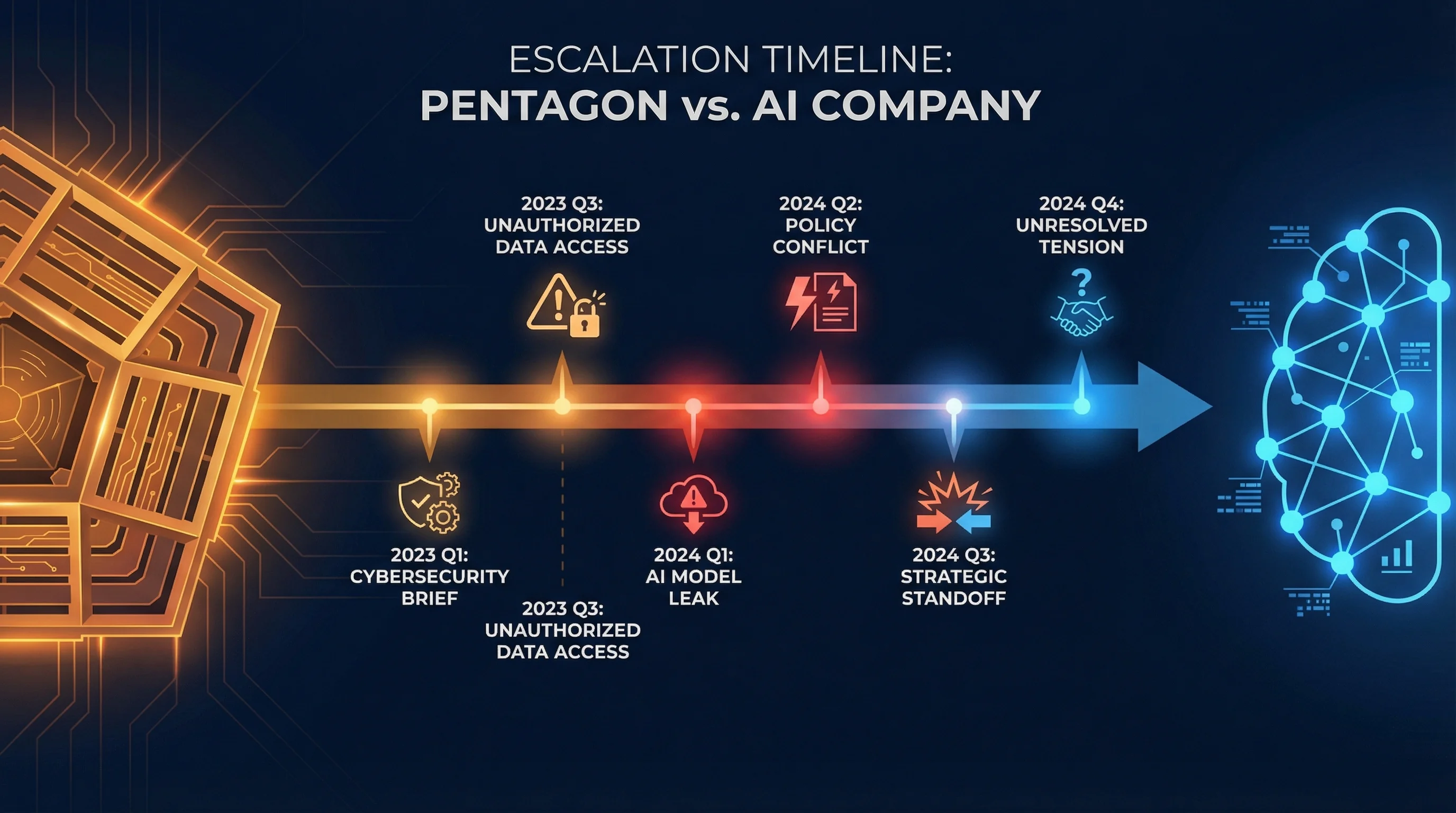
The standoff has been building since January 2026, when the Wall Street Journal reported that Anthropic's Claude was used to assist US forces in capturing Venezuelan leader Nicolas Maduro. Anthropic then contacted Palantir, the intermediary providing Claude to the Pentagon, to raise concerns about how the model had been deployed.
The Pentagon's $200 million contract with Anthropic allows the company to work within classified networks. But Anthropic has always maintained two firm limits: Claude cannot be used for fully autonomous weapons, and it cannot be used for mass domestic surveillance of civilians. Anthropic believes AI is not reliable enough to operate weapons without human oversight, and that no legal framework yet governs mass AI surveillance.
The Pentagon disagrees. It wants Claude available "for all lawful purposes" without limitation. When Anthropic wouldn't budge, Hegseth escalated.
The Defense Production Act Threat, Explained
The Defense Production Act gives the US government authority to compel private companies to prioritise national defence needs. It was last used during the pandemic to force manufacturers to produce ventilators and masks. Using it to compel access to an AI model would be unprecedented.
The "supply chain risk" designation is potentially more damaging. Under the Federal Acquisition Supply Chain Security Act, it would prohibit any company with military contracts from using Anthropic's products in defence work. That doesn't just affect Anthropic's $200 million Pentagon contract. It could ripple through every defence contractor and government vendor that relies on Claude for internal operations.
Katie Sweeten, a former liaison for the US Justice Department to the Department of Defense, pointed out the logical contradiction in a CBS News report: "I would assume we don't want to utilize the technology that is the supply chain risk, right? So I don't know how you square that."
Owen Daniels, Associate Director of Analysis at Georgetown University's Center for Security and Emerging Technology, offered a different assessment: "Anthropic's peers, including Meta, Google and xAI, have been willing to comply with the department's policy on using models for all lawful applications. So the company's bargaining power here is limited, and it risks losing influence in the department's push to adopt AI."
Why This Matters to Every Business Using AI
Most coverage of this story focuses on the politics. That misses the point for the millions of businesses building products, workflows, and services on top of Claude.
Consider the scenario. A "supply chain risk" designation means defence contractors can't use Claude. Defence contractors work with thousands of subcontractors. Those subcontractors work with civilian firms. The chilling effect on commercial adoption would be significant, even if the designation technically only covers military work.
Then there's the IPO question. Anthropic has been preparing to go public in 2026. Uncertainty about its relationship with the US government creates the kind of risk investors price into valuations. During Anthropic's recent $30 billion funding round, conservative venture firm 1789 Capital explicitly declined to invest, citing the company's advocacy for AI regulation.
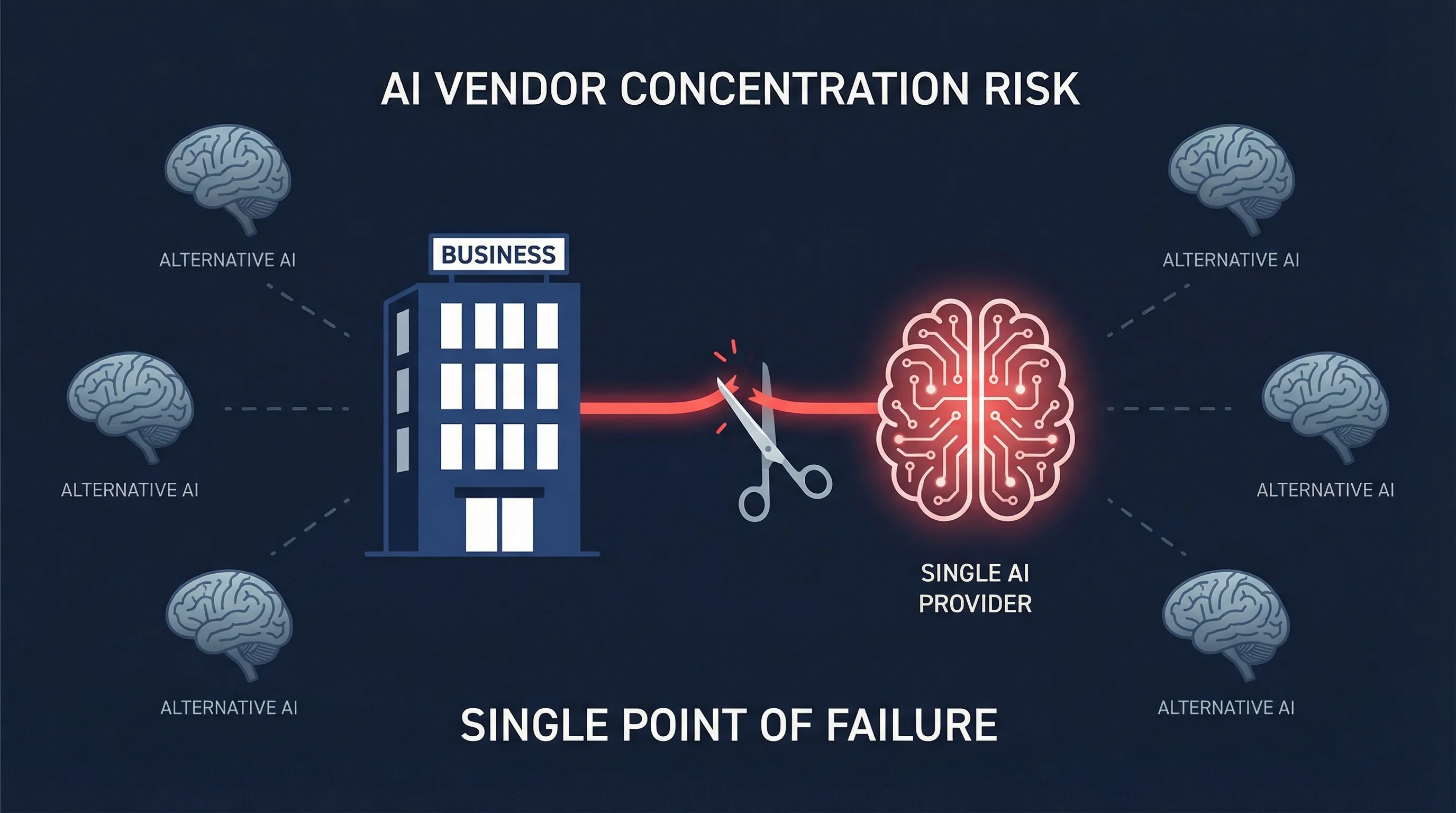
For businesses that have standardised on Claude, this creates a practical problem. Your AI provider's commercial stability is now subject to a political negotiation you have no input into.
The AI Vendor Concentration Problem
This isn't just an Anthropic problem. It's a structural one. The AI industry is dominated by a handful of providers, each subject to their own regulatory and political pressures.
OpenAI, Google, and xAI have all agreed to the Pentagon's "all lawful applications" terms. The Pentagon has reportedly reached a deal to use xAI's Grok in classified systems, and has been accelerating conversations with OpenAI and Google about bringing their models into classified settings.
That compliance means something different depending on your perspective. For the Pentagon, it means fewer restrictions. For businesses evaluating AI providers, it means every major provider is making governance choices influenced by government relationships, not just product quality or customer needs.
Anthropic's CEO Dario Amodei framed his concern in stark terms: "My main fear is having too small a number of 'fingers on the button,' such that one or a handful of people could essentially operate a drone army without needing any other humans to cooperate to carry out their orders."
Whether you agree with that position or not, the business question is separate: can you afford to have a single AI vendor whose commercial future depends on a political negotiation?
The Global Governance Vacuum
Luke Barnes at NYU Stern's Center for Business and Human Rights put it directly: "If the United States government responds to principled limits by threatening to cut off the company that imposes them, it sends a clear message to the entire industry: responsibility is a liability."
That message matters because no binding international framework governs how AI models can be deployed by governments. The EU's AI Act covers commercial applications within European borders. California's Transparency in Frontier AI Act focuses on disclosure. Neither addresses the scenario playing out between the Pentagon and Anthropic.
Alan Rozenshtein, writing in Lawfare, argued that Congress, not the Pentagon or Anthropic, should set military AI rules. Without legislation, "the underlying problem will remain: the rules governing military AI will be set through ad hoc negotiations between executive officials and individual companies, with no democratic input, no durable constraints, and no framework that survives the next change of administration."
For businesses, the takeaway is sobering. Your AI provider's terms of service are downstream of government pressure. And that pressure varies by country, by administration, and by the political moment.
What Businesses Should Do Now
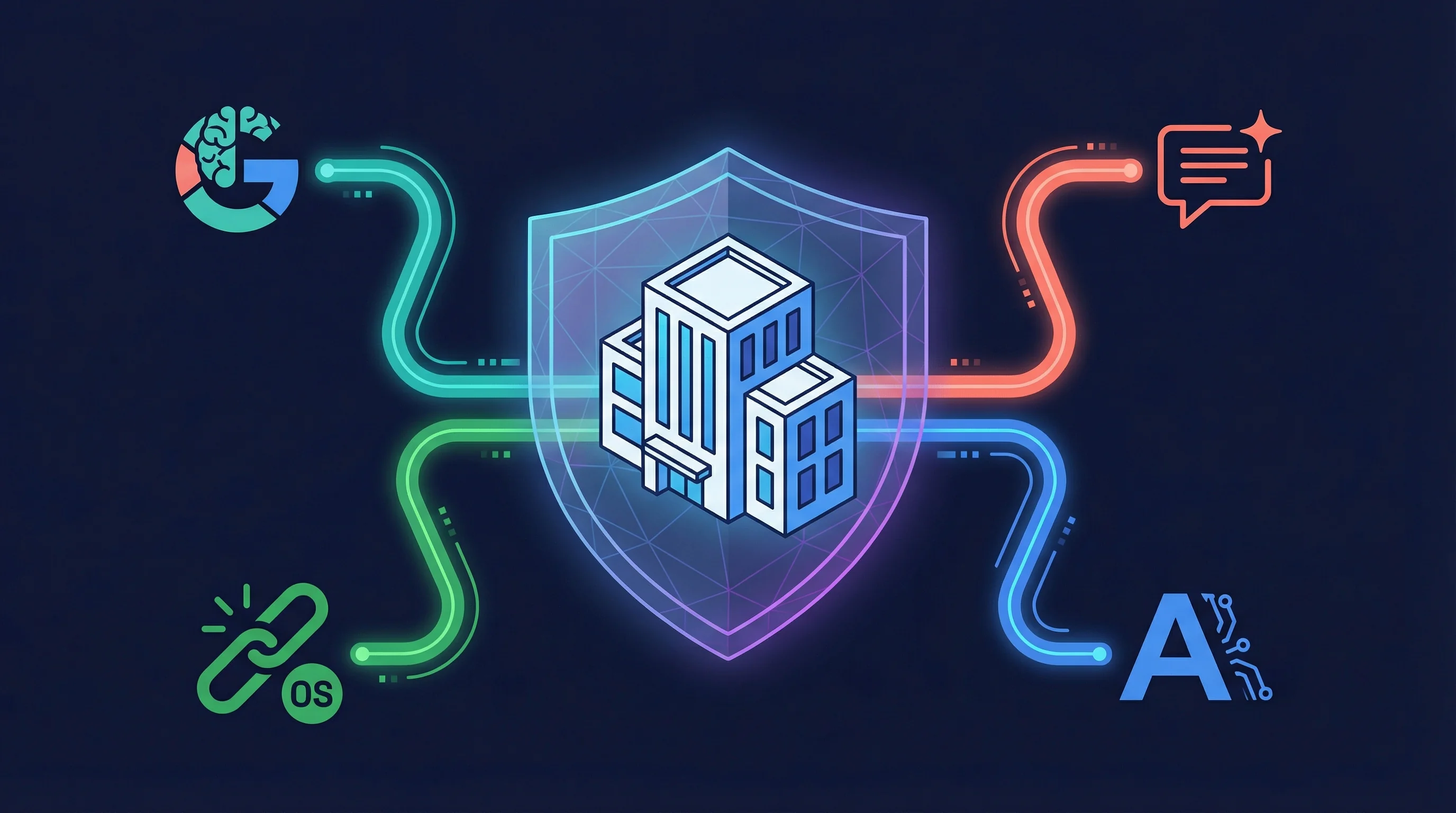
1. Audit your AI vendor dependency. Map every workflow, product, and service that relies on a specific AI provider. If Claude disappeared tomorrow, or if OpenAI changed its terms next month, which processes break? Most organisations don't have this documented.
2. Build multi-vendor capability. Test alternative models for your critical workflows now, not when there's a crisis. Our comparison of ChatGPT, Claude, and Manus found that each excels in different areas. A multi-model strategy gives you options.
3. Consider self-hosted fallbacks for sensitive work. For operations where data privacy or continuity is critical, running open-source LLMs on cloud GPU infrastructure provides a backstop that no government can cut off. Open models like Llama and Mistral can't be designated supply chain risks.
4. Build your AI presence independently. Whatever happens to individual AI providers, AI-powered search and recommendation systems are here to stay. Making your business visible to AI through proper discovery files and structured data ensures you're findable regardless of which model is asking. The AI Visibility Checker can show you where you stand today.
5. Watch the Friday deadline. This story has a ticking clock. If Anthropic holds firm and the Pentagon follows through on its threats, the impact on Claude's commercial availability could become clear within days. If you rely on Claude's API, have a contingency plan ready.
What Comes Next
The Friday 5:01pm deadline will pass before many businesses read this article. Three outcomes are possible.
Anthropic could compromise, perhaps allowing broader military use while maintaining specific guardrails around autonomous targeting. The Pentagon could back down, recognising that designating its own AI provider a "supply chain risk" is contradictory. Or the standoff could escalate, with the Defense Production Act invoked for the first time against an AI company.
Any of those outcomes reshapes the commercial AI landscape. A compromise sets a precedent for how far governments can push AI providers. A Pentagon retreat signals that safety-first AI companies can hold their ground. An escalation tells the entire industry that government access trumps corporate governance.
The one thing that won't change: businesses need AI strategies that don't depend on any single provider staying in exactly the same position it's in today. The vendors will shift. The regulations will shift. The political winds will shift. Your AI architecture should be built to handle all of it.
Frequently Asked Questions
What is the Pentagon-Anthropic dispute about?
Defense Secretary Hegseth demanded that Anthropic remove safety restrictions on Claude for military use. Anthropic refuses to allow its AI for fully autonomous weapons or mass surveillance. Hegseth gave Anthropic until Friday 28 February to comply, threatening to invoke the Defense Production Act and label the company a "supply chain risk."
What is the Defense Production Act and how could it affect AI?
The Defense Production Act is a US law that allows the government to compel private companies to prioritise national defence needs. It was used during the pandemic for ventilators. Using it to force access to an AI model would be the first time it's been applied to frontier AI technology, setting a major precedent for the entire industry.
What does a "supply chain risk" designation mean for Anthropic's customers?
The designation would prohibit any company with US military contracts from using Anthropic's products in defence work. Since many large corporations hold defence contracts, this could force them to drop Claude across their organisations, affecting both military and commercial use of the platform.
Are businesses that use Claude commercially at risk?
Commercial Claude access is not directly threatened by the Pentagon dispute. The supply chain risk designation targets military-related work. But the broader instability, combined with Anthropic's planned IPO and investor uncertainty, creates business continuity questions that any organisation dependent on Claude should plan for.
Have other AI companies agreed to the Pentagon's terms?
OpenAI, Google, and xAI have agreed to allow their models for "all lawful applications" in military settings. xAI's Grok was recently approved for classified use. Anthropic is the only major AI company holding firm on restrictions, which limits its bargaining position but distinguishes its safety-first approach.
What are Anthropic's specific safety redlines?
Anthropic has two firm limits. First, Claude cannot be used for fully autonomous weapons where AI makes targeting decisions without human oversight. Second, it cannot be used for mass domestic surveillance of civilians. Anthropic argues AI is not yet reliable enough for autonomous weapon systems and that no legal framework governs AI mass surveillance.
How should businesses protect themselves from AI vendor disruption?
Audit your dependency on any single AI provider. Test alternative models for critical workflows before a crisis forces the switch. Consider open-source LLMs on self-hosted infrastructure for sensitive operations. Build AI visibility for your business through discovery files and structured data so you're findable across all AI platforms, regardless of provider changes.
What happens after the Friday deadline?
Three scenarios are likely: Anthropic compromises on specific use cases while keeping core restrictions, the Pentagon softens its demands to avoid the contradiction of blacklisting its own AI provider, or the standoff escalates with Defense Production Act invocation. Any outcome sets precedent for government leverage over commercial AI companies globally.
Is your business ready for AI disruption?
AI providers can change terms, face regulatory pressure, or be cut off by governments. Build resilience by making your business visible across all AI platforms with structured discovery files. Our free checker shows you where you stand.
Check Your AI VisibilitySources
- Pentagon threatens to make Anthropic a pariah if it refuses to drop AI guardrails - CNN Business (24 February 2026)
- Hegseth threatens to blacklist Anthropic over 'woke AI' concerns - NPR (24 February 2026)
- Hegseth demands full military access to Anthropic's AI model Claude - CBS News (24 February 2026)
- Anthropic won't budge as Pentagon escalates AI dispute - TechCrunch (24 February 2026)
- The Cost of Conscience: What the Anthropic-Pentagon Feud Means for AI Governance - NYU Stern (19 February 2026)
- Congress, Not the Pentagon or Anthropic, Should Set Military AI Rules - Lawfare (20 February 2026)
Published: · Last reviewed: · Written by: Mark McNeece, Founder & Managing Director, 365i
Editorially reviewed by: Mark McNeece on · Our editorial standards