
Most agencies fix a website that isn't performing by adding more to it. More posts, more landing pages, more "content velocity". We did the opposite. On Brewood Removals, a West Midlands removals firm, the first thing we did was delete the entire blog. Every post. Then we asked an AI to mark the rebuild against the best removals websites it could find, and it scored the result 99 out of 100, ahead of Pickfords and every national chain in the set.
This is an early case study. The rebuilt site went live recently, it's still being indexed, and the Google Search Console numbers that will tell the real story are a few weeks away. We'll publish those when they land, good or bad. What we can show you today is the decision, the rebuild, and an independent on-page assessment that turned out better than we expected. The honest caveats are in their own section near the end, because a case study that hides them isn't worth reading.
The site was designed and built by Press Forge, our sister website design studio, and it's hosted on 365i Linux web hosting. The owner, Sean Hamilton, is a repeat client. We already rebuilt his locksmith business, Lockerfella, which we wrote up in detail as a non-commodity local business case study. He liked how that went, so when his removals website needed the same treatment, he came back. Two businesses, one owner, the same playbook applied twice.
The Site We Inherited: AI Slop and Thin Pages
The old Brewood Removals site had a problem that's become common in 2026. Somewhere along the way it had been fed through an AI content tool and told to produce blog posts. Lots of them. The result is what the industry has started calling "AI slop": mass-produced, generic articles written for an algorithm rather than a reader. None of it was wrong, exactly. It just wasn't anything. You could have published the same posts on any removals website in the country and nobody would have noticed.
Sitting underneath the blog was a bigger problem: doorway sprawl. The old WordPress and Elementor site had grown to 247 URLs, and around 160 of them were near-identical "removals in {suburb}" landing pages. Swap the place name, change nothing else. No real prices, no real jobs, no sign an actual removals crew had ever read them. That's the textbook pattern Google calls doorway pages, and it's exactly the kind of thin, interchangeable content that lacks any of the four E-E-A-T signals (Experience, Expertise, Authoritativeness, Trustworthiness) the quality guidance keeps coming back to. Worse, all those near-duplicate pages competed with each other for the same searches, so none of them won.
The cruel part: this is a properly good business with real proof. A 5.0 rating from 74 Google reviews. 4.8 on Trustpilot. 133 reviews on removalreviews.co.uk with a "Best Removal Company Reviews 2026" badge. Three-plus years trading. And after all that, the site ranked on page one for next to none of the "removals company {town}" terms that actually bring in work. A real, well-reviewed firm was buried under a website that worked against it.
That combination, a slop-filled blog plus interchangeable landing pages, is exactly the profile that's been losing visibility through 2026. Lily Ray, VP of SEO Strategy and Research at Amsive, analysed more than 220 websites that publicly identified as customers of AI content tools. Her finding was blunt:
"It can produce real short-term gains in both SEO and AI search, but across this dataset, those gains have rarely held."
The number that stuck with me from her dataset: 54% of those sites lost 30% or more of their peak organic traffic, and 22% lost more than 75%. When I read that I thought of every client who's ever asked us to "just churn out more posts". The instinct feels productive. The data says it's often a slow puncture. Brewood Removals hadn't crashed, but it was carrying a lot of dead weight, and dead weight is the thing you remove first.
Why We Deleted Every Post Instead of Improving Them
The obvious move would have been to rewrite the blog. Take the slop, improve it, add a human touch. We didn't, and the reason is worth explaining because it's the contrarian decision at the heart of this piece.
More pages is not more authority. A site's credibility isn't the sum of its URLs. Thin and generic posts don't sit there harmlessly waiting to be improved. They dilute the strong pages, they spread crawl attention across material that will never rank, and on a small business site they actively work against the few pages that deserve to win. The right number of AI-slop posts on a website is not "fewer". It's zero.
Content pruning at scale isn't a fringe idea, either. The most-cited example is HubSpot, which deleted roughly 3,000 old posts and saw organic performance improve rather than collapse. The lesson HubSpot took from it was the one we applied to Brewood: better content beats more content, and removing the weak stuff lets the strong stuff breathe.
So the blog went, in full. The doorway pages went too. The whole thing collapsed from 247 URLs down to roughly 25: ten area pages, eight or so service pages, and the core.
How you remove pages matters as much as that you remove them, and this is the part most rebuilds get wrong. The lazy move is to 301-redirect all 160 doorway pages onto the nearest surviving page. Don't. A 301 from a page Google considers doorway spam doesn't pass equity to the target, it passes the spam signal. So we gave 225 of the 247 old URLs an explicit 410 Gone, told Google plainly that this thin content is deliberately retired, kept 18 as 301s where a real equivalent actually existed, and left 3 on their original URLs. Clean amputation, not redirect-spraying.
What replaced them was not "more content". It was fewer, much stronger pages, every one built to pass a single test we use on every project: could a competitor in the next town publish this page after swapping one or two words? If yes, the page is commodity content and it isn't worth having. If no, it's the kind of material Google has been explicit about rewarding.
"Creating content that people find unique, compelling, and useful will likely influence your website's presence in generative AI search in the long run more than any of the other suggestions in this guide."
That line is the whole strategy in one sentence. Google formalised its "non-commodity content" guidance in May 2026, and it reads like a description of what a small, real, local business can do that a content farm cannot. Brewood Removals is run by people who move people for a living. The website just had to sound like them.
What We Built Instead: An Advice Hub From Real Jobs
In place of the blog, we built an advice hub. Not a blog with a nicer name, a proper customer-journey resource that follows a real move from "should I get quotes" through to "what happens on the day". Its own strapline gives the game away: "Moving advice from people who actually move people", with guides "written from the jobs our crew does every week across the West Midlands".
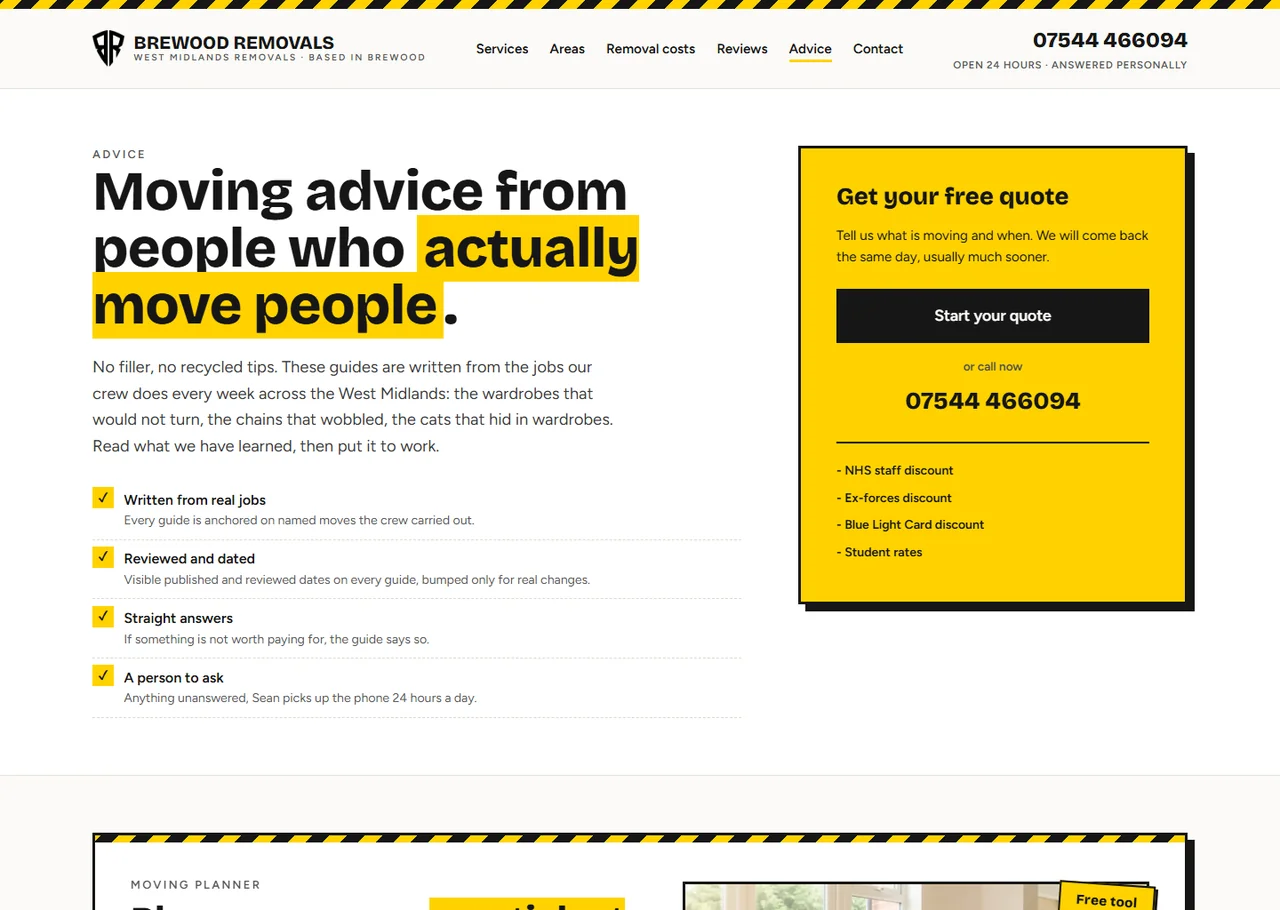
The hub isn't a token gesture either. It runs to fourteen guides, each one mapped to a real question a customer asks before, during or after a move:
- Moving house checklist, week by week
- Removal costs in the West Midlands, with actual numbers
- How to pack for a move
- Boxes and packing materials
- Storage when moving house
- Moving house with pets
- Student moving guide
- Moving over a bank holiday or half-term
- Moving day: what to expect
- Last-minute and short-notice moves
- The best day to move house
- How to choose a removals company
- Removal quotes explained
- Man and van, or a removals company?
The checklist ties into a free moving planner tool, so the advice isn't just words, it's something a customer can actually use. That's the difference between "start packing early" (true, useless) and a dated, week-by-week plan that covers parking permits, Royal Mail redirection, broadband transfers, schools and pets.
The same standard runs through the service pages and the area pages. Take the piano removals page. Instead of generic "we move pianos safely" filler, it tells you about a specific job: "In April 2025 a Solihull baby grand looked straightforward until the final doorway disagreed, so the legs came off." You can't template that. It happened. Likewise the Wolverhampton page quotes a real "Studio from £199" starting point and notes that "Wolverhampton has the least travel of any patch we cover, which helps the price", the kind of detail only a crew that actually drives those roads from Brewood would know.
The detail isn't a writing flourish, it's the architecture. There are now exactly ten area pages, a deliberate hard cap, where the old site had around 160. Behind them sits a data layer of 131 real, dated jobs from the owner's own work diary (roughly 40 area jobs, 40 service jobs and 51 planner testimonials), each one feeding the visible page, the schema and the AI files from a single source so the three can never drift apart. The pages read like a removals crew wrote them because, in substance, one did.
Each of the eight services (house removals, office moves, man and van, packing, storage, piano moves, student moves and house clearances) and each of the ten coverage areas (Birmingham, Cannock, Coventry, Dudley, Sandwell, Shrewsbury, Solihull, Stafford, Walsall and Wolverhampton) earns its place by carrying something real. Fewer pages than the old site. Each one impossible to copy.
Transparency as Strategy: The Removal Costs Page
If one page proves the approach, it's the removal costs page. Its heading is the whole argument: "Removal costs in 2026: actual numbers, published." And it means it. It carries the byline "By Sean Hamilton, Owner" with a published date and an "Editorially reviewed by" line, exactly the visible-attribution pattern we bang on about for E-E-A-T.
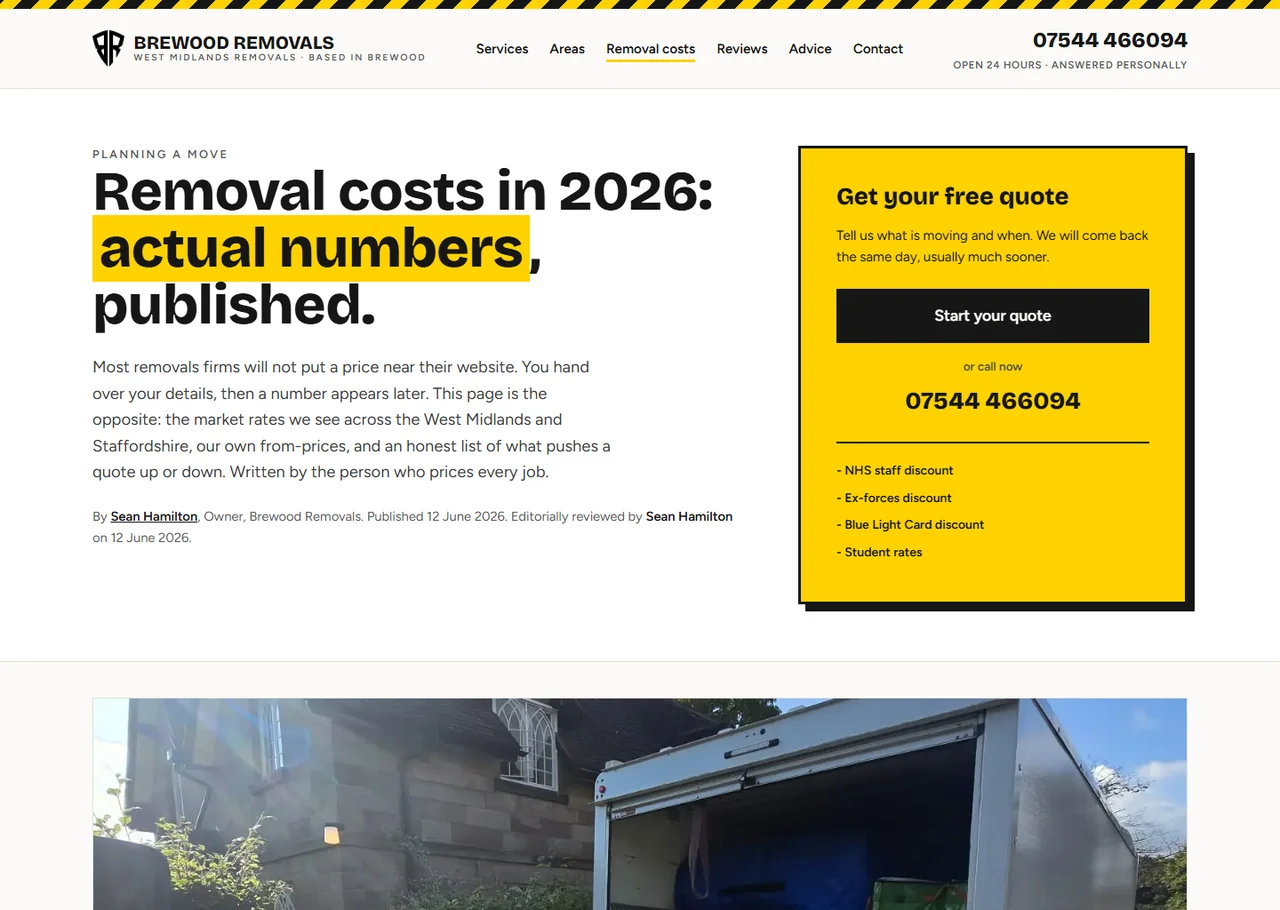
The page publishes wider market ranges (a 3-bed move at £800 to £1,500, a 5-bed at £1,800 to £3,500, full 3-bed packing at £400 to £700) alongside Brewood's own from-prices: studio from £199, 3-bed from £799. It then explains what actually moves a quote up or down, access, parking, volume, stairs, distance. And it names the reason most people never see a price online:
"Most removals firms will not put a price near their website. You hand over your details, then a number appears later. This page is the opposite."
This is the contrarian thing most removals companies refuse to do, because publishing prices feels like giving something away. It isn't. It's the single strongest trust signal a service business can offer, and it's a page a competitor hiding behind a quote form physically cannot match without changing how they run the business.
Served Twice: AI Discovery Files and the Directory
Building pages that are actually useful is the human half of the job. The machine half is making sure the AI engines can read that work cleanly. So alongside the rebuild, we shipped the full suite of AI Discovery Files for the site: a set of machine-readable files (llms.txt, llms.html, ai.txt, ai.json, identity.json, brand.txt, faq-ai.txt, developer-ai.txt and robots-ai.txt) that let AI agents identify the business, its services, its pricing model and its preferred citation format without having to parse the rendered HTML. It's the same evidence the human-readable site publishes, served a second time in a format machines find trivial to index.
Brewood Removals is now listed in the verified AI Visibility Directory at Platinum tier, scoring 10 out of 10 on discovery-file conformance. Almost no small business does this. It costs nothing in ranking terms to be absent, which is exactly why it's a cheap, durable edge to be present. If you want to see whether your own site is readable to AI engines, the free AI Visibility Checker grades your discovery files, and our own AI Crawler Checker tells you whether your host is quietly blocking the AI crawlers in the first place, a problem we covered in detail when we looked at hosts that block AI bots by default.
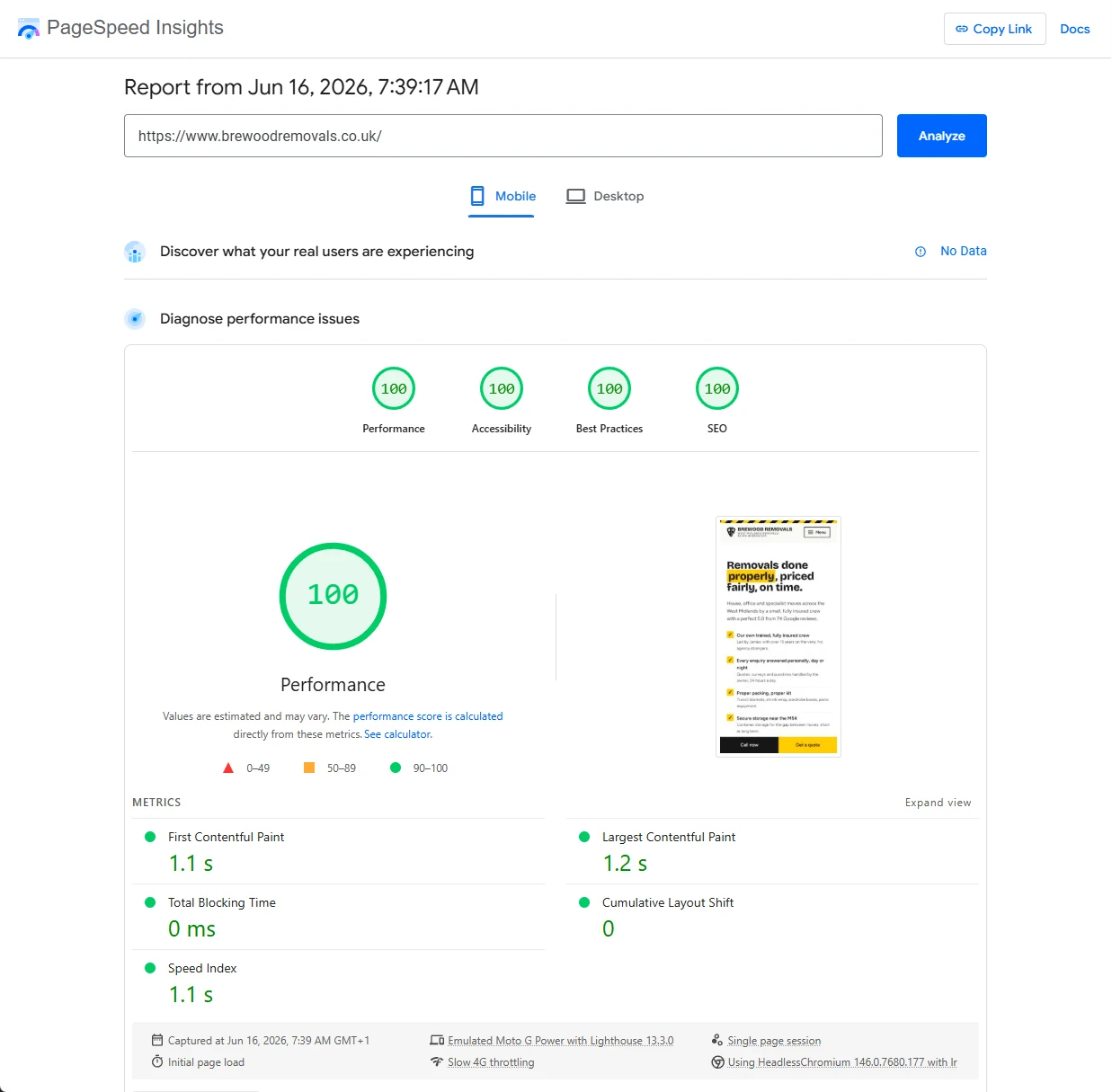
Speed is the other half of being readable. The old Elementor build carried the usual page-builder weight; the rebuild is hand-coded PHP, CSS and vanilla JavaScript with no builder and no third-party script bloat, served from 365i Linux hosting behind our CDN. The numbers that fell out of that: a perfect 100/100/100/100 in Google PageSpeed Insights on mobile, Cumulative Layout Shift pulled from 0.44 on the old site down to about 0.02 with a pre-paint class swap, and a clean 8/8 on the security headers with HSTS. A fast, stable page isn't a vanity metric here, it's the floor a credible local business site needs before any of the content work counts.
Sean, who owns Brewood Removals, left this verified review on our Google profile the same week the rebuild went live. He's a repeat client, so he's now had the same treatment on both his businesses:
"After speaking with a few web companies, I decided to go with Mark and I'm glad I did. The website is fast, professional and performs brilliantly. I was amazed when he showed me it had achieved 100 out of 100 on Google PageSpeed. What impressed me most though was the ongoing support. Mark genuinely cares about his clients and wants their business to succeed. Highly recommended."
We Asked ChatGPT to Mark Our Homework
Here's where it gets interesting, and where I want to be careful about what this does and doesn't prove. We asked ChatGPT to assess the rebuilt Brewood Removals site against the best removals company websites it could find, scoring six dimensions out of 100: SEO, E-E-A-T, non-commodity content, advice content, useful tools and an overall mark. We gave it the full site to look at, including the advice hub, the moving planner, the area pages and the cost guide. This is an on-page assessment by a language model that we prompted. It is not a Google ranking, and we'll say so again in the honest section. With that stated plainly, here's what came back.
| Website | SEO | E-E-A-T | Non-commodity | Advice | Tools | Overall |
|---|---|---|---|---|---|---|
| Brewood Removals | 98 | 98 | 99 | 99 | 99 | 99 |
| Pickfords | 95 | 96 | 91 | 93 | 94 | 94 |
| White & Company | 94 | 97 | 89 | 91 | 82 | 92 |
| Compare My Move | 96 | 89 | 88 | 94 | 92 | 91 |
| HomeOwners Alliance (removals advice) | 94 | 93 | 86 | 93 | 80 | 90 |
| Bishop's Move | 91 | 96 | 86 | 86 | 78 | 89 |
| Winchester Removals | 89 | 88 | 88 | 87 | 75 | 86 |
Brewood Removals came out top overall, and top on the three dimensions that matter most for the rebuild: non-commodity content, advice content and useful tools, all at 99. The assessment's own summary put it plainly:
"I'd now score Brewood Removals as the best on-page removals company website I found. Not because it's the biggest. It isn't. Not because it has the oldest brand. It doesn't. But because the pages are doing the hardest thing well: they're commercially useful, locally specific, transparent, practical, trust-building and full of details competitors usually don't bother writing."
What I find more useful than the headline number is what it said about why. It singled out the removal-costs page as "a major win because it gives actual 2026 price ranges" and the kind of page "most removals companies dodge because it requires being transparent rather than hiding behind 'request a quote'." It described the advice hub as "not a blog bolted on for SEO. It's a proper customer journey hub." Those are the exact two decisions we made, named back to us by a system that had never spoken to us. When the reasoning matches the intent that precisely, the score is almost beside the point.
Why a One-Van Firm Out-Scored Pickfords
Pickfords is a serious operation. It's been moving people since the 1600s, the brand trust is enormous, and the assessment correctly called it the closest challenger, with a strong 2026 cost guide and a really useful removal cost calendar tool that helps people find cheaper moving dates. On scale, breadth and brand history, a Brewood firm doesn't get near it. So how does it lose on-page?
Because scale and local texture pull in opposite directions. A national brand writes for everyone, so its pages read like they were written for no one in particular. The assessment's phrase for the gap was that Pickfords "feels more national/corporate" and "loses on local specificity, human texture and 'this was written from actual jobs we've done around here' detail." That's the whole story. Brewood can name the Solihull baby grand, the Wolverhampton drive time, the studio-from-£199 starting point, because one person planned those jobs and one crew did them.
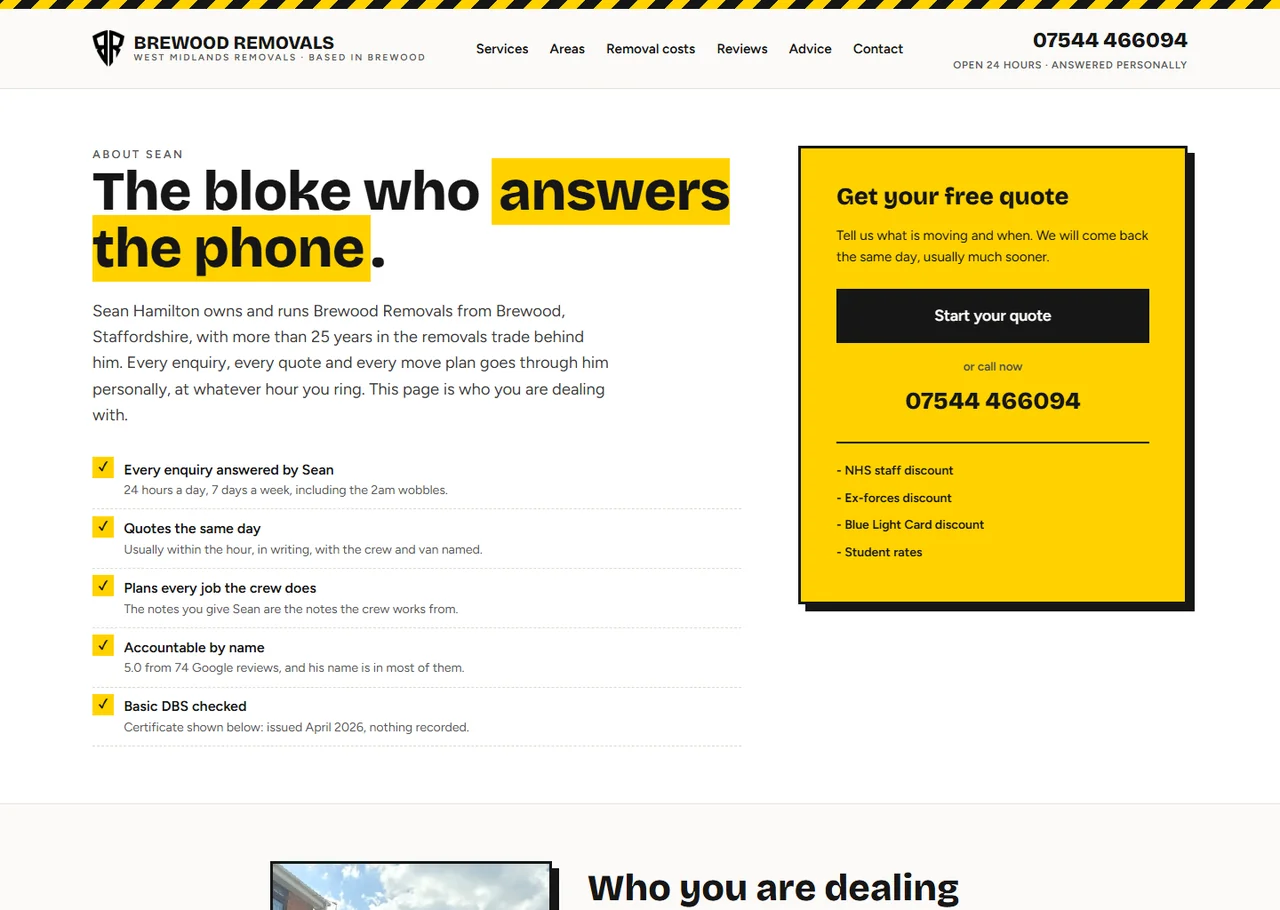
It helps that the trust signals are real and linkable: a 5.0 rating from 74 Google reviews, 4.8 on Trustpilot, a Checkatrade membership, a lead mover with 15-plus years on the vans and an owner with more than 25 years in the trade. None of that is a tagline. Each one is a third party a customer can go and check. And the rebuilt reviews page renders all 74 verbatim, never curated: the single four-star review among the seventy-three five-stars stays exactly where it is, because a wall of nothing but five stars reads as suspicious and one honest four-star is worth more than the gloss it would take to hide it. This is the same lesson from the Lockerfella build: a small business wins on-page not despite being small, but because being small is what makes the specifics possible. If you want the locksmith version of this argument in full, the Lockerfella case study walks every E-E-A-T letter against dated, named evidence.
The Honest Part: What We Do Not Know Yet
Now the caveats, because this is an early case study and pretending otherwise would undercut everything above.
The ChatGPT score is not a Google ranking. It's an on-page quality assessment by a language model, run against a competitor set the model chose, on a prompt we wrote. It's a useful independent read on content quality, and the reasoning is sound, but it doesn't move the search results by a single position on its own. Anyone selling you "we scored 99 with AI, so you'll rank" is selling you something.
The search data isn't in yet. The rebuilt site is freshly live and still being crawled and indexed. The Search Console story, impressions, clicks, average position, the queries that actually convert, takes weeks to stabilise on any new build. We don't have it, so we're not going to dress up early wobble as a trend in either direction.
One contrarian decision isn't a universal law. Deleting an entire blog was right here, because the blog was slop and the landing pages were thin. On a site with strong, well-loved archive content, pruning is a scalpel, not a bulldozer. Don't read this as "delete your blog". Read it as "delete the part of your site that no reader would miss".
What we've promised Sean, and what we'll do publicly, is a follow-up in a few weeks with the real GSC numbers. If they're strong, you'll see them. If they're middling, you'll see those too. A case study you only publish when it works isn't a case study. It's an advert.
How to Run This Audit on Your Own Site
You don't need us, or a rebuild, to start. Here's the version any UK business can run on its own site this week.
- List every blog post and ask one question of each. "Would a reader miss this if it vanished?" If the honest answer is no, it's a pruning candidate. Be ruthless. The count doesn't matter; the quality does.
- Find your duplicate-intent pages. If three pages all chase the same search term, they're competing with each other. Merge them into one strong page and redirect the rest.
- Rewrite your best service or area page from your own work diary. Walk through the last ten real jobs. Name the streets, the months, the prices, the things that went wrong and how you fixed them. If two area pages would be improved by swapping their text wholesale, neither is non-commodity yet.
- Publish your prices where the customer reads them. Not behind a form. A "from £199" on the page beats ten lines of "competitive pricing" in a brochure block.
- Make every review linkable to its source. Google, Trustpilot, Checkatrade. If a testimonial doesn't link back to where the customer wrote it, it's a claim, not evidence.
- Check the machines can read you. Run the AI Visibility Checker and the AI Crawler Checker. The first tells you whether AI engines can understand your site; the second tells you whether your host is blocking them.
There's no schema trick that fixes commodity content, and no AI tool that fakes lived experience. The work is the work. We deleted the part of Brewood Removals that pretended to do the work, and kept the part that actually did. Then we asked a machine to read it, and it agreed.
Frequently Asked Questions
What is AI slop?
AI slop is mass-produced, low-quality content generated by AI tools without subject knowledge or proper human editing, written for an algorithm rather than a reader. It's usually generic, interchangeable and indistinguishable from the same content on any rival site. The Brewood Removals blog we deleted was a textbook example: technically fine, completely forgettable, and impossible to tell apart from a hundred other removals blogs.
Does AI-generated content hurt your SEO?
Mass-produced AI content frequently does. Lily Ray of Amsive analysed 220-plus sites using AI content tools and found short-term gains that "rarely held", with 54% losing 30% or more of their peak organic traffic. Google judges content on quality regardless of how it was produced, so AI content has to meet the same E-E-A-T bar as anything else. AI used carefully, with real expertise and human editing, can be fine. AI used to churn out generic posts at volume is the problem.
Can deleting blog posts really improve SEO?
Yes, when the posts are thin, generic or competing with each other. HubSpot famously deleted around 3,000 old posts and saw organic performance improve. Pruning weak content reduces keyword cannibalisation, focuses crawl attention on your strong pages, and lifts the overall quality signal of the site. It's a scalpel, not a bulldozer: delete what no reader would miss, and strengthen what's left rather than deleting indiscriminately.
Why delete the posts instead of improving them?
Because rewriting slop into something good usually costs more effort than writing fewer, stronger pages from scratch, and the rewrite still drags the old thin URLs along behind it. On Brewood Removals the blog had no salvageable angle a reader would value, so deletion was cleaner than rehabilitation. The effort went into a 14-page advice hub written from the crew's real jobs instead.
Did ChatGPT really score the site 99/100?
Yes. We asked ChatGPT to assess the rebuilt site against the best removals websites it could find, scoring SEO, E-E-A-T, non-commodity content, advice content, useful tools and an overall mark out of 100. It returned 99 overall for Brewood Removals, ahead of Pickfords (94), White & Company (92), Compare My Move (91), HomeOwners Alliance (90), Bishop's Move (89) and Winchester Removals (86). Important caveat: this is an on-page quality assessment by a language model we prompted, not a Google ranking. It measures how good the pages are, not where they sit in search results.
How did a small firm out-score Pickfords on-page?
On local specificity and human texture. National brands write for everyone, so their pages read like they were written for no one. A Brewood firm can name a real Solihull piano job, a Wolverhampton drive time and a studio-from-£199 price because one owner planned the work and one crew did it. The assessment scored Pickfords higher on nothing it measured for content quality except a close call on SEO and tools; on non-commodity and advice content, the local detail won.
Who built and hosts the Brewood Removals site?
It was designed and built by Press Forge, our sister website design studio, and it's hosted on 365i Linux web hosting. The owner, Sean Hamilton, is a repeat client: we'd already rebuilt his locksmith business, Lockerfella. He owns both businesses and has consented to this public documentation.
When will you publish the actual search results?
In a few weeks. The site is freshly live and still indexing, so Google Search Console data (impressions, clicks, average position) needs time to stabilise. We'll publish a follow-up with the real numbers whether they're strong or middling. An early case study without the search data is exactly that: early, and honest about it.
Want a website built to be read, by people and by AI?
Whether it's hand-coded or WordPress, 365i Linux web hosting gives a credible business site the floor it needs: fast UK, US & Asia data centres, free SSL, the Web Optimisations panel, and dedicated 7-day expert support. From £5.99/month ex VAT. The design half is handled by our sister studio, Press Forge.
Explore 365i Web HostingSources
Case-study site (Brewood Removals)
- Brewood Removals - homepage and trust signals
- Brewood Removals - advice hub
- Brewood Removals - Removal costs in 2026 (published prices)
- Brewood Removals - piano removals (Solihull baby grand)
- Brewood Removals - Wolverhampton area page
- Brewood Removals - About Sean Hamilton
AI visibility (same property)
- AI Visibility Directory - Brewood Removals (Platinum, 10/10)
- AI Visibility - AI Discovery Files specification
- AI Visibility Checker tool
- 365i - AI Crawler Checker tool
Industry data and guidance
- Google Search Central - Optimizing your website for generative AI features (non-commodity content)
- Lily Ray, Amsive - It Works Until It Doesn't: AI Content Strategies That Backfire, May 2026
- HubSpot SEO case study - why deleting ~3,000 posts boosted traffic
- SEO.com - AI Slop: breaking down the 2026 buzzword
Competitor website referenced in the assessment
Related 365i family coverage
Published: · Last reviewed: · Written by: Mark McNeece, Founder & Managing Director, 365i
Editorially reviewed by: Mark McNeece on · Our editorial standards