You've sent three emails. You've left two voicemails. The last reply from your web designer was a thumbs-up emoji in March. It's August now, the prices on your site are wrong, and you can't get into the WordPress dashboard because you never had the login in the first place.
This article is for you. We see this pattern at 365i a few times a year, and the honest news is better than you might think. Your website almost certainly still belongs to you, even if it doesn't feel like it. The takeover is usually a 30-minute job at our end, not a multi-week recovery operation. And once it's done, the running costs are almost always lower than you were paying your designer.
The rest of the piece walks through exactly how that works, including a real customer case from one of our own helpdesk tickets, a six-step process you can use to take your site back, and a quietly important thing we always do that almost nobody else writes about: before we move your site, we try to speak to your original designer first. The aim isn't to win a new customer. The aim is for the end customer (you) to end up looked after.
When the Replies Stop Coming
The reasons web designers stop replying are usually mundane and rarely sinister. Freelance designers burn out. Small agencies close quietly. Personal circumstances change. Health intervenes. A side-business stops being financially viable when the main job gets busier. We've seen all of these in the past few years on our own platform. Two recent named examples, both with permission and anonymised to first name plus initial:
- Adam C. ran a UK web design agency with a 365i agency hosting plan. Adam decided he no longer wished to be involved in web design at all. He came to us to ask how to wind his clients down respectfully.
- Johnny S. also ran a UK web design agency on a 365i agency plan. He stepped back from web design because of personal issues at home. Months later he was rebuilding. He now has a new agency plan with us and is gradually adding clients back to it.
Between them, Adam and Johnny had over 30 client sites and more than 50 domains with us at their peak. Some of those sites were retired (the end client really didn't need a website anymore). Roughly half were taken over by 365i directly, with each client moving to their own 365i account in their own name. We'll come back to the mechanics later.
The point for now is that this is not a rare scenario. If your designer has gone quiet, you are not the only one. Most of the time the cause is human and uncomplicated, and the path back to control is the same regardless of why.
Your Website Is Almost Certainly Still Working
Here is the first piece of reassurance. A web designer falling out of contact does not, by itself, take your website offline.
"First, don't panic. When you panic, you make poor decisions."
Chris is one of the most consistently sensible voices in the WordPress space, and that line is the bit of advice we'd echo back to almost everyone who comes to us in this situation. The instinct is to fire off urgent messages, change passwords on a panic, or threaten the designer publicly. Almost none of that helps. The website is rarely about to disappear in the next 48 hours, and the takeover is much easier from a calm starting position than a frantic one.
That's because hosting is paid for in advance, usually monthly or annually. Domains are paid for in years, often two years at a time. The site keeps serving pages until either the hosting subscription lapses, the domain expires, or somebody actively switches it off. None of those things happen the moment the designer stops replying to your emails.
That gives you a window. The window can be short or long depending on how the designer set things up, but in our experience it's almost always long enough to take action without panic. We've seen sites still serving traffic seven months after the designer stopped paying for hosting, because the platform hadn't been told to switch the package off and there was no automatic deletion. That is exactly what happened in Amy's case, which we'll get to in a moment.
Two things change the urgency:
- Hosting that stops getting paid. If the designer's card on file fails and the package goes into arrears, the host's response varies. Some suspend immediately. Some keep the site live for weeks or months as a courtesy and chase the debt separately. Either way, you have time to act, but not unlimited time.
- Domain expiry. If the domain reaches its expiry date without renewal, and the designer registered it in their own name, you'll lose the address before you lose anything else. Domain renewals are the most time-sensitive item in this whole situation. They're also the easiest to check (we'll show you how shortly).
Both of those are fixable. Neither of them needs a panic response. The first job is to find out what state your site is in.
What You Actually Own
The website is yours. The hard part is usually realising which pieces of it are yours and which pieces are sitting in someone else's account.
If your site runs on WordPress (and most small-business UK sites do), there's a useful piece of background to know. WordPress is open-source software, and its own published philosophy is built around what it calls a "bill of rights":
"The freedom to run the program, for any purpose. The freedom to study how the program works, and change it to make it do what you wish. The freedom to redistribute. The freedom to distribute copies of your modified versions to others."
That matters in the context of a takeover. Your WordPress site isn't licensed to your designer. It runs under a software licence that explicitly entitles you (or anyone) to run, modify and move it. Nothing your designer can do, deliberately or accidentally, takes that away from you. The hosting account is just the plot of land. The house on it is yours.
There are four moving parts in any small-business website. They are often muddled together when a designer manages everything for you, but they are legally and technically distinct, and ownership of each one can sit with a different person:
- The domain name. The address (yourbusiness.co.uk) is the most valuable single item. If it's registered to your name and address at the registry, it's unambiguously yours. If it's registered in your designer's name with their email as the contact, you may have a recovery step to take, but you still almost always have an ownership claim because you paid for it.
- The hosting package. The plot of internet land where your site's files actually live. Usually paid for monthly. Can be moved to a different account within the same provider in minutes, or to a different provider in a day or two.
- The website files and database. The PHP, the CSS, the images, the WordPress database. These belong to you as the commissioning party once they've been built and paid for, regardless of who has the keys today.
- The design IP (if it matters). If your designer built you something truly custom and your contract specifically reserved IP to them, the visual style could in theory belong to them. In practice this is almost never enforced and rarely worth worrying about for a routine takeover.
The combination of (1) and (2) is what we usually need to address first. The hosting can be reassigned in minutes. The domain can be left where it is if the designer keeps paying for it, or moved to your name properly if it's worth the certainty.
Amy's Story: A 30-Minute Takeover That Turned Into a 2-Year Customer
Here is what this looked like for one of our customers, anonymised by first name plus initial. We'll call her Amy C. She runs a UK party-supplies and event-hire business. Her website was built by a freelance web designer (we'll call him "her original designer") who registered the hosting package in his own 365i account, not Amy's.
One morning Amy opened a ticket. The exact phrasing she used is below, captured as a clean ticket card. She'd worked out something was wrong but didn't have the technical vocabulary for it. That's normal. Most people in this situation don't.
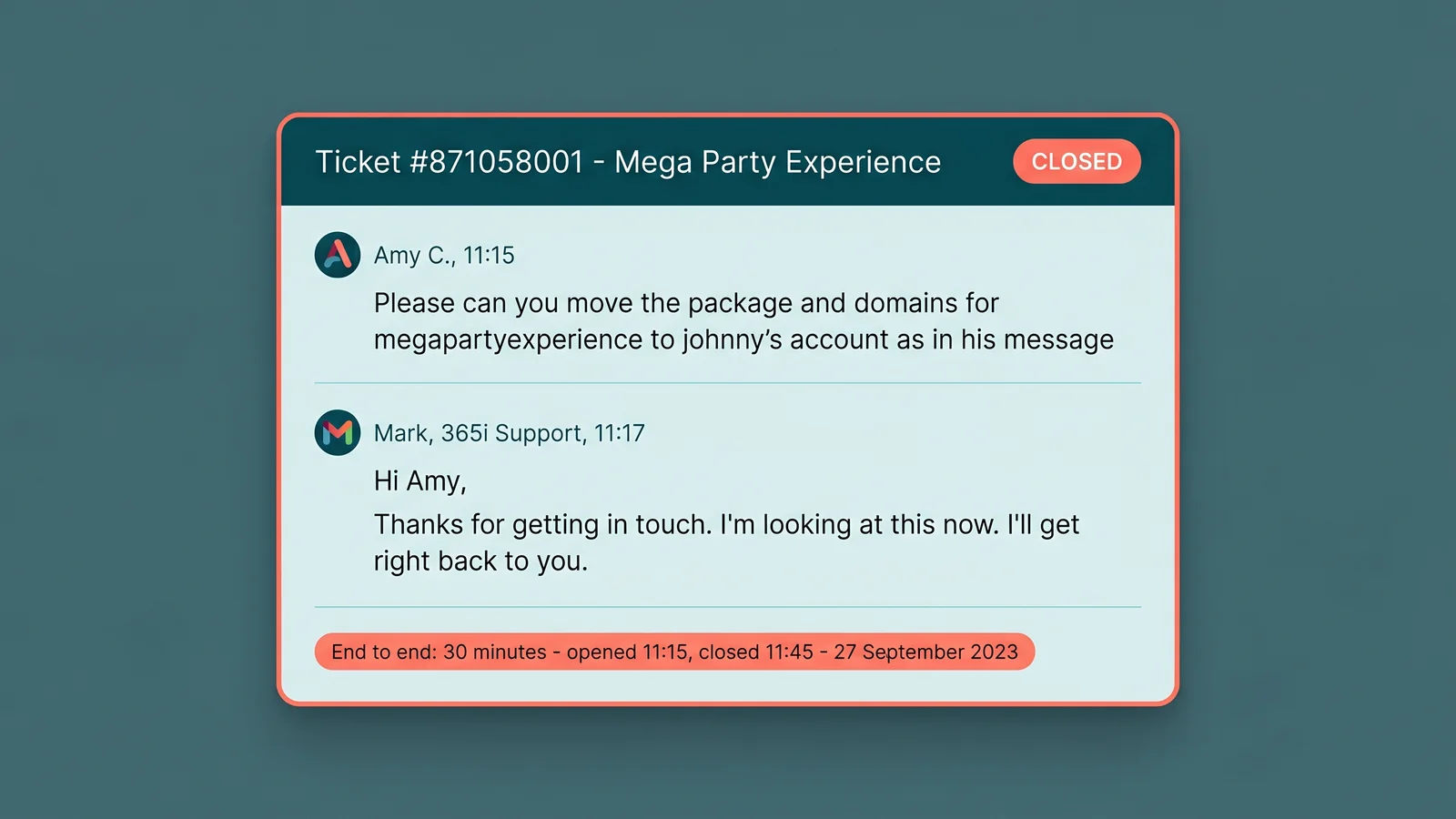
What had happened underneath was this. Amy's designer had stopped paying for the hosting since February 2023. That was seven months of unpaid invoices at £14.99 plus VAT per month, roughly £105 in arrears. The package hadn't been deleted because the designer still had login access to his account, and 365i hadn't pulled the plug. The site kept serving Amy's customers all that time. She didn't know about the unpaid bills. The designer hadn't told her.
What we did was pragmatic, not punitive. We didn't ask Amy to pay seven months of someone else's invoices to take control of her own website. We didn't chase the designer for the full arrears either, because at some point the cost of chasing exceeds the value of recovering. We negotiated a settlement of £60 plus VAT with the designer, he paid it, and the package was reassigned to Amy's new 365i account inside the same morning. Total time from her ticket opening to her holding the keys: 30 minutes.
Two years later, in August 2025, Amy came back to us. The site was still hers, still hosted with us, and now needed some content changes. The prices on the site were wrong because her business had moved on. She couldn't easily go back to her original designer for the edits, and she said so plainly:
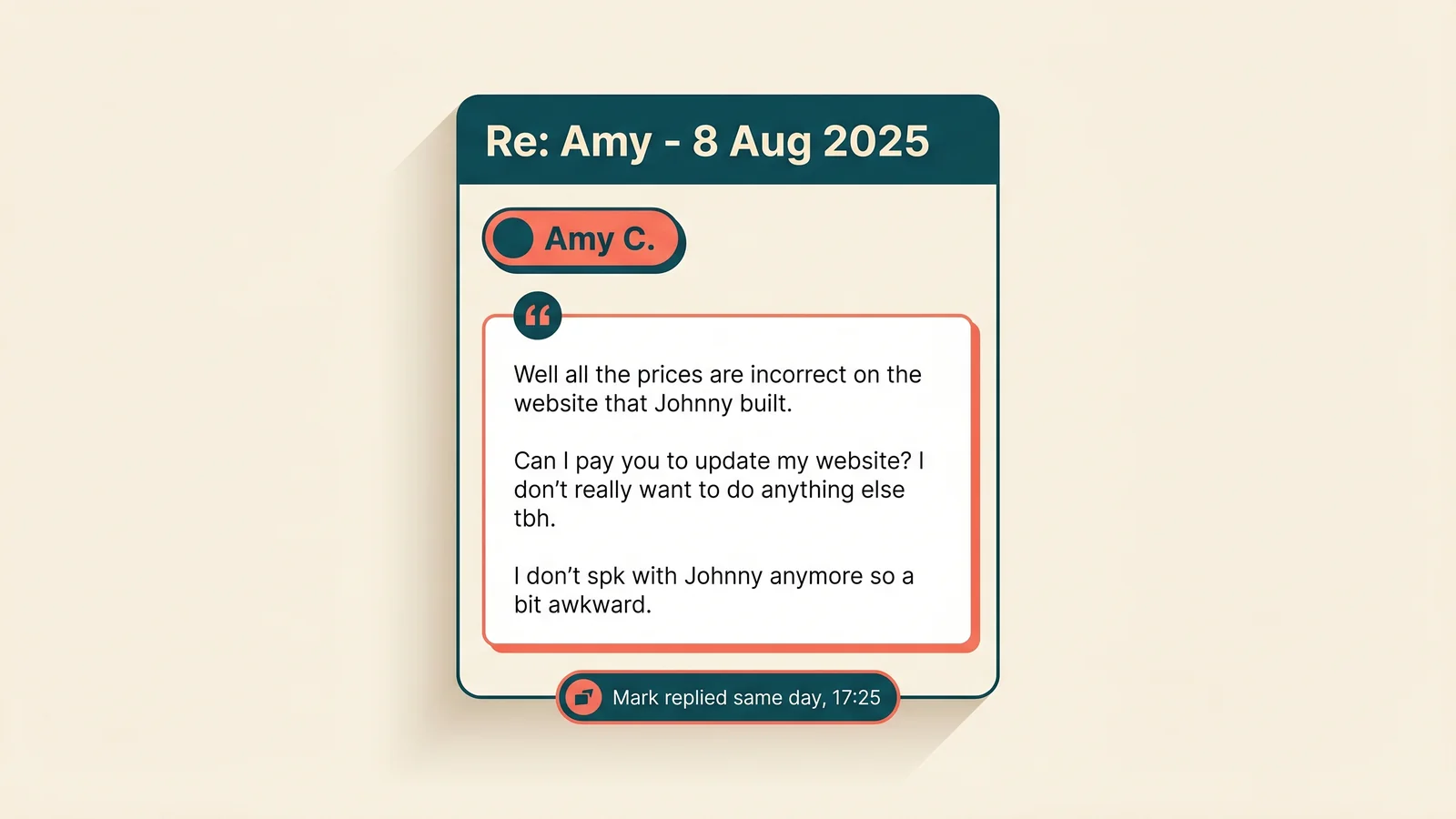
We offered her two options in the reply: a £30 plus VAT per month support and maintenance package that covers her updates and a short amount of content work each month, or one-off ad-hoc work charged when she needs it. She picked what suited her cashflow. Either was fine with us. The wider point is that Amy didn't have to ring her original designer to get the prices updated on her own website. She had us, on her own terms, paying us directly for what she actually needed.
That outcome, for us, is the whole point of the takeover process. It isn't about converting a new customer. It's about leaving a small business owner with a working website they can actually maintain.
The Other Direction: When the Designer Asks Us to Take Their Clients On
Amy's case is one of two patterns we see. The other goes in the opposite direction: the designer themselves contacts us, says they're winding down, and asks if we'll take their clients on.
Adam C. and Johnny S., who we mentioned earlier, are the cleanest examples. Between them they had over 30 client sites and 50+ domains on our agency hosting plans. When each of them reached the point of needing to step back, the conversation with us was the same: I need to wind this down. What happens to my clients?
What happens is that we treat every affected end client as the decision-maker. We don't automatically absorb the portfolio. We contact each client individually and explain what's going on, with the designer's permission. The client then decides for themselves whether to:
- Move to a direct 365i account in their own name and continue with the site (typically the choice for businesses that depend on the website for orders or leads)
- Retire the site, because they don't need it anymore (more common than you might think for older small businesses)
- Move the site to a different host or designer entirely (perfectly acceptable, no friction from us)
For Adam's and Johnny's clients, that breakdown ended up roughly 50/50 between "sites taken over by 365i directly" and "sites retired by the client". Nobody was pressured to keep their site alive just because the platform was willing to host it. Nobody was pressured to leave just because the designer had stepped away.
Johnny's story has a coda that we particularly like. After a while he came back. He now has a new agency hosting plan with us and is gradually rebuilding his client base. He asked us to move some of his original clients back to his new agency plan, and we did, but only where each individual client said that was what they wanted. No bulk re-transfer. Every move re-consented one by one. That principle matters: if the designer comes back and the client wants the original relationship back too, the path is open in both directions.
Why We Always Speak to the Designer First
This is the part of the process that most articles on this topic don't cover, and it's the part we're most proud of.
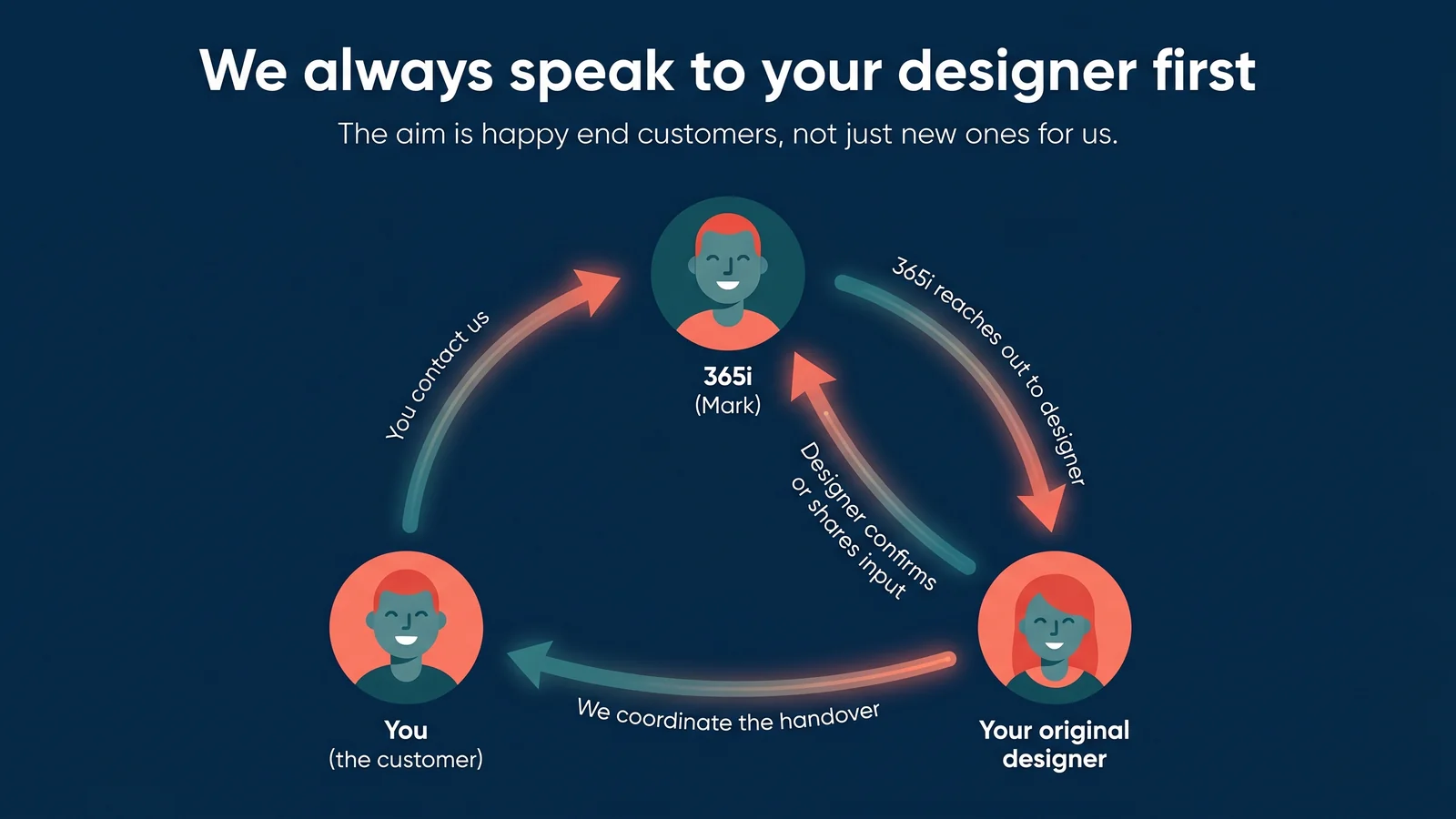
When an end client comes to us asking to take their website over from a designer they can't reach, our first move is not to start the migration. Our first move is to try to reach the designer ourselves. We have the designer's contact details (they're our customer too, or they were), and we can usually get through where the client has not.
We do this for three reasons. None of them are about us.
- The designer might be fine and just busy. A short message from us, in plain language, often gets a reply within hours that the client wouldn't have got in weeks. That sometimes resolves the situation without any takeover happening at all, and that's a good outcome.
- The designer is owed dignity in the conversation. Their client is asking to leave. They deserve to hear about it from us, not to find out later that we moved their package without telling them. Most designers we deal with are perfectly reasonable people working through a difficult patch. Going behind their back would poison a relationship that almost always still has value.
- The aim is happy end customers, not new customers for us. If the right answer is for the designer to wake up, return the client's calls, and resume the relationship, we'll happily say so and bow out. We are not in the business of poaching clients from designers who are still in business.
This is the principle behind every takeover we've ever handled. We don't always succeed in reaching the designer, and when we don't, the takeover still goes ahead because the end client's website cannot be held hostage to an absent third party. But we always try first. And we always tell the client we tried.
How to Find Out Where Your Website Actually Lives
If you're at the very beginning of this and don't even know who hosts your site or who owns your domain, you don't need to wait for help. There are three free public tools you can run yourself right now. We've built friendly versions of all three on 365i, free, with no sign-up.
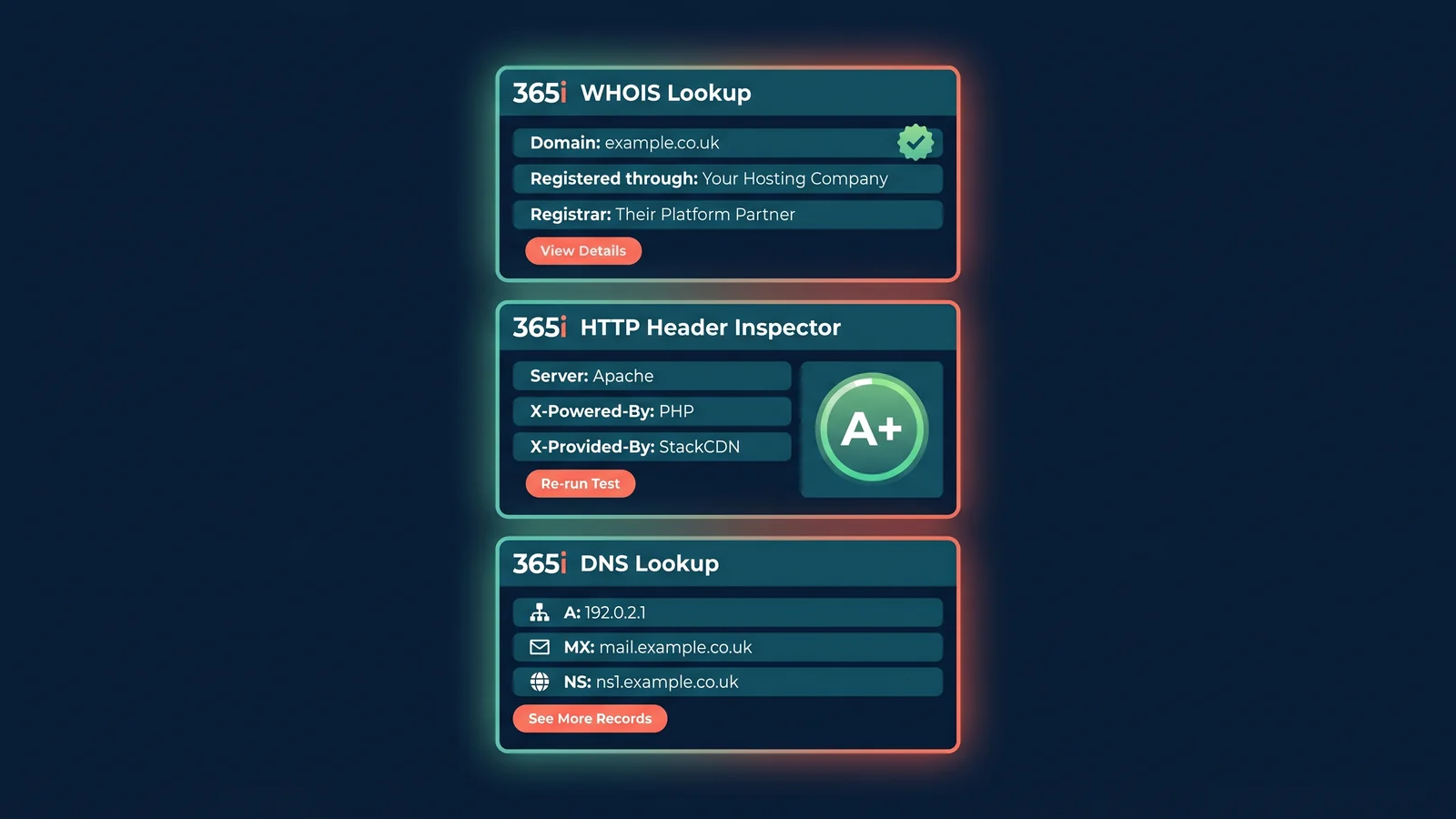
Here's the order to run them in, and what each one tells you.
1. WHOIS Lookup (who owns your domain)
Our WHOIS Lookup tool queries the official registry record for your domain and shows the registrar, the registration date, the expiry date, and (for .uk domains) the "Registered through" name, which is the customer-facing brand of whoever sold the domain. If the "Registered through" name is your designer's company name, the domain might be under their account. If it's a hosting company you don't recognise, that's where to start asking.
The most important field to check is the expiry date. If that date is within the next few months, prioritise getting the domain into your own name before anything else. A lapsed domain is the one thing in this situation that's actually hard to undo.
2. HTTP Header Inspector (who hosts your site)
Our HTTP Header Inspector fetches your site and shows the response headers, including the Server header, any X-Powered-By identifiers, and any CDN markers like X-Provided-By: StackCDN. Those tell you which hosting company's infrastructure your site is actually served from, even if your designer never told you who they used.
3. DNS Lookup (where is your email routed)
Our DNS Lookup tool shows the A records (your hosting), MX records (your email), and NS records (your nameservers) for your domain. Two cases to watch for. If your MX records point somewhere different from your A records, your email is hosted separately from your website (very common). If your nameservers belong to a company you don't recognise, that's where to start asking about DNS control.
Run all three. Note what they say. You don't need to act on them yet. Knowing the lie of the land is most of the battle.
The 365i Takeover: Six Steps From "Stuck" to "In Control"
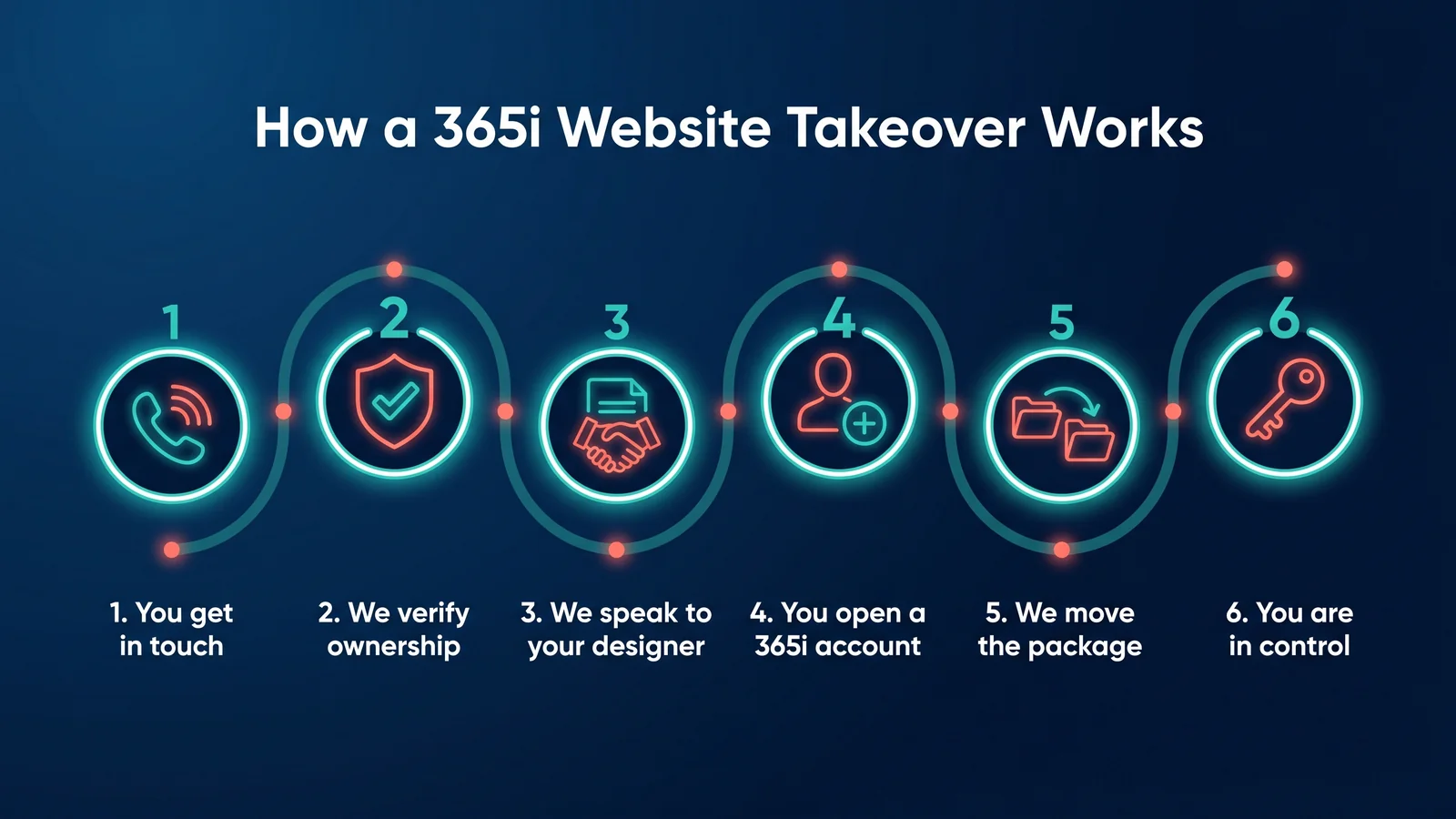
If you decide to come to us, here's exactly what happens. We've run this same sequence many times. It's predictable enough that we can usually tell you on day one how long it will take.
- You get in touch. Email support@365i.co.uk, use the contact form, or call. Tell us your domain name and a sentence or two about what's happening. You don't need to have all the technical details. We'll work them out.
- We verify ownership. We confirm you're the rightful owner of the business and the website. Usually a quick check of business records (Companies House for limited companies, your email under your own domain for sole traders, a recent invoice from the designer, anything reasonable). We're being careful here on your behalf, not adversarial.
- We try to speak to your designer first. The part covered in the section above. We let them know you've been in touch and give them a fair chance to respond. We tell you the outcome, including if we didn't hear back.
- You open a 365i account. A few minutes, billing details, your name and email. The account is yours, in your name, with you in control. Even if your designer is cooperative, you're not opening an account under their umbrella. You're opening your own.
- We move the package. If your hosting is already with 365i (because that's where your designer kept it), the move is a few clicks in the back-office and your package is reassigned to your new account. If your hosting is somewhere else, we run a free migration onto our platform, set up SSL, and switch the domain over when you're ready. Either way, no downtime, and you get advance notice of every change.
- You're in control. The hosting bill comes from us, in your name. You have direct contact with us, 7 days a week. You decide what changes go in. If you want ongoing maintenance, we have a package for that (more below). If you'd rather call us only when you need something, that's fine too.
What It Costs (And Why It's Usually Less Than You're Paying Now)
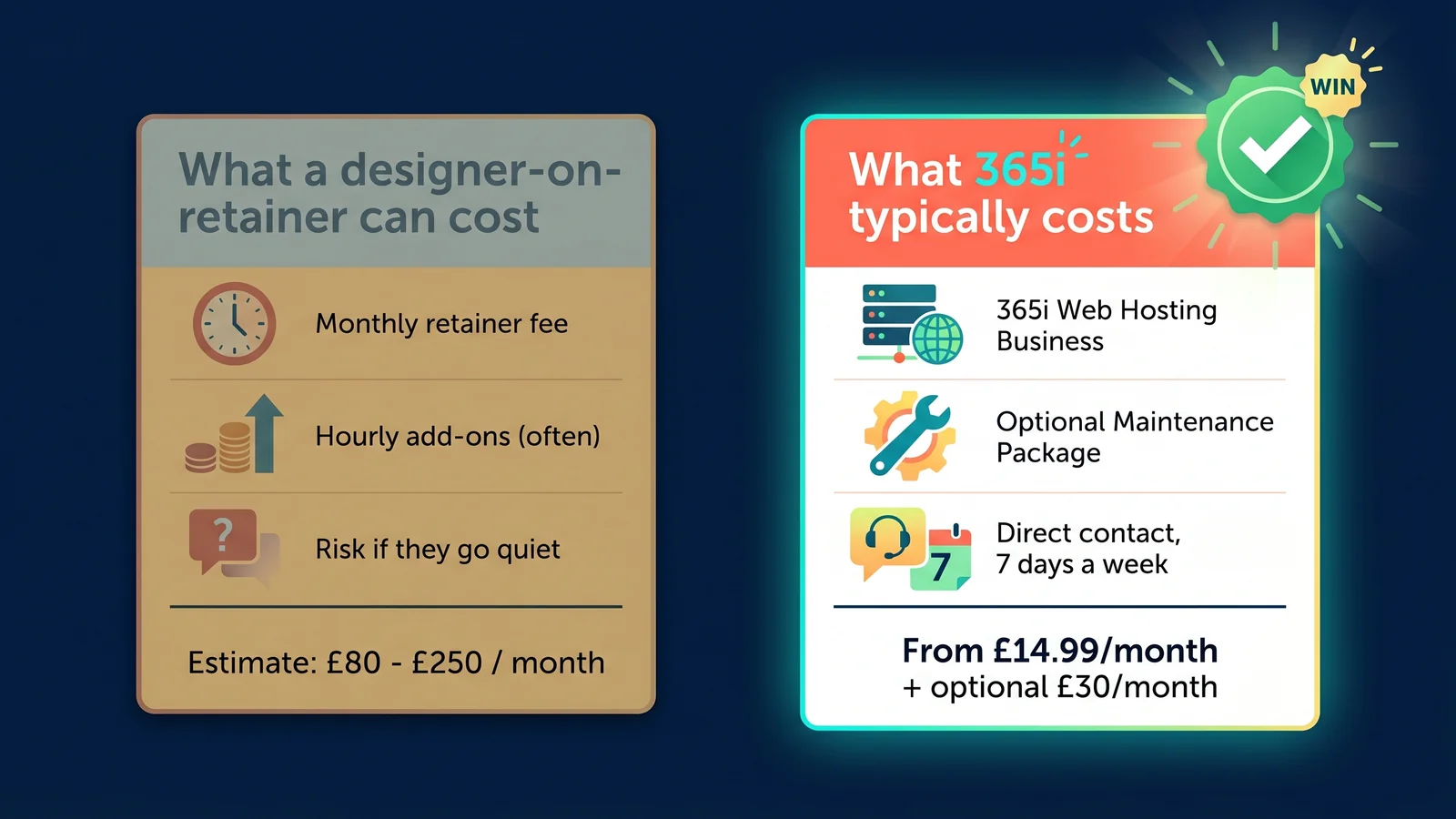
Most small-business owners we take over from a previous designer are surprised by how the numbers work out. Two pieces:
- Hosting. 365i Web Hosting starts at £5.99 + VAT per month and goes up to £14.99 + VAT per month for our Business plan with Timeline Backup included. WordPress sites typically go on WordPress Hosting, which is comparably priced. Renewal price equals the new-customer price (no introductory deal that triples on renewal). Free SSL, free CDN, free migration onto our platform.
- Optional maintenance. If you want us to handle ongoing content updates (like Amy's price-change request in her August 2025 email above), we look after WordPress sites for £30 + VAT a month: all your core and plugin updates, plus up to 20 minutes of content work. You can also pay ad-hoc, no recurring charge, just an hourly rate when you need something. Pick whichever suits how often you change your site.
Most of the takeover customers we look after end up paying us between £15 and £45 per month all-in. That's typically lower, sometimes a lot lower, than what they were paying their designer for the same arrangement. The reason is simple: we are the hosting platform, so we aren't paying a margin to a host above us. We charge for the hosting and the time we spend on your site, and nothing in between.
You don't need to commit to a maintenance package on day one. Most takeover customers start with hosting only and add maintenance later (or not at all). Amy did. Two years passed between her takeover and her first paid maintenance ask.
What We Won't Do
To round out the picture honestly, here's the other side. A takeover isn't a no-questions-asked transfer of someone else's account to whoever asks. There are a few things we don't do.
- We won't take over a website without verifying you're entitled to it. If there's any real dispute about ownership (a business partnership ended badly, a contract was paid for but not delivered, the domain was registered by a third party with conflicting claims) we'll ask you to evidence ownership before we proceed.
- We won't impersonate you with your previous designer. If contact needs to happen between you and them about money owed, intellectual property, or domain transfer, that needs to be your conversation, not ours. We can advise you on what to ask, but we'll do it as your hosting company, not as your representative.
- We won't take sides in a commercial dispute. If you and your designer are arguing about an unpaid invoice or a botched build, we'll keep our part of the takeover technically clean and stay out of the disagreement. The website ownership and the commercial argument are separate matters.
- We won't withhold your site if you later want to leave. The reverse of what you might have just escaped. If a year from now you want to take your website elsewhere, you'll get a clean export and a clean handover with no friction. That's a 365i principle, and it's why Johnny was able to come back and rebuild later: we never tried to keep his old clients from him.
- We won't pretend we can rebuild a botched website for free. Taking over hosting and basic maintenance is included in the move. If your site needs a full rebuild because the original work was poor, that's separate work. We'll be upfront about what's in scope and what isn't, and we'll point you at 365i Web Design or Press Forge (our sister design studios) if you want a quote for that.
Frequently Asked Questions
Can I take over my own website if my designer won't reply?
Yes. The website is yours. The hosting account it sits in might currently be in your designer's name, but the website itself, the domain, and the right to control where it's hosted belong to you as the commissioning party. Most takeovers we handle are completed in 24 to 48 hours from first contact, with the actual platform move taking minutes once we have your account open and ownership verified.
How do I find out who hosts my website?
Run our free HTTP Header Inspector on your domain. The response headers usually identify the hosting platform and any CDN sitting in front of it. For domain ownership, use our WHOIS Lookup. Both are free, no sign-up.
What if I don't have my WordPress admin login?
If we end up handling your hosting, we can reset the WordPress admin password from the server side once the package is in your account. You don't need the existing login. Anyone with control of the hosting can issue a new WordPress admin user. That's part of the takeover.
Do I have to pay my designer's outstanding bills to get my website back?
From us, no. We will not ask you to pay invoices that belong to your designer. If there are arrears on the hosting package, that's a matter between us and the designer, and we'll handle it pragmatically (in Amy's case we settled seven months of arrears with the designer for less than half the full amount, and she paid nothing). If your designer is owed money by you separately for work they did, that's a private matter between you and them.
How long does the takeover usually take?
If your hosting is already with 365i (because your designer used us), the actual package move is typically under an hour once your new account is open and ownership is verified. If we need to migrate from a different host, the technical work is usually completed within a working day, with the DNS switch scheduled when you're ready. Amy's full takeover from first ticket to in-control was 30 minutes.
Why do you contact my designer first? Isn't that slowing things down?
We try to. It usually adds a day or two and sometimes resolves the situation without a takeover happening at all. We do it because the designer is a stakeholder in your website even if they've gone quiet, and treating them with respect is part of how we want to operate. If we can't reach them at all, or if they decline to engage, the takeover still goes ahead. Your site won't be held hostage to an absent designer.
If I move to 365i and later want to leave, can I?
Yes, cleanly, with a full export and no friction from us. We've literally moved customers back to a returning designer (that's what happened with Johnny's clients when he reopened his agency plan). The takeover is a custodianship, not a capture. If you want to leave one day, that's your right and we'll make it easy.
What happens to my business email if we move the hosting?
If your email is hosted on the same package as your website (common with bundled designer setups), it moves with the hosting and we set up your mailboxes on our platform. If your email is hosted separately (with Google Workspace, Microsoft 365, or another provider), the website move doesn't affect it at all. We'll check this up front using your DNS records and tell you which case applies before any change happens.
Stuck with a website your original designer doesn't manage anymore?
If your designer has gone quiet and you want a clean, respectful path to taking your site back, get in touch. We'll talk you through what's possible, try to reach your original designer first, and quote you honestly for what comes next.
Get in touch with 365iPublished: · Last reviewed: · Written by: Mark McNeece, Founder & Managing Director, 365i
Editorially reviewed by: Mark McNeece on · Our editorial standards
Sources and further reading
- How 365i Actually Registers Your Domain (With WHOIS Proof): context on what WHOIS data actually shows for a UK domain registered through a hosting partner.
- WordPress Hosting Support: 11 Real Tickets Inside Our Helpdesk: for the wider pattern of how 365i support actually responds, with timings.
- The Real Cost of Cheap UK Domains in 2026: relevant if your domain is currently registered with a budget registrar on an introductory deal.
- 365i WHOIS Lookup, HTTP Header Inspector, DNS Lookup: free diagnostic tools mentioned in the article.
- 365i Web Design and Press Forge: sister studios that can quote for a full rebuild if your existing site needs more than maintenance.