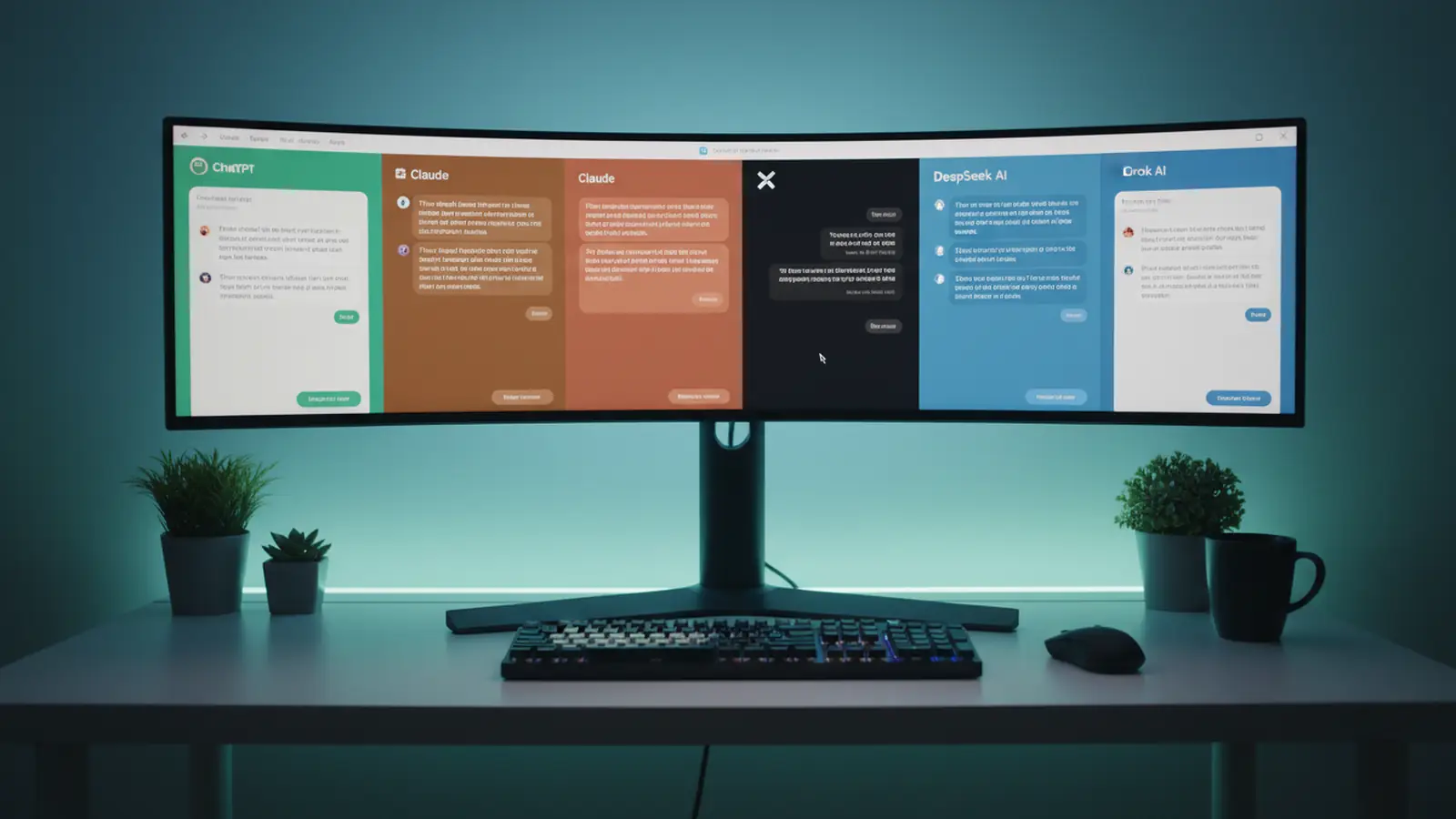
Update (April 2026): This article was first published in April 2025. The model lineup has rotated through several major releases since. The current state of play, in one paragraph: OpenAI is on GPT-5.4 ($2.50 input / $15 output per million tokens). Anthropic shipped Claude Opus 4.7 on 16 April 2026 ($5/$25, 1M-token context at standard pricing) and Sonnet 4.6 in February ($3/$15, leads on office and finance work). xAI released Grok 4 ($2/$15) which now leads SWE-bench coding at 75%. DeepSeek is on V3.2 at $0.28 per million tokens, delivering roughly 90% of GPT-5.4 quality with an MIT licence. The category-by-category verdicts below are from the original April 2025 testing. The pricing table has been updated. For the current head-to-head between Sonnet 4.6, GPT-5.2 and Gemini 3, see our 2026 sister-site comparison.
I've spent the last three months using ChatGPT, Claude, Grok, and DeepSeek for actual business work. Not running benchmarks or comparing spec sheets. Writing real emails, debugging real code, researching real topics, and creating real content for client websites.
Most AI comparisons you'll find online read like spec sheets. Model parameters, context windows, training data cutoffs. That stuff matters to developers. It doesn't tell a business owner which tool will save them the most time on a Tuesday morning when they need a product description written, a spreadsheet formula fixed, or a blog post outlined.
This is the comparison I wished I'd had three months ago. Every ranking comes from hands-on use, not marketing claims.
The Four Contenders

ChatGPT by OpenAI. The one everyone knows. GPT-4o is the current model, with image generation via DALL-E built in. It's the Swiss army knife of AI tools.
Claude by Anthropic. My personal favourite for anything requiring careful thought. Claude excels at nuance, long documents, and research-heavy tasks. It's also the engine behind Claude Code, which I use daily for WordPress development.
Grok by xAI (Elon Musk's AI company). Integrated with X/Twitter, it has access to real-time social media data. Personality-heavy, sometimes at the expense of accuracy.
DeepSeek by the Chinese AI lab of the same name. The dark horse. Surprised everyone with coding abilities that rival GPT-4 at a fraction of the cost. The privacy implications are worth discussing, which I'll get to.
What They Cost
Let's start with the money, because this is where most comparisons are dishonest. "Free tier available" doesn't mean "free for business use." It means "free until you need it for anything important."
| Tool | Current Model | Consumer Plan | API ($ per 1M tokens, in/out) |
|---|---|---|---|
| ChatGPT | GPT-5.4 | $20/month (Plus) | $2.50 / $15 |
| Claude | Opus 4.7 / Sonnet 4.6 | $20/month (Pro) | $5 / $25 (Opus); $3 / $15 (Sonnet) |
| Grok | Grok 4 / 4.20 | $22/month (X Premium+) | $2 / $15 |
| DeepSeek | V3.2 | Generous free tier | $0.28 (effectively flat) |
The 2025 pricing table that originally sat here used pounds and was anchored to ChatGPT Plus at £20/month. A year on, all four providers publish API pricing in dollars and the consumer-tier prices have settled at roughly $20/month for ChatGPT Plus, Claude Pro, and Grok on X Premium+. DeepSeek's API stays the cheapest by an order of magnitude, with V3.2 at $0.28 per million tokens delivering close to GPT-5.4 quality. Claude Sonnet 4.6 at $3/$15 is the value pick for office work and computer use; Opus 4.7 at $5/$25 leads on coding and reasoning. Grok 4 leads SWE-bench coding at 75% but its real-time X/Twitter integration is the differentiator.
Content Creation: ChatGPT Wins, Claude Closes
I tested all four on the same task: write a 500-word product description for a managed WordPress hosting plan, targeting UK small business owners.
ChatGPT produced the most polished first draft. Good structure, natural flow, appropriate level of detail. It needed minor edits but was publishable within 10 minutes. This is ChatGPT's wheelhouse and it shows.
Claude wrote something more thoughtful but longer. It added context I hadn't asked for (comparisons to shared hosting, a note about GDPR compliance) that actually improved the piece. Claude's tendency to think before writing often produces better content, but you'll need to trim it down.
Grok tried to be funny. The result was a product description that read like a Twitter thread with jokes about "boomer hosting." Not what a business wants.
DeepSeek produced competent but bland content. Grammatically correct, structurally sound, but with no personality. Adequate for filler content, not for anything customer-facing.
Verdict: ChatGPT for speed, Claude for quality. If you only subscribe to one tool for content work, ChatGPT gives you the most versatile output.
Coding: DeepSeek Punches Above Its Weight
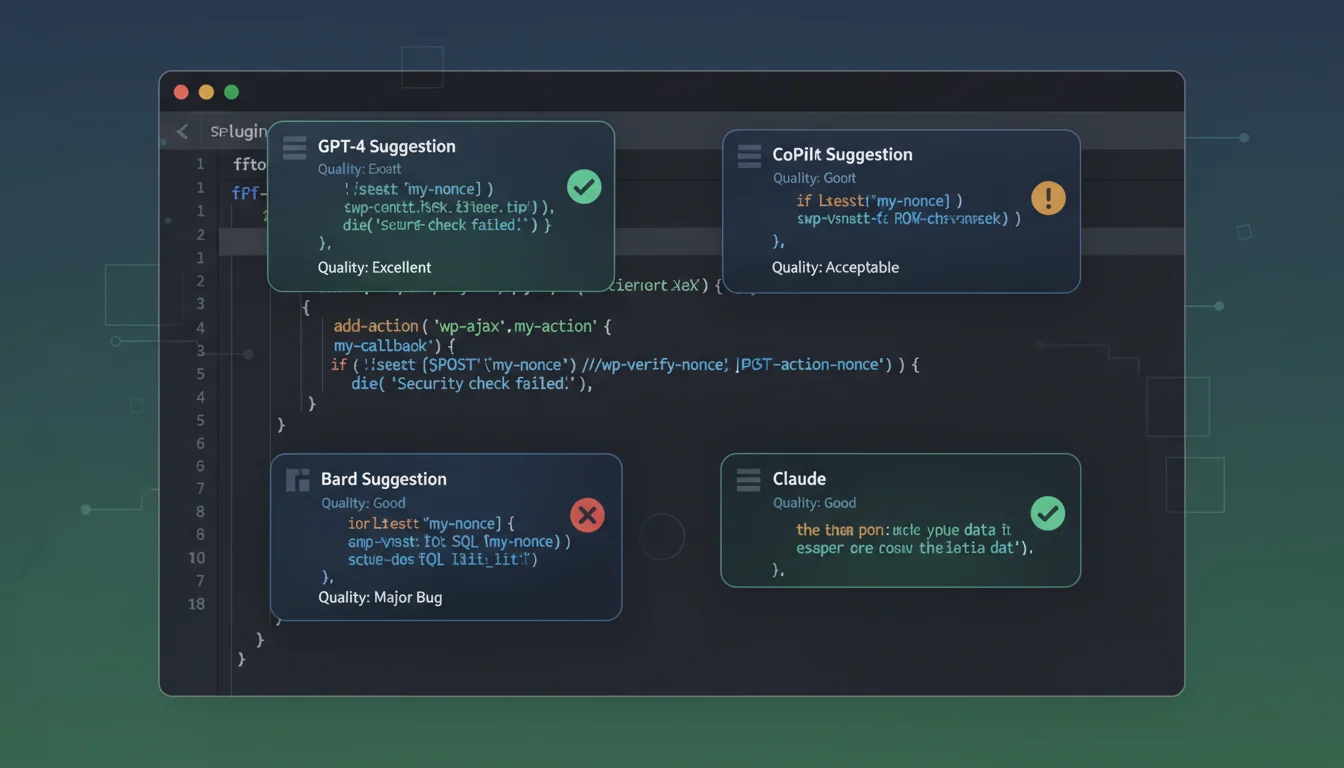
Test: Fix a WordPress plugin that was throwing a PHP 8.4 deprecation warning, then add a new settings page with proper nonces and capability checks.
DeepSeek nailed it. Clean code, proper WordPress coding standards, correct nonce implementation. For a tool that costs almost nothing, the code quality is remarkable. It's become my go-to recommendation for developers on a budget.
ChatGPT produced working code but missed one nonce check and used an older sanitisation function. Good enough for most cases, but you'd need to review it carefully for production.
Claude was the most cautious. It flagged security concerns I hadn't considered, suggested a different approach to the settings page that was more future-proof, and included inline comments explaining every decision. Slower to get a result, but the result was the most maintainable. I use Claude Code extensively for hosting platform development and it consistently produces the most reliable code.
Grok got the basics right but the code had formatting issues and one outright bug in the settings page registration. Not production-ready without significant review.
Verdict: DeepSeek for quick coding tasks, Claude for anything going into production. ChatGPT sits in the middle.
Research and Analysis: Claude Dominates
This is where Claude pulls ahead of everything else. I gave each tool a 40-page PDF about UK data protection regulations and asked for a summary relevant to small business website owners.
Claude produced a structured, accurate summary that correctly identified the three most relevant sections, quoted specific clauses, and flagged two areas where the guidance had changed since the previous version. It even noted a conflict between two paragraphs that a human reviewer might miss.
"The best AI for business isn't the one with the most parameters. It's the one that understands what you're actually trying to accomplish and helps you get there faster."
Ethan Mollick, Professor at Wharton School, One Useful Thing
Mollick's point captures exactly why Claude wins the research category. It doesn't just process text. It understands context and pulls out what actually matters for your specific situation. I've found this consistently true when researching topics for AI visibility articles and technical guides.
ChatGPT gave a competent summary but missed the regulatory conflict and was less precise about clause references.
DeepSeek struggled with the nuances. It summarised the document accurately but at a surface level.
Grok declined to process the full document within the free tier and the summary from the paid tier was the weakest of the four.
Image Generation: ChatGPT Is the Only Serious Option
Only ChatGPT has built-in image generation via DALL-E. Claude doesn't generate images at all (though Anthropic has since added this via API). Grok has image generation but the quality is inconsistent. DeepSeek has no image capabilities.
For business use, ChatGPT's DALL-E integration is convenient but not exceptional. Professional design work still needs professional tools. Where it excels is quick mockups, social media graphics, and blog post illustrations where speed matters more than pixel-perfect quality.
The Privacy Elephant: DeepSeek's Data Problem
DeepSeek is a Chinese company. Your data is subject to Chinese data laws. For casual coding questions, that's probably fine. For anything involving client data, business strategy, or sensitive information, it's a risk most UK businesses shouldn't take.
"When evaluating AI tools, the question isn't just 'what can it do?' but 'what happens to my data after I hit send?' That's especially critical for businesses handling customer information."
Bruce Schneier, Security Technologist, Schneier on Security
Schneier's been writing about this for decades, and it applies perfectly to the AI choice. I'd happily use DeepSeek for public code questions. I wouldn't paste a client contract into it. ChatGPT and Claude both have stronger privacy guarantees for business use, with Claude being particularly transparent about its data handling practices.
If your business handles sensitive data (and most do), stick with ChatGPT or Claude for anything confidential. Use DeepSeek for coding tasks where the input doesn't contain proprietary information. That said, spreading your AI usage across multiple providers is increasingly smart: the Pentagon's recent threat to force Anthropic to drop its safety guardrails shows that political risks can hit even the most trusted vendors without warning.
The Bottom Line: Which One Should You Pay For?

If you're paying for one tool (April 2026 update): Claude Pro at $20/month has overtaken ChatGPT Plus as the all-rounder pick for me personally. Sonnet 4.6 leads on office tasks and finance work, Opus 4.7 leads on coding and reasoning, and the 1M-token context window in both is the most useful single change of the year. ChatGPT Plus at the same $20/month is still the safer choice if you rely on DALL-E image generation in the same subscription. They are both excellent.
If you do heavy research or long-form writing: Claude Pro remains the strongest option. Opus 4.7's 1M-token context and Sonnet 4.6's office-work scores are both unmatched in this category.
If you're a developer on a budget: DeepSeek V3.2 at $0.28 per million tokens still punches well above its price for routine code work. For production code, Claude Opus 4.7 (87.6% on SWE-bench Verified) and Grok 4 (75% on SWE-bench) are the two to weigh up. The data-jurisdiction caveat below still applies to DeepSeek.
Skip Grok unless you're specifically creating content tied to X/Twitter trends. For everything else, the rest of the field has caught up or pulled ahead.
The difference between free and paid AI tiers isn't just features. It's time. A paid tool that saves you 30 minutes a day on content, email, and research pays for itself by the end of the first week. For a small business owner juggling everything, that's not a luxury. It's an investment with measurable return.
Frequently Asked Questions
Which AI tool is best for UK small businesses in 2026?
Claude Pro at $20/month is now the best all-rounder for small business use. Sonnet 4.6 covers office and finance work, Opus 4.7 covers coding and reasoning, and the 1M-token context window is the single most useful change of the past year. ChatGPT Plus at the same $20/month is still the right pick if you rely on built-in DALL-E image generation. Both pay for themselves in time savings within a week of regular use.
Are free AI tools good enough for business use?
Free tiers work for occasional, simple tasks. For daily business use, the message limits, slower responses, and reduced capabilities make them frustrating. The paid tiers pay for themselves in time savings within a week of regular use.
Is my business data safe with AI tools?
ChatGPT and Claude both have business-grade privacy policies and don't train on your data by default (with paid plans). DeepSeek is subject to Chinese data laws, making it unsuitable for sensitive business information. Never paste confidential data into any free AI tier.
What's the difference between ChatGPT and Claude?
ChatGPT is more versatile and polished for everyday tasks. Claude is better at research, analysis, and careful reasoning. ChatGPT generates images; Claude doesn't. Claude handles longer documents better. Both are excellent, just for different strengths.
Is DeepSeek safe to use?
DeepSeek is safe for non-sensitive tasks like public code questions and general knowledge queries. For anything involving client data, business strategy, or confidential information, use ChatGPT or Claude instead. DeepSeek is a Chinese company and your data is subject to Chinese data laws.
Can AI tools replace a web developer?
No. AI tools accelerate development work but can't replace the judgement, architecture decisions, and security awareness of an experienced developer. They're best used as assistants that handle routine coding tasks while humans focus on design and strategy.
Will AI tools improve my website's SEO?
AI tools can help draft content, generate meta descriptions, and research keywords faster. But they can't replace a solid SEO strategy, quality hosting with fast page speeds, and genuine expertise in your subject area. Use AI to speed up content creation, not to replace it entirely.
Fast Hosting for AI-Enhanced Websites
Whether you're using AI to create content or build features, your website needs hosting that keeps up. WordPress hosting with PHP 8.5, built-in CDN, and expert support.
Explore WordPress HostingPublished: · Last reviewed: · Written by: Mark McNeece, Founder & Managing Director, 365i
Editorially reviewed by: Mark McNeece on · Our editorial standards