Most local business websites claim trust. The strong ones publish the evidence.
That distinction has always mattered for readers. It now matters for Google as well. On 15 May 2026, Google added a new official guide on optimising for generative AI features in Search, in which it formalised and expanded its guidance on what it calls non-commodity content. The phrase isn't brand new. Google had used similar wording in earlier writing on helpful, people-first content. What changed in May is that Google now points sites at a single named document and tells them: this is the type of content that earns visibility in AI-powered Search.
Five days before this article went live, Google also released the May 2026 core update, with a stated rollout window of up to two weeks. We'll come back to that later. The core update is not the reason to write this piece. The reason to write this piece is that Google has just published its clearest statement yet on what non-commodity local-business content looks like, and one of our sister-studio clients happens to be a textbook example of it.
We have a name for the test that piece of content has to pass before it earns the kind of visibility Google is now pointing sites toward. We call it The Receipt Test, after a line that recurs through this article: the site is the receipt. If a competitor in the next town can publish your page after swapping one or two words, the page is commodity content. If your page reads like a receipt for work you actually did, with named third parties, dated documents and customers a reader could in principle ring up, the page passes The Receipt Test. The rest of this article is a walk through what passing the test looks like on a live UK locksmith site, mid-core-update.
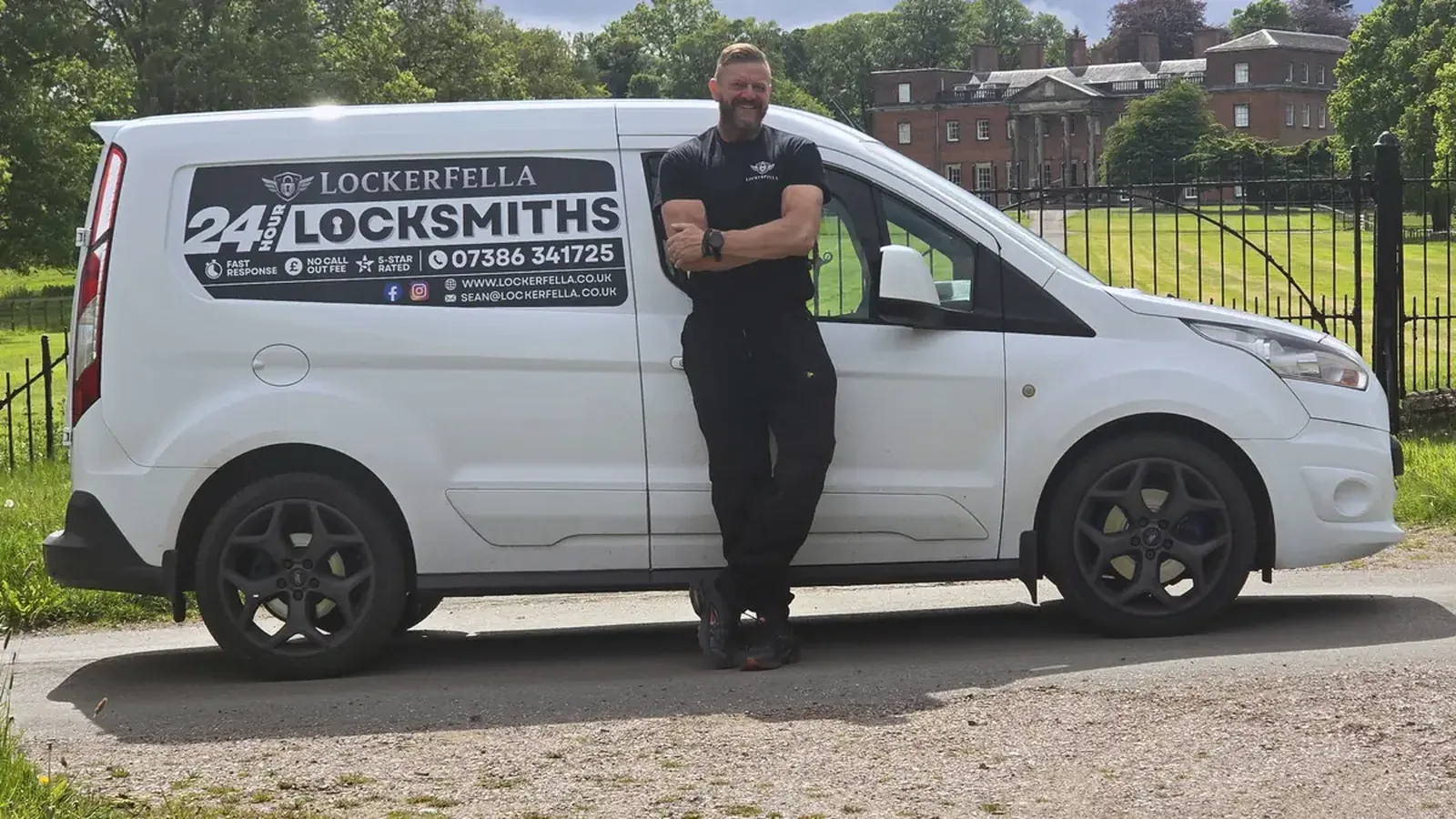
The site we're going to walk through is Lockerfella, run by Sean Hamilton, an independent locksmith based in Brewood on the south Staffordshire / Wolverhampton border. The site was built by Press Forge, our sister website design studio. It is hosted on 365i Linux web hosting. It is not a WordPress site. It is hand-coded PHP, CSS, and vanilla JavaScript. We've covered it before, twice: an on-launch PageSpeed case study and an E-E-A-T build guide that used Lockerfella as one of its worked examples. This piece does not repeat either of those. This one walks the evidence, page by page, against the language Google has just put on the table. (Sean liked the result enough that he later had us rebuild his removals business, Brewood Removals, on the same principles, which we wrote up as a separate case study where we deleted the entire old blog and an independent ChatGPT assessment scored the rebuild 99/100.)
What Google Formalised on 15 May 2026
Here is what Google's official Search Central updates page says about the 15 May release, in its own words:
"Added a new guide on optimizing for generative AI features on Search. Notable new sections include guidance on the importance of providing non-commodity content, tips about providing local, shopping, image, and video content, mythbusting common 'AEO/GEO' misconceptions, initial guidance on AI agents, and more information on why SEO best practices continue to be relevant for success in our generative AI features on Search."
The guide itself defines non-commodity content as material built on direct experience, original research, proprietary data, and viewpoints that cannot be synthesised at a desk by someone reading the top of the SERP. Google's contrast in its own examples is striking. The commodity version of a real-estate post is "7 Tips for First-Time Homebuyers". The non-commodity version is "Why We Waived the Inspection & Saved Money: A Look Inside the Sewer Line". One could be produced by any AI from scraping the top ten results. The other could only be written by someone who actually waived the inspection.
Google's own statement in the new guide is the line worth tattooing on the wall:
"Creating content that people find unique, compelling, and useful will likely influence your website's presence in generative AI search in the long run more than any of the other suggestions in this guide."
For a local business, that's the question to ask of every page on your site. Could a competitor copy this and change one or two words? If yes, it's commodity content. If no, it's the kind of content Google has just told you it cares about most.
The Receipt Test: Claim vs Prove
Read enough local business websites in a row and you start to notice a pattern. The trust language is interchangeable. Every site has it. Almost no site backs it up.
Here is what most local sites publish, alongside what a non-commodity site like Lockerfella publishes instead.
| What most local sites claim | What Lockerfella publishes instead |
|---|---|
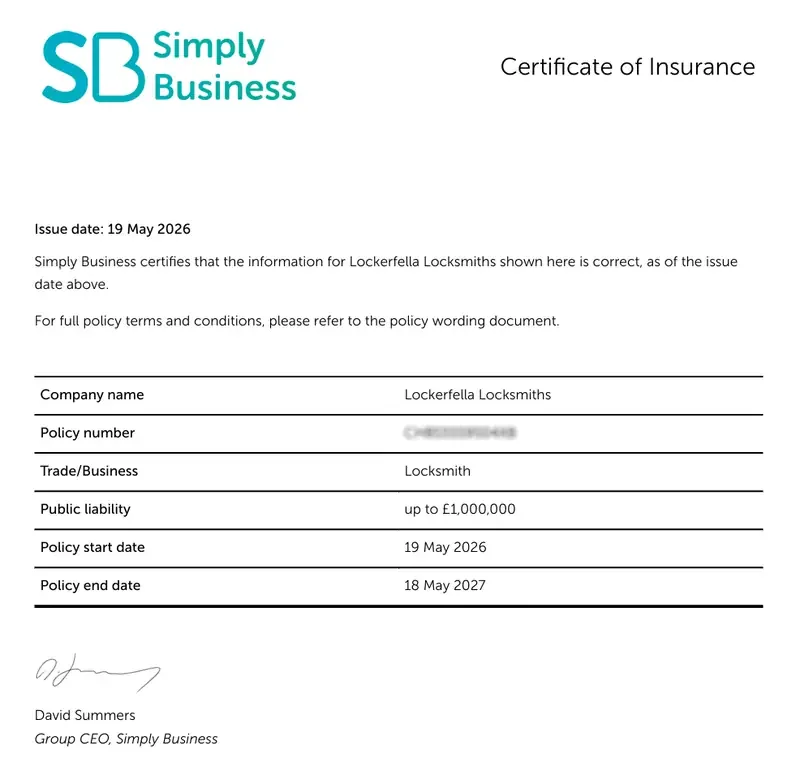
| "Fully insured" | Public Liability £1,000,000 with Simply Business, certificate dated 19 May 2026, valid to 18 May 2027 |
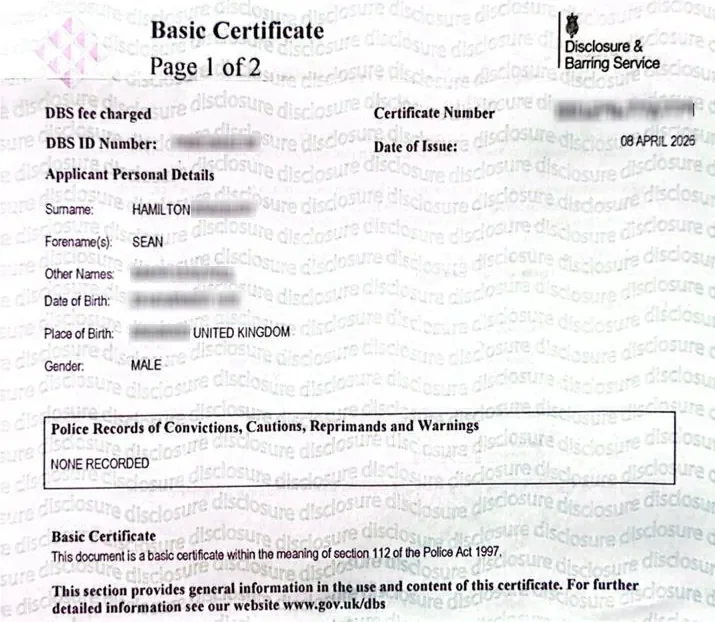
| "DBS checked" | Basic DBS Disclosure issued 8 April 2026, redacted certificate displayed in full on the About page |
| "Fully trained" / "qualified locksmith" | Certificate of Locksmith Skills from A J Am Locksmiths covering cylinder, mortice, padlock, wafer and Euro lock picking, plus re-keying and bypass. Training provider named and linked. |
| "Locks fitted to British standards" | BS 3621 mortice locks. TS007 3-star anti-snap cylinders. Sold Secure SS312 Diamond. Specific products from Avocet ABS, Ultion, ERA Fortress, Yale, Mul-T-Lock and ASSA. |
| "No hidden fees" | "No call-out fee" stated on the homepage. All-in prices quoted on the phone before the van leaves. Daytime rate from £90. Out-of-hours from £170. |
| "5-star service" with no link | 22 verified Google reviews at 5.0 stars (as of 26 May 2026), sourced directly from the Google Business Profile, every review one click away from the original on Google Maps |
| "Local locksmith" | Real address: 6 Rowan Grove, Brewood, Staffordshire ST19 9HR. Real catchment described page-by-page with named streets, lock failure patterns, housing-stock eras and customer callouts. |
| "30 years experience" | "30+ years of personal fascination with locks, now full-time professional. Trained and certified at A J Am Locksmiths in 2026." The wording is honest about which years are amateur interest and which are professional practice. |
Every right-hand row is something a competitor could not template-clone. Every left-hand row is generic and worth nothing on its own. The argument of the rest of this article is that the right-hand pattern is what Google has just told local sites to invest in.
A Real Local Business Site That Ships the Evidence
Lockerfella is a one-person locksmith business. Sean answers the phone himself. Sean drives the van. Sean is the person on the doorstep. The site is honest about all three because dishonest framing rarely survives the first phone call.
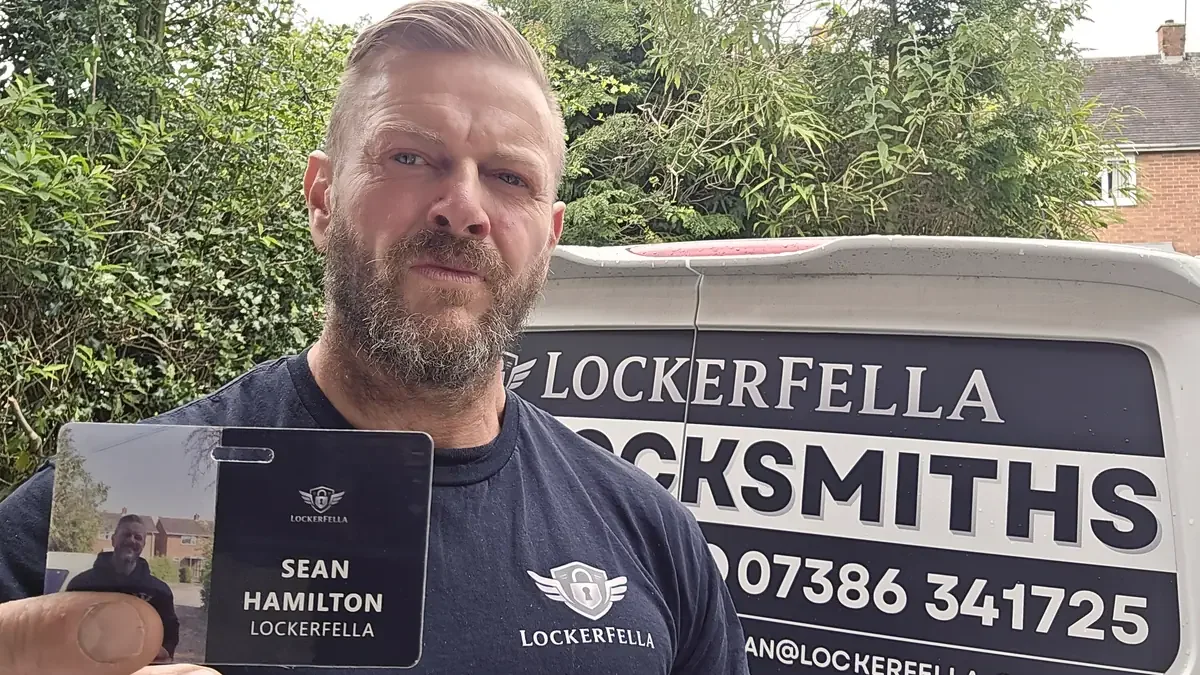
Here's how Sean described the framing in the full Press Forge interview on the sister site:
"I wanted people to land on it and think, 'Right, this bloke looks genuine. He knows what he's doing.' But I also wanted it to sound like me. Not a call centre. Not one of those national locksmith sites pretending to be local. Just me. One man, one van, one phone number. That's how I work, so that's how I wanted the website to feel."
The simplest way to test whether a local business site has anything non-commodity to offer is to look at four things: the area pages, the credentials, the third-party signals, and the dated documents. That's the rest of this article. Each section is one of those.
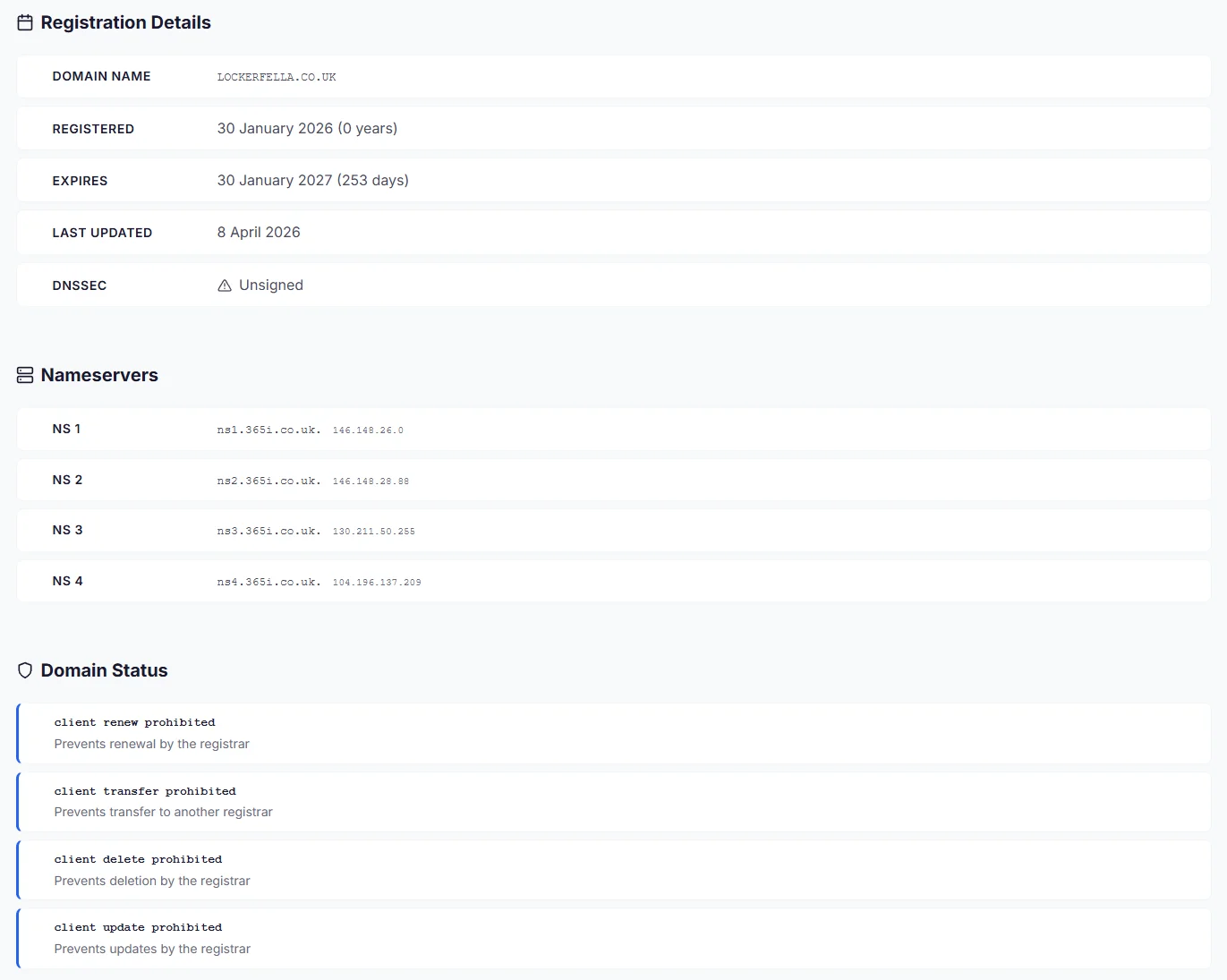
One housekeeping note before we walk the evidence. Domain WHOIS or RDAP records are sometimes presented online as proof of when a website launched. They aren't. RDAP confirms a domain registration date and a "last updated" date. Neither field is, on its own, a site launch date. Sean originally registered lockerfella.co.uk himself via 123 Reg on 30 January 2026, then spent a couple of months attempting to build the site on his own before deciding professional help was the better call. Press Forge took over, ran the design and build, and launched the fully built site on 8 April 2026. The "last updated" date now showing in RDAP is 8 April 2026 because that is when the domain moved to 365i management to sit alongside the new build. The dates align because of the timing of that handover, not because RDAP is a "launch date" field. Independent launch evidence sits across the press coverage at Press Forge, the on-launch PageSpeed case study here on 365i, and Sean's own dated DBS certificate, which we'll see in a moment.
Experience: Area Pages That Read Like the Locksmith Wrote Them
Google's May 2026 guidance is also explicit about something else. It warns against creating separate pages for every search variation primarily to manipulate rankings or AI responses. We're not going to argue here that Lockerfella's area pages are valuable because there are a lot of them. We're going to argue that the strongest area pages are valuable because they're useful, locally grounded, and impossible to template-clone.
Take the Wolverhampton area page. Three named callouts appear on it:
- Caroline Whitehouse, Coalway Road, Penn. February. Cylinder swap on a uPVC door that wouldn't lock after a winter morning of dropped temperature. Quoted on the phone, finished in the afternoon.
- Steve and Yasmin Khan, Bushbury Lane, Pendeford. March. Lockout. An anti-snap cylinder swap and re-keying.
- Mr Lloyd, Tettenhall Road. Saturday morning. A misaligned uPVC door where the multi-point gearbox was the symptom and the dropped door was the cause.
These are not generic case studies. They are specific. They include the customer's name, the street, the month, the symptom, the part, and the fix. They're written from the locksmith's own work diary, which is the only place this content could come from.
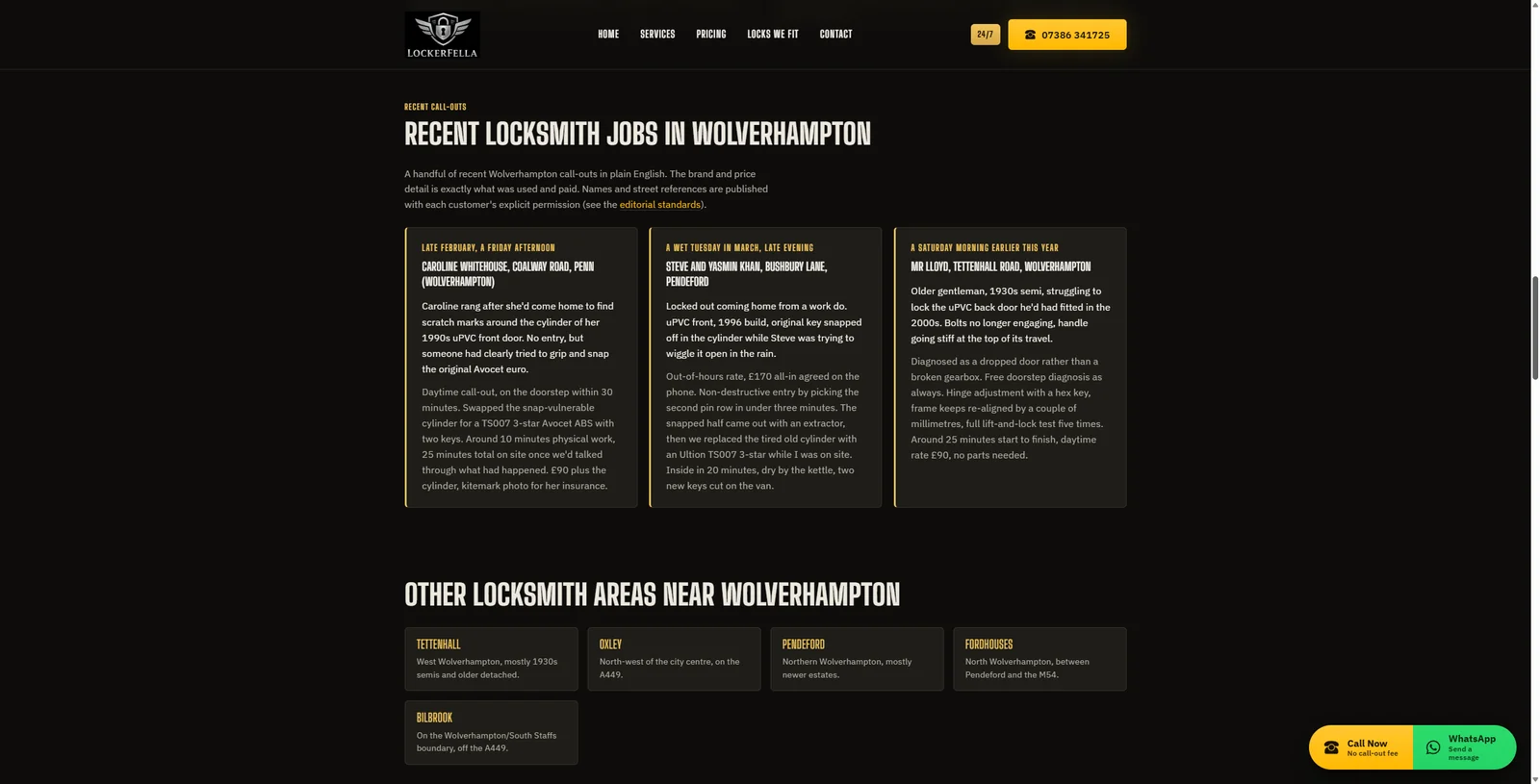
The page also references the local housing stock the way someone who actually services it would: 1920s to 1950s semis and detached houses in Tettenhall and Penn, 1960s to 1990s estates in Pendeford and Fordhouses, the Victorian and Edwardian terraced housing closer to the centre. It names the lock failure patterns the locksmith expects in each, including dropped Fullex, GU, Mila and Lockmaster multi-point gearboxes in the newer builds. It quotes a daytime rate from £90 and an out-of-hours rate from £170. It states a response time of 20 to 35 minutes from Brewood.
None of that survives a template. Swap "Wolverhampton" for "Stafford" and the housing eras change, the gearbox patterns change, the response time changes, the customer names change. Sean said it best in the interview:
"You can read those pages and tell someone's thought about the actual area. Cannock isn't the same as Stafford. Dudley isn't the same as Codsall. Wolverhampton isn't the same as Brewood. And from my side, those differences are real. You do see different doors, different locks, different ages of houses, different problems. It changes what you expect when you turn up."
If you can read an area page on a local business site without telling whether the operator has ever actually worked there, the page is commodity. If you can read it and learn something about the place you didn't know before, it isn't.
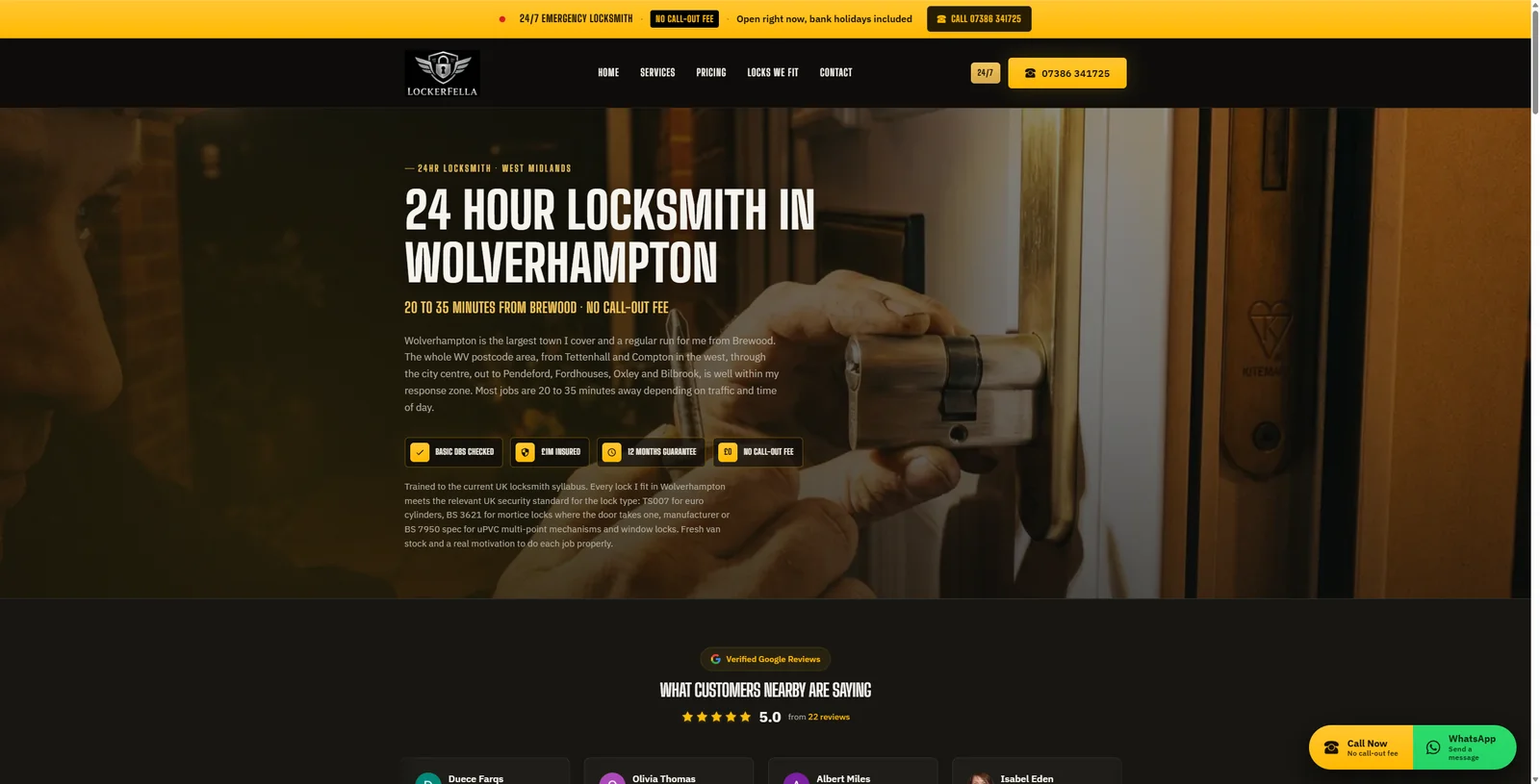
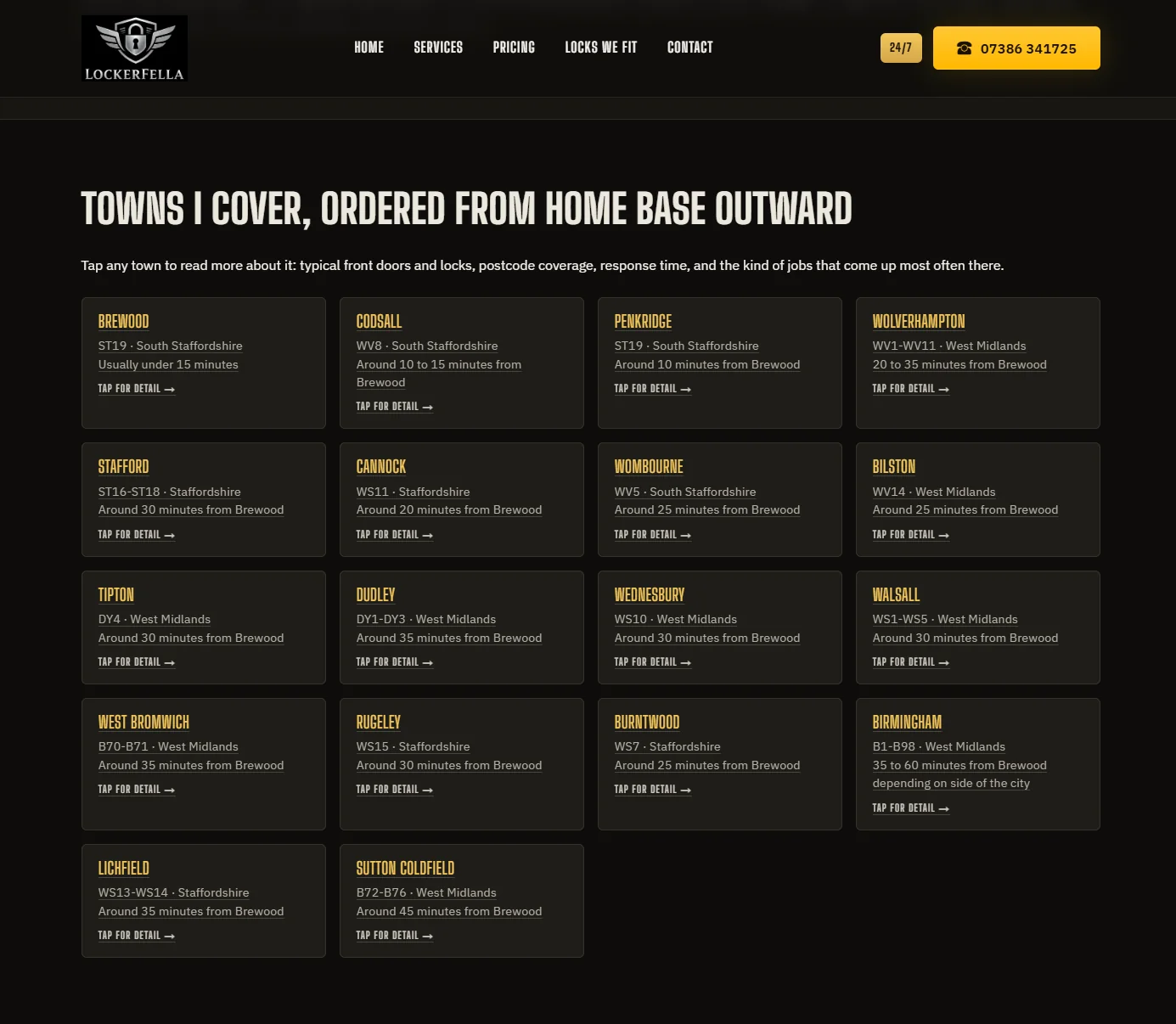
The areas hub itself is worth a look for one reason and one reason only: it isn't a thin list of links labelled "areas we cover". Each area on Lockerfella has a dedicated page with its own structure and its own evidence.
Wolverhampton isn't the only worked example. The Penkridge area page follows the same pattern with three different named callouts:
- Maggie Norton, Stone Cross. A 100-year-old mortice on the original timber front door, still working, but her insurer refused to renew without a current BS 3621. February afternoon. £90 plus lock. 50 minutes on-site.
- Pete and Linda Walker, Wolverhampton Road. Previously quoted £180 elsewhere; paid £90 all-in for an anti-snap cylinder. Two neighbour referrals followed.
- Mrs Begum, Filance Lane. Worn gearbox on a 2010 uPVC. £145 daytime including frame-keep adjustment. 35 minutes.
The page then describes Penkridge in the locksmith's own framing: the conservation area around the church with properties dating back to the 18th and 19th centuries, contrasted with the 1970s-onwards estates of uPVC fronts with multi-point gearboxes, and "about 10 minutes from Brewood" repeated as a deliberate proximity signal. This is the page that earned the ChatGPT citation we'll look at in the AI Search Visibility section. None of it is template content.
Expertise: Named Training, Named Standards
Expertise on a local business site usually shows up as a sentence like "fully trained" or "qualified" or "30 years experience". The strong version of expertise names the training provider, the standards covered, and the specific products the operator works with.
Sean's About page credits the training to a named provider: A J Am Locksmiths, with a Certificate of Locksmith Skills covering cylinder lock picking, mortice lock picking, padlock and wafer lock work, euro cylinder picking, re-keying, and bypassing and changing of mortice locks. It names the British and European standards that the security work is done to: BS 3621 mortice locks, TS007 3-star anti-snap cylinders, and Sold Secure SS312 Diamond.
The site also has a dedicated Locks We Fit page that names the manufacturers and product families. Avocet ABS. Ultion. ERA Fortress. Yale. Mul-T-Lock. ASSA Abloy. Brisant. Fullex, GU, Mila and Lockmaster for multi-point gearboxes. None of that is window dressing. Those are the names a customer searching for a particular cylinder spec might also be searching for, and they are referenced because Sean actually fits them. That's how expertise reads when it isn't padded.

Authoritativeness: Named Third Parties, Not Self-Assertion
The strongest authority signals on any local business site are the ones produced by third parties. Reviews on Google. Insurance with a named provider. Training from a named institution. Press coverage on sites owned by other organisations.
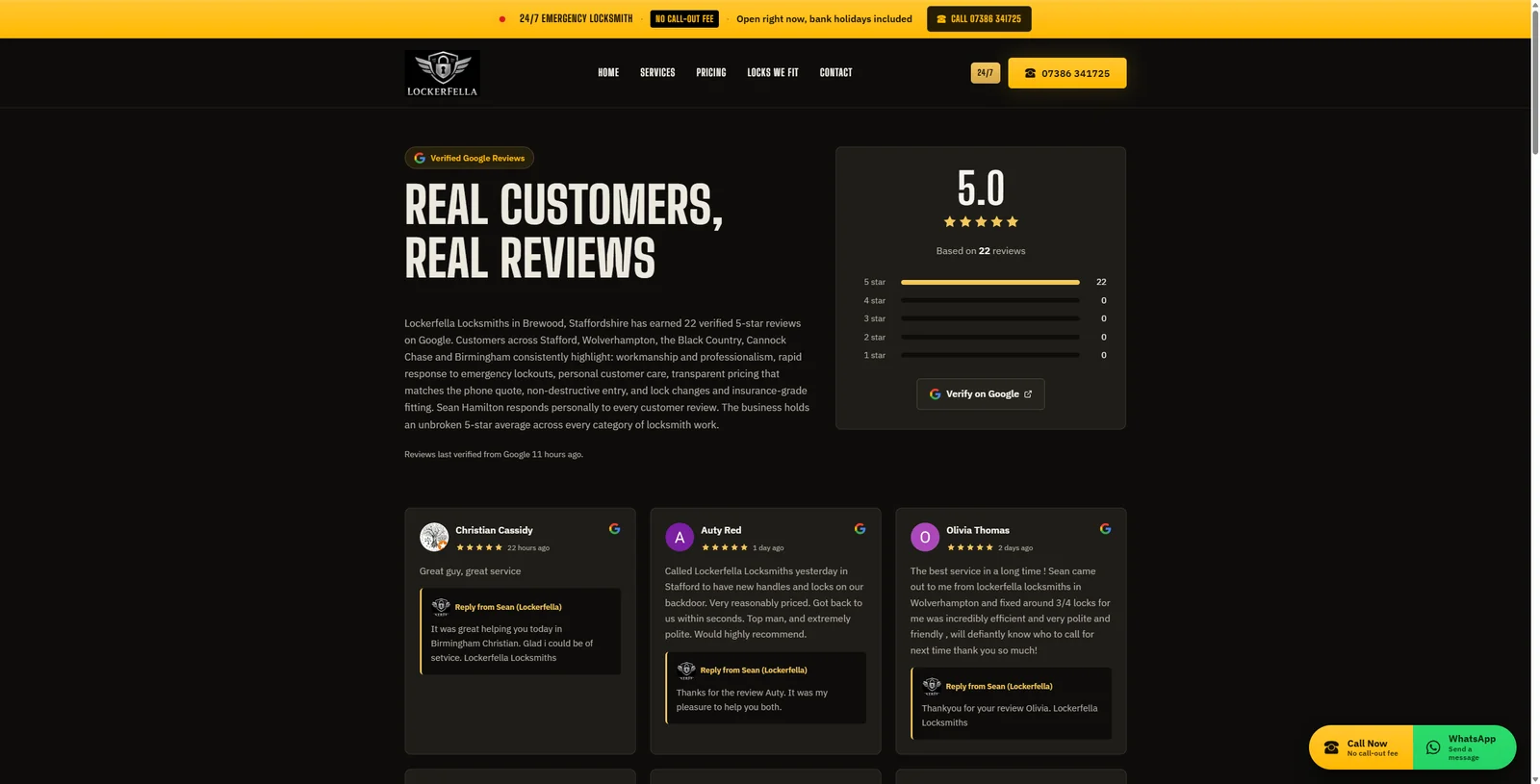
Lockerfella's reviews page reports 22 verified Google reviews at 5.0 stars as of 26 May 2026, sourced directly from Sean's Google Business Profile. The page itself says: "Every review on this page is sourced from the Lockerfella Locksmiths Google Business Profile." Each review is one click away from the original on Google Maps. That last bit matters. If a review on a website isn't linkable back to its source, it's a claim, not evidence.
The insurance is with Simply Business, not some unnamed underwriter. The training is from A J Am Locksmiths, an organisation any customer can phone to ask whether Sean really trained there. The press coverage is on Press Forge, on 365i Web Design, on AI Visibility, and now here on 365i. None of those four publications are controlled by Sean. All four are publicly accessible. All four are dated.
This is the difference between a self-asserted "trusted local business" and a third-party-verifiable one. The first is a tagline. The second is a paper trail.
One service page on the site deserves a callout in this section because it leans hard on external authority signals other than Sean's own. The Locksmith Scams page documents seven repeating rogue-trader patterns in the UK locksmith industry. It cites the Master Locksmiths Association's reporting of a 66% rise in overcharging complaints between 2021 and 2025. It uses real comparative figures: scam doorstep bills of £300 to £600 versus honest costs in the £85 to £200 range. It names the structural problem in plain English: the UK locksmith trade is unregulated, and call-centre operations take 30 to 40 per cent referral fees from the locksmiths they dispatch.
And it carries the line that, in retrospect, prefigured the whole framework of this article in Sean's own words: "The price I quote on the phone is the price on the receipt." A non-commodity service page on a local business site rarely looks like an SEO landing page. It looks like a piece of consumer journalism the operator wrote because they got fed up with what was on the rest of the SERP.
Trustworthiness: Dated Documents, Transparent Pricing
If experience, expertise and authoritativeness are the three things you build up over time, trustworthiness is the one you have to display every day. It's the readable, dated, scrutiny-resistant version of the business.
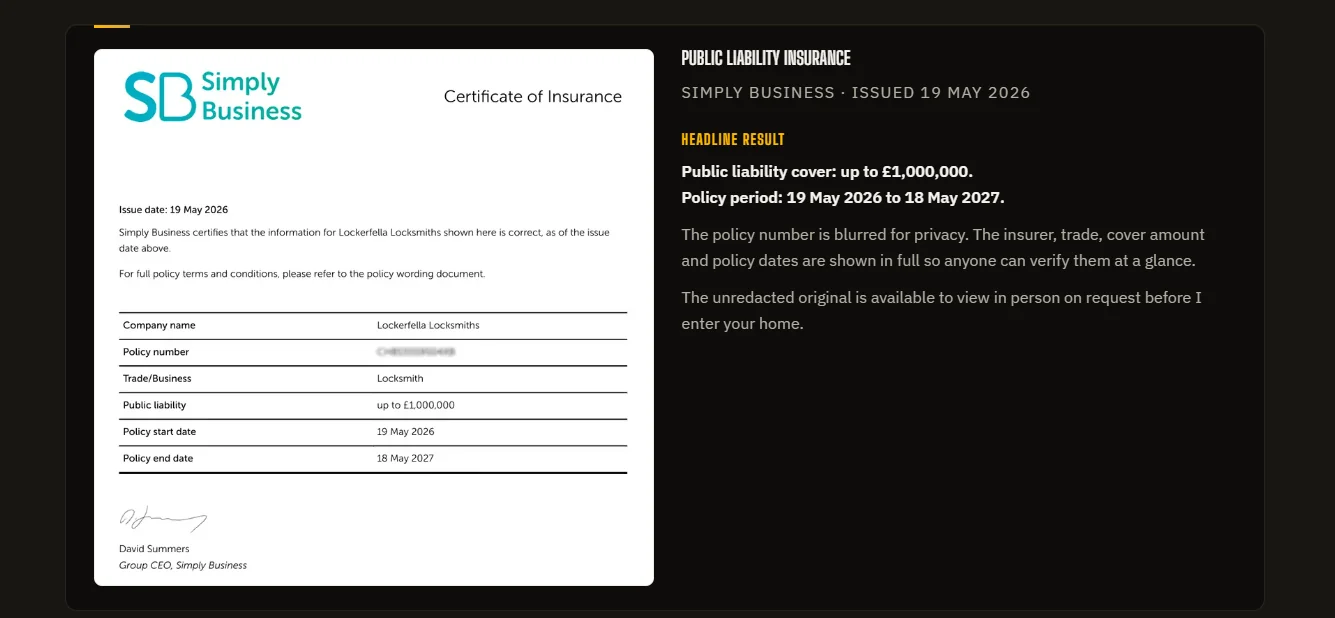
On Lockerfella, that means three things. The DBS Basic Disclosure, dated 8 April 2026, displayed as a redacted certificate on the About page, with the original available on request in person. The public liability certificate from Simply Business, showing £1,000,000 of cover dated 19 May 2026, valid to 18 May 2027.
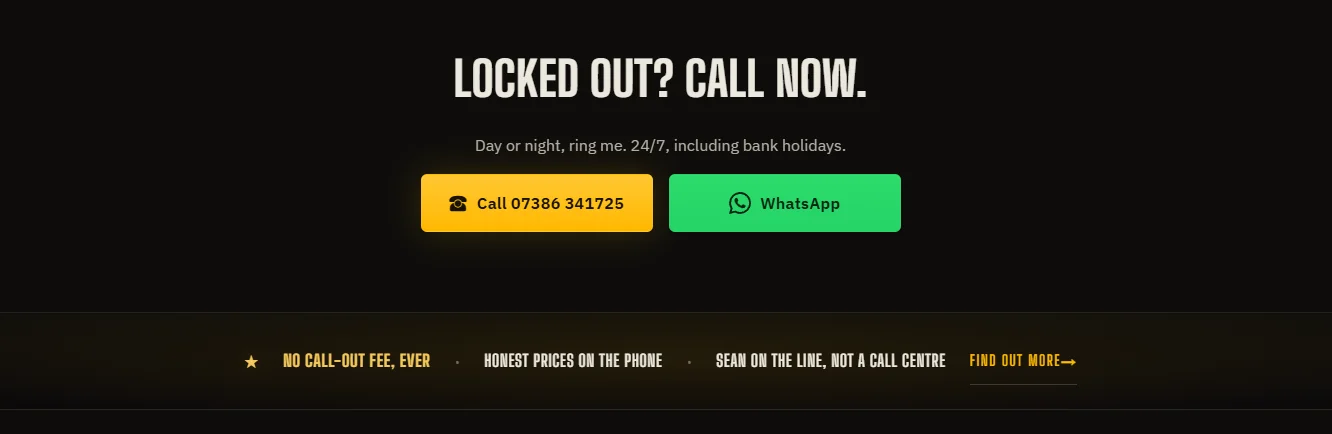
And the pricing. Sean has built the pricing transparency into the homepage itself, not buried it in a small-print page. "No call-out fee, ever." All-in prices quoted on the phone. No VAT on top because the business is not VAT-registered. Sean's view on why this matters, in his own words from the interview:
"It winds me up because it makes life harder for everyone who is trying to do the job properly. If someone has had a bad experience before, or they've heard horror stories, you can hear it in their voice when they ring. They're already suspicious before you've even said hello. And I don't blame them. If you're locked out or your door won't secure, you're vulnerable. You're stressed. You might have kids with you. It might be late. You need help, and that's when some people take advantage. I think that's unforgivable. I don't want Lockerfella to be anything like that. I want people to know the price before I get in the van wherever possible."
One last trust artefact, and it's the rarest one on a local business site of any kind. Lockerfella publishes its own Editorial Standards page. Most multi-million-pound brands don't. Sean's is written in plain English, last reviewed 22 May 2026, and is honest about what editorial review looks like on a one-person business. It names Sean as the sole author and reviewer. It declares 365i's role as technical and typographic assistance. It acknowledges the structural limitation that a single-locksmith site cannot have a separate editorial reviewer, and treats that as a transparency obligation rather than something to hide. The page covers what gets reviewed, how facts get sourced, how customer-callout details are anonymised, and how the AI discovery files alongside the site are kept in sync with what the workflow actually does.
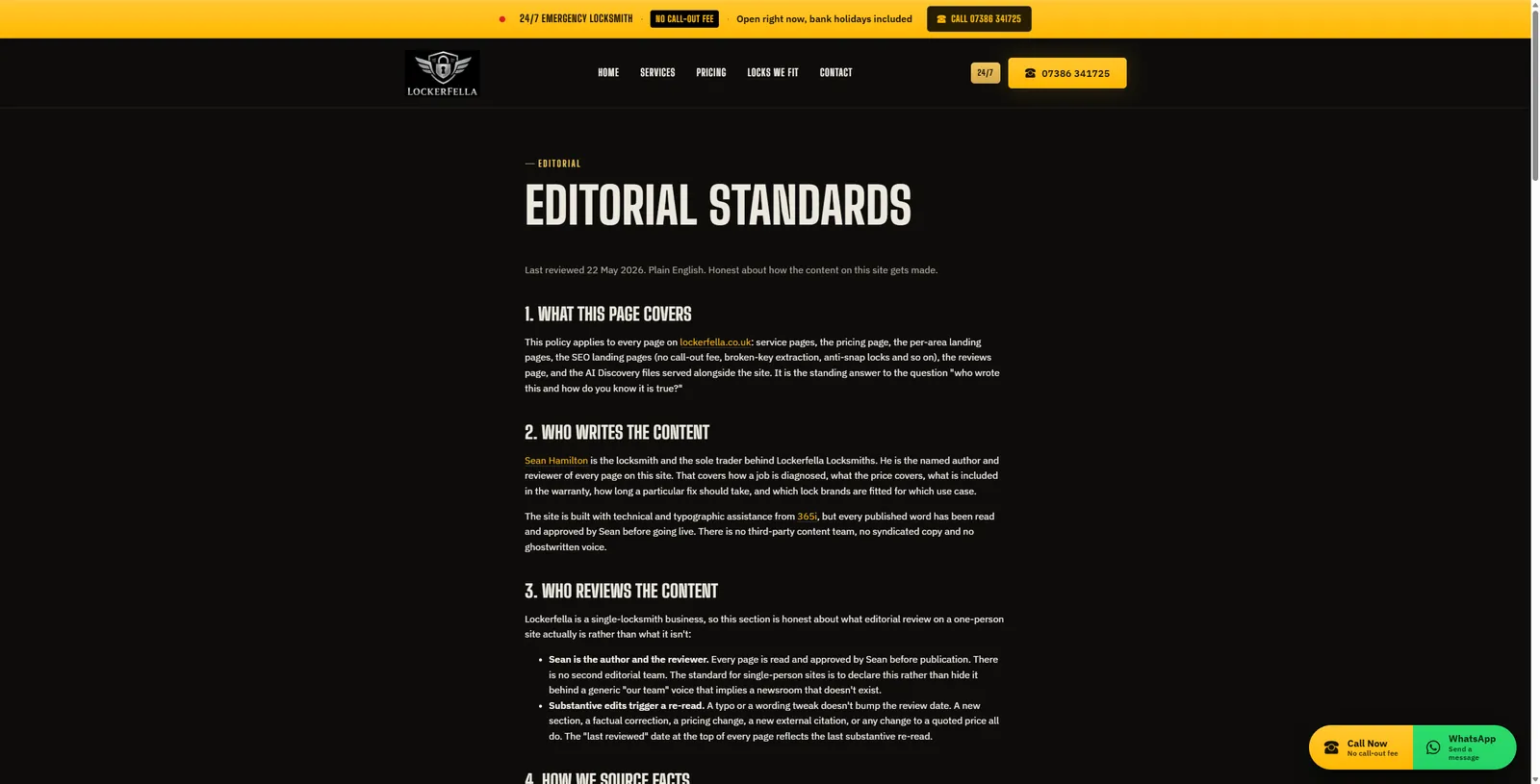
That page is, in itself, the strongest single example of The Receipt Test in this article. A locksmith publishing an editorial-standards page is the website-content equivalent of a tradesperson handing you a written quote before they start. It is not required. It is not common. It exists because Sean wrote it.
AI Search Visibility: Where the Receipts Show Up
The whole point of writing down the evidence is so something can pick it up. Customers do, when they read the site. Increasingly, so do the AI engines that decide which sites get cited in front of customers. The question for any non-commodity argument has to be: when the engines look at the work, do they cite it?
The screenshots and table below were captured on 23 May 2026, three days before this article went live and two days into the May 2026 core update rollout. Two caveats up front. First, the core update is still rolling out as we publish, so any of these results may shift. We're not going to dress these up as permanent rankings. Second, Lockerfella is a six-week-old website at the time of writing. None of what follows is a finished story. What it is, is a snapshot of how the engines are reading the published evidence right now.
Across nine queries we captured on the morning of 23 May 2026, the pattern is consistent: Lockerfella is the named first option for the local searches closest to Brewood, and a named credible option further out into the West Midlands.
| Query | Platform | Position / framing |
|---|---|---|
| locksmith Brewood | Google organic | #1 organic with the "No Call-Out Fee" page snippet, plus the Google Business Profile knowledge panel |
| locksmith Brewood | Google AI Mode | #1 named source ("Independent Domestic Locksmiths"), Lockerfella featured at the top of the sources panel |
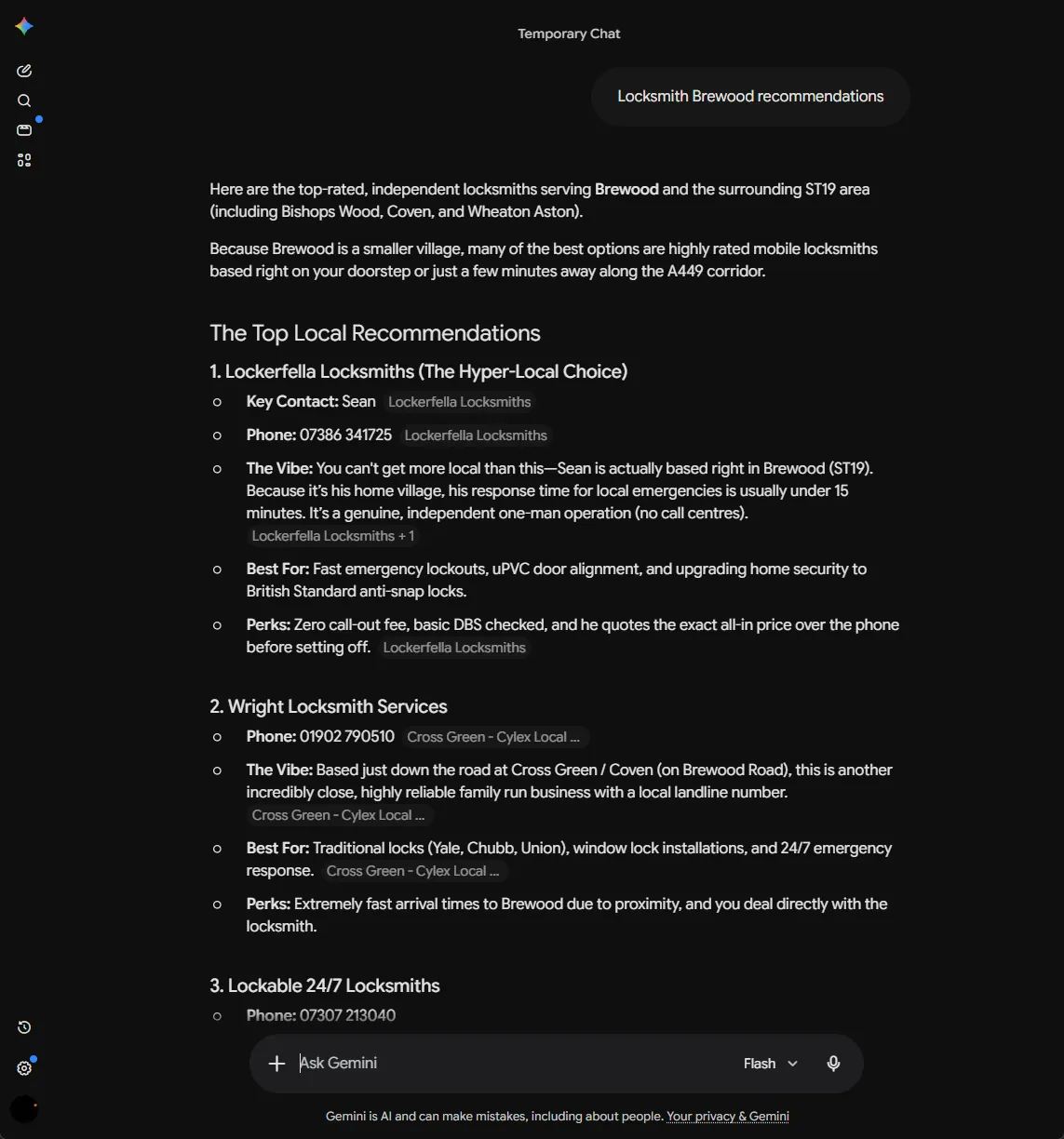
| Brewood locksmith recommendations | Gemini | #1, explicitly labelled by Gemini as "(The Hyper-Local Choice)" |
| locksmith Penkridge | Gemini | #1, called out for transparent fixed pricing and no VAT |
| who is the best locksmith in Penkridge? | ChatGPT | "The best local locksmith for Penkridge is Lockerfella Locksmiths." Closes: "My pick for Penkridge: Lockerfella." |
| locksmith Penkridge | Google AI Mode | Named in the sources panel for the "24/7 Emergency & Domestic" listing |
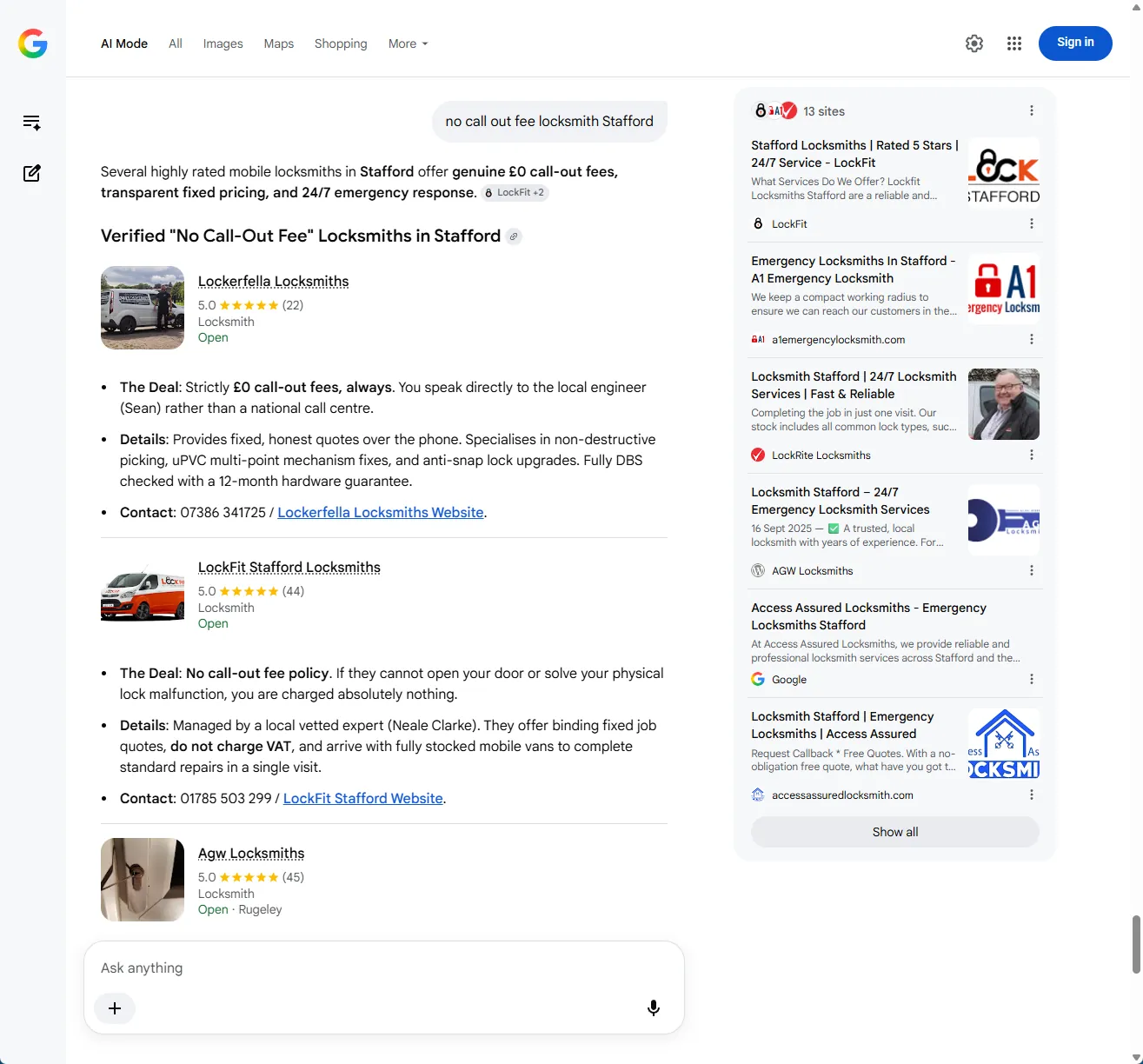
| no call out fee locksmith Stafford | Google AI Mode | #1 result on "Verified 'No Call-Out Fee' Locksmiths in Stafford" |
| emergency locksmith Stafford | Google AI Mode | Cited source in the right-hand panel |
| locksmith in Wolverhampton I can trust | ChatGPT | Named third option, weighed honestly against more-established competitors; recommended as "credible nearby choice, especially if you value direct contact with the locksmith and visible pricing" |
Three of those screenshots are worth reading in full, because the language the engines use about Lockerfella is the language Sean published on the site, not language we wrote on his behalf.
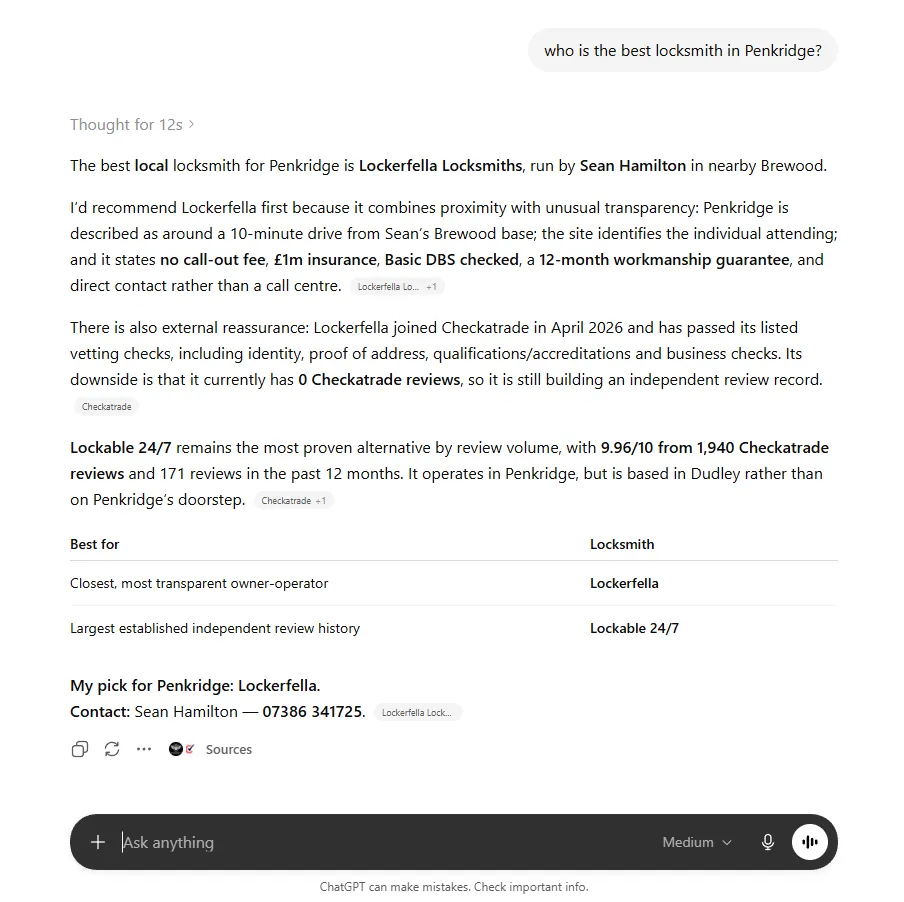
The fourth result worth describing in prose is the ChatGPT response to "locksmith in Wolverhampton I can trust". For that query, ChatGPT recommends Lockable 24/7 first (longest independent review history), JR Locksmiths second (Wolverhampton-based, higher cover, fixed-price claim), and Lockerfella third, with this line: "Lockerfella remains a credible nearby choice, especially if you value direct contact with the locksmith and visible pricing. Its published rates start at £90 daytime and £170 out of hours, with parts itemised separately and the cost confirmed before work begins." Note what the engine is doing there. It isn't ranking Lockerfella first. It's weighing the evidence honestly. The lower review count is correctly identified as a caveat. The transparent pricing is correctly identified as a positive. The recommendation is to choose Lockerfella for the customer who prefers direct contact and visible pricing. That is The Receipt Test working as intended. The receipt is being read.
None of this is a prediction. The core update is still rolling out as we publish. Any of these results can move in either direction over the next nine days of the rollout window. What we will say is this: if a site that's six weeks old, hand-coded, and hosted on £5.99-a-month Linux web hosting can be the named pick for an AI engine on six of nine queries in the geography it actually serves, the Receipt Test approach has done the kind of work most local business sites haven't even started.
There's one final reason the AI engines have an easy time reading Lockerfella, and it's worth naming because it's almost unheard-of on a one-person business: Lockerfella ships the full AI Discovery Files specification. Nine files, served alongside the live site, that machine-readable agents and AI engines can use to identify the business, its services, its pricing model, its brand voice, and its preferred citation format without parsing the rendered HTML.
- /llms.txt (49 KB) and /llms.html (64 KB): the canonical site-summary files in plain text and HTML
- /ai.txt and /ai.json: AI training, usage and citation policy
- /identity.json and /brand.txt: business identity, brand voice and naming conventions for machine readers
- /faq-ai.txt (88 KB, larger than most locksmith websites in their entirety): a machine-readable FAQ corpus
- /developer-ai.txt: technical guidance for AI agent developers
- /robots-ai.txt: AI-specific crawl policy that supplements the standard robots.txt
The specification these files implement is maintained on our sister site at ai-visibility.org.uk/specifications/. None of it is required. None of it would have hurt Lockerfella's ranking by being absent. What it does is give the engines a structured, machine-friendly version of exactly the same evidence the human-readable site already publishes. The Receipt Test, served twice.
Where Structured Data Adds Value
This is a section where the new Google guidance has shifted the conversation in a way that some SEO writing hasn't yet caught up with. Google's May 2026 guide is explicit on one point: structured data is not required for generative AI features in Search. There is no special schema markup needed for AI Search. Anyone telling you otherwise is selling you something.
Structured data still adds value where it accurately mirrors the visible human-readable evidence on the page. On Lockerfella the schema is not doing magic. It is repeating in machine-readable form what a reader can already see.
Here is a fragment of the actual JSON-LD on the Lockerfella About page, in particular the credentials array on the Person entity:
{
  "@type": "Person",
  "name": "Sean Hamilton",
  "jobTitle": "Locksmith",
  "url": "https://lockerfella.co.uk/about/",
  "alumniOf": {
    "@type": "EducationalOrganization",
    "name": "A J Am Locksmiths",
    "url": "https://www.ajamlocksmiths.com"
  },
  "hasCredential": [
    {
      "@type": "EducationalOccupationalCredential",
      "name": "DBS Basic Disclosure",
      "dateCreated": "2026-04-08",
      "recognizedBy": {
        "@type": "GovernmentOrganization",
        "name": "Disclosure and Barring Service"
      }
    },
    {
      "@type": "EducationalOccupationalCredential",
      "name": "Public Liability Insurance (£1,000,000)",
      "dateCreated": "2026-05-19",
      "validFor": "P1Y",
      "recognizedBy": {
        "@type": "Organization",
        "name": "Simply Business"
      }
    }
  ]
}
Three things are worth saying about this fragment.
First, every field maps to something visible. A reader on the About page can see the DBS certificate, see the date, see the issuing body. The schema does not invent any of it. It restates it in a way that machine readers can index reliably.
Second, the structured data uses named third-party organisations. Simply Business. Disclosure and Barring Service. A J Am Locksmiths. None of those are Sean's businesses. None of them are claims Sean can edit. That is what makes the JSON useful: not the format, the named entities inside it.
Third, the schema is part of a wider SEO strategy. It complements, but does not replace, the on-page evidence. If Sean took the structured data off the site tomorrow, the human-readable About page would still be a strong E-E-A-T page.
The May 2026 Core Update Context
Google released the May 2026 core update on 21 May 2026, with a stated rollout window of up to two weeks. The full text of the announcement on Google's official Search Status Dashboard:
"Released the May 2026 core update. The rollout may take up to 2 weeks to complete."
Two things matter about that timing for this article, and one thing very much doesn't.
What matters: this article is being published mid-rollout, eleven days after Google's new non-commodity guide and five days into the new core update window. Anyone reading it now is reading it during the live period of a Google ranking change that has been signposted, in writing, as being about helpful, people-first content.
What also matters: the non-commodity argument doesn't depend on the core update. Even if the May 2026 core update produced no measurable change anywhere, the case for ditching template-cloned trust language and shipping verifiable evidence still stands on its own. Google has now formally pointed local sites at this pattern. That's enough.
What doesn't matter, and what we're not going to claim: that the core update rewarded Lockerfella, or that Lockerfella's visibility was caused by the rollout, or that Google has stated E-E-A-T or non-commodity content is a direct standalone ranking factor. None of those would be defensible from the outside, and there's no need to make them.
Where This Approach Breaks
Three places, off the top of our heads.
Saturated metros. "Locksmith in London" is a different sport. The competitive set is large, established and operating with established backlink graphs. The same non-commodity playbook still helps, but the time-to-citation is longer. Sean himself called this out in the interview, in slightly different words: the playbook landed quickly in Brewood and Wolverhampton because the field was small. It will not land as quickly in central Birmingham or central London.
Faceless service brands. If your business model is a multi-operator franchise with rotating staff, this approach is harder. The named individual is part of the proof. A franchise can still publish the named insurer, the named training provider, the named manufacturers, and the dated customer cases, but the "one person on the doorstep" framing isn't available.
Regulated industries with disclosure constraints. Financial services, healthcare, legal. Some of the evidence patterns we've walked through here are not available because of regulator rules on identification, advertising, or customer privacy. The principle still applies. The mechanism has to be adapted to what disclosure rules actually permit.
None of those break the underlying principle. They change how it has to be implemented.
The Six-Step Methodology, aka The Receipt Test
Here's the version of this that any UK local business can run on its own site, regardless of CMS, hosting, or budget. Lockerfella is hand-coded PHP on standard 365i Linux web hosting. Most readers of this article will be on WordPress. The methodology doesn't care. The same six steps below are what we mean by The Receipt Test in practice.
- Audit your About page for named third parties. For every trust claim ("insured", "trained", "checked"), name the third party who provides the evidence. Display the dated document where possible. If you cannot name anyone outside your own organisation as a source for a trust claim, the claim is doing no work.
- Strip claim-language from your service pages. "Fully insured" goes. "Public Liability £1,000,000 with Simply Business, certificate dated 19 May 2026" stays. Apply the swap across the site.
- Rewrite your strongest area or service page from your own work diary. Pick one. Walk through the last ten jobs you did there. Name the streets, the months, the symptoms, the parts, the fixes, the response times. If two area pages on your site would be improved by swapping their text wholesale, neither is non-commodity yet.
- Publish your pricing where the customer reads it. Homepage, service page, area page. Not a hidden "request a quote" form, not a small-print footer. "No call-out fee" on the homepage is worth ten "competitive pricing" lines in a service block.
- Make reviews linkable back to their source. If your testimonials don't link to Google, Trustpilot, Bark or wherever the customer actually wrote them, they're claims, not evidence. Move every review on your site to a one-click verification.
- Sanity-test every page with one question. "Could a competitor in the next town publish this page after swapping one or two words?" If yes, the page is commodity content. If no, you have something Google's May 2026 guidance has now told you it cares about.
That's it. There's no special schema markup that fixes commodity content. There's no AI optimisation hack that fakes lived experience. The work is the work. The site is the receipt.
Frequently Asked Questions
What is The Receipt Test?
The Receipt Test is our shorthand for the question Google's May 2026 non-commodity guidance has just put on the table for every local business website: could a competitor in the next town publish this page after swapping one or two words? If yes, the page is commodity content. If no, the page reads like a receipt for work the operator actually did, with named third parties, dated documents, and customer cases a reader could in principle verify. The whole of lockerfella.co.uk is a worked example. The six-step methodology in this article is the operational version of the test.
What is non-commodity content?
Non-commodity content is content built on direct experience, original research, proprietary data, or viewpoints that cannot be synthesised at a desk from the top of the SERP. Google formalised the term in its 15 May 2026 guide on optimising for generative AI features in Search. Google's own contrast is "7 Tips for First-Time Homebuyers" (commodity) versus "Why We Waived the Inspection & Saved Money: A Look Inside the Sewer Line" (non-commodity).
How do you show E-E-A-T on a local business website?
Stop claiming it and start publishing the evidence. Name the third parties behind every trust claim. Display dated documents (DBS, insurance, training certificates) instead of generic badges. Write area pages from your own work diary with real customer cases, streets, prices and lock or part types. Make reviews linkable back to their original source. Lockerfella's About and area pages are a worked example of all four.
What did Google's May 2026 guidance change for local business websites?
It didn't introduce non-commodity content as a concept; Google had used similar wording before. What it did was formalise and expand the guidance into a single named document for generative AI features in Search, with explicit sections on local content, image content and AEO/GEO myths. For local sites, the practical implication is that template-cloned area pages and generic trust claims have just been called out, in writing, as the wrong pattern.
Did the May 2026 core update reward Lockerfella?
We don't know, and we don't claim it did. The May 2026 core update was released on 21 May 2026 with a stated rollout window of up to two weeks. This article is being published mid-rollout. Lockerfella's visibility on Google, ChatGPT and Gemini for "Brewood Locksmith" had already been documented before the core update, in the earlier launch case study. What we will say is that the new guide and the rollout, together, make this a timely week to be talking about non-commodity local content.
Where does Lockerfella appear in AI Search results?
Captured on 23 May 2026 (two days into the May 2026 core update rollout), Lockerfella is the #1 organic Google result for "locksmith Brewood", the #1 named source in Google AI Mode for the same query, the #1 result in Google AI Mode for "no call-out fee locksmith Stafford", Gemini's "Hyper-Local Choice" for Brewood, Gemini's #1 result for Penkridge, and ChatGPT's explicit pick ("My pick for Penkridge: Lockerfella.") for "best locksmith in Penkridge". For wider-net queries like "locksmith in Wolverhampton I can trust", ChatGPT weighs Lockerfella honestly against more-established competitors and recommends it for customers who value direct contact and visible pricing. The core update is still rolling out at the time of publication, so these positions may shift. The detailed table and screenshots are in the AI Search Visibility section.
Who built the Lockerfella website?
The site was designed and built by Press Forge, our sister website design studio. It is hosted on 365i Linux web hosting. It is not a WordPress site; it is hand-coded PHP, CSS and vanilla JavaScript. Sean Hamilton owns and operates the business, gives Press Forge editorial direction, and has consented to the public documentation across the case studies on Press Forge, 365i Web Design, AI Visibility and here on 365i.
Is structured data required for AI search visibility?
No. Google's May 2026 guide is explicit that structured data is not required for generative AI features in Search and that no special schema markup is needed for AI Search. Schema still adds value as part of a wider SEO strategy where it accurately mirrors the visible human-readable evidence on the page. On Lockerfella the JSON-LD repeats the same dated credentials and named third parties that a reader can see on the About page. The schema doesn't invent anything new.
Does the number of area pages matter?
No, and the May 2026 guide warns specifically against creating separate pages for every search variation primarily to manipulate rankings or AI responses. What matters is whether each area page contains real, locally grounded content that a competitor couldn't template-clone. Lockerfella's strongest area pages (Wolverhampton, Brewood, Cannock, Stafford, Codsall and so on) carry real customer callouts, real housing-stock detail, real lock failure patterns and real prices. A site with three of those is worth more than a site with thirty templated ones.
Where can I see a real example of a non-commodity local business website?
The whole of lockerfella.co.uk is the example walked through in this article. The strongest single page for the non-commodity argument is the About page, because every trust claim is paired with named evidence. The strongest area pages right now are Wolverhampton and Penkridge, each with three named callouts and detailed local-knowledge framing. The Locksmith Scams page is the strongest example of a non-commodity service page. The Editorial Standards page is the rarest single trust artefact on the site. The reviews page shows what linkable third-party social proof looks like.
Want to build a site that passes The Receipt Test?
Whether it's hand-coded PHP like Lockerfella, WordPress, or anything in between, 365i Linux web hosting gives you the floor every credible local business site needs: fast UK, US & Asia data centres, free SSL, 79 one-click application installs, the Web Optimisations panel, and dedicated 7-day expert support. From £5.99/month ex VAT.
Explore 365i Web HostingSources
Primary Google sources
- Google Search Central updates - 15 May 2026 entry on the generative AI optimisation guide
- Google Search Central - Optimizing your website for generative AI features on Google Search
- Google Search Status Dashboard - May 2026 core update, released 21 May 2026
Live case-study site (Lockerfella)
- Lockerfella - homepage with pricing transparency policy
- Lockerfella - About page with credentials
- Lockerfella - Wolverhampton area page with three named callouts
- Lockerfella - Penkridge area page (Maggie Norton, Pete & Linda Walker, Mrs Begum)
- Lockerfella - areas hub
- Lockerfella - reviews page (22 verified Google reviews at 5.0 as of 26 May 2026)
- Lockerfella - Editorial Standards page (last reviewed 22 May 2026)
- Lockerfella - Locksmith Scams consumer-protection page
AI discovery files (Lockerfella)
- AI Visibility - AI Discovery Files specification (canonical reference)
- Lockerfella - /llms.txt (49 KB) and /llms.html (64 KB)
- /ai.txt, /ai.json, /identity.json, /brand.txt, /faq-ai.txt (88 KB), /developer-ai.txt, /robots-ai.txt
Sister-site coverage
- 365i Web Design - The Full Lockerfella Interview with Sean Hamilton, 30 April 2026
- Press Forge - How Lockerfella reached AI search results in 10 days, 28 April 2026
- AI Visibility - AI Visibility for Small Businesses, 30 April 2026
- 365i - 100 Mobile PageSpeed at Launch: The Lockerfella Case Study, 29 April 2026
- 365i - How to Show E-E-A-T in 2026: A Non-Commodity Build Guide, 24 April 2026
Named third parties (the receipts)
Published: · Last reviewed: · Written by: Mark McNeece, Founder & Managing Director, 365i
Editorially reviewed by: Mark McNeece on · Our editorial standards