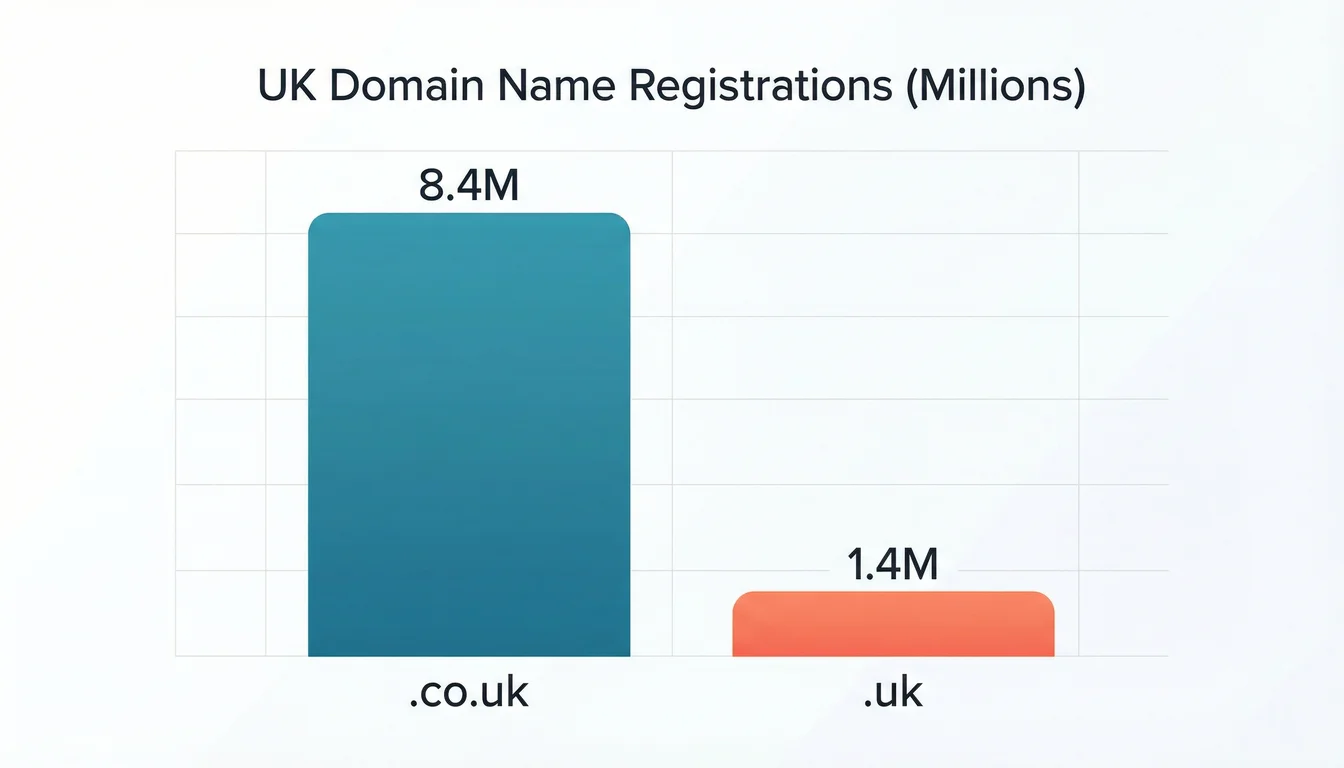
8.4 million businesses use .co.uk. 1.4 million use .uk. That's a 6-to-1 ratio, and it tells you everything you need to know about which extension British consumers actually trust. But the answer to "which should I use?" isn't as simple as picking the popular one.
I've been registering domains for customers since 2002. Back then, .co.uk was the only real option for UK businesses. When Nominet launched .uk as a standalone extension in June 2014, the prediction was that everyone would migrate to the shorter version. More than a decade later, that migration never happened, and the broader extension universe is about to expand again with ICANN's 2026 new TLD round.
Here's what actually matters when you're choosing between the two, backed by real Nominet data and over 20 years of watching businesses get this decision wrong.
The Numbers Tell the Story
Nominet publishes monthly registration statistics. As of January 2026, the UK domain namespace breaks down like this:
| Extension | Registrations | Share |
|---|---|---|
| .co.uk | 8,424,307 | 81.0% |
| .uk | 1,383,807 | 13.3% |
| .org.uk | 363,218 | 3.5% |
| .me.uk | 52,507 | 0.5% |
| Others | 39,132 | 0.4% |
The total .UK namespace sits at around 10.3 million domains. But the split is what matters: .co.uk holds 81% of the market. After twelve years, .uk has captured just 13%.
That's not a failure. It's a clear signal about consumer behaviour. British businesses chose .co.uk when they had the option of something shorter, and they kept choosing it.
Why .co.uk Still Wins on Trust
Recognition drives trust. When someone sees yourcompany.co.uk, they immediately know three things: it's a UK business, it's commercial, and it's been around long enough to have the familiar extension. That last point matters more than it should.
Nominet's own research found that 4 in 5 people searching online in the UK prefer to click on .co.uk websites over other extensions. That's not nostalgia; it's pattern recognition. British consumers have spent 30 years associating .co.uk with legitimate UK businesses.
For B2B companies, local trades (plumbers, solicitors, accountants), and established ecommerce stores, .co.uk carries weight that .uk simply hasn't earned yet. Your customer base expects it. Your printed materials already use it. Your email addresses end in it.
"While .uk offers a fresh, modern, and concise option, .co.uk remains a trusted and familiar choice for UK businesses. Established businesses that rely on a strong, recognisable brand identity may prefer to stick with .co.uk."
Tristan Whittaker, Founder, Infinity3
That matches what I see with our hosting customers. When a business already has recognition and repeat customers, swapping to a .uk domain creates confusion for zero measurable benefit. The shorter URL doesn't convert better. It doesn't rank better. It just looks different.
When .uk Makes More Sense
None of that means .uk is a bad choice. For certain businesses, it's the better one.
Tech startups, creative agencies, app developers, and modern SaaS brands tend to favour .uk. The shorter extension feels cleaner on a landing page, fits neatly in social media bios, and signals a certain kind of forward-thinking identity. If your target audience is under 35 and digitally native, .uk can actually be an advantage.
Personal brands work well on .uk too. marksmith.uk reads better than marksmith.co.uk, and it's easier to say on a podcast or in a meeting.

Quick Decision Guide
| Choose .co.uk if you are... | Choose .uk if you are... |
|---|---|
| A B2B company | A tech startup |
| A local trade or professional service | A creative agency or consultancy |
| An established ecommerce store | A SaaS or app business |
| Targeting customers over 40 | Targeting a younger, digital-first audience |
| Already using .co.uk everywhere | Starting fresh with no existing presence |
The SEO Question: Does Google Care?
Google's Search Advocate John Mueller has been clear on this for years: both .co.uk and .uk are treated as country-code TLDs (ccTLDs). Both provide the same geographic signal to Google that your site serves the UK market. Neither gets a ranking advantage over the other.
The important bit is that both do signal UK relevance, which gives them an edge over a generic .com for UK-focused searches. If you're a Kettering plumber or a London accountant, a .co.uk or .uk domain tells Google your content is meant for British searchers.
Where things get messy is if you run both extensions with different content. Don't do that. Google treats them as separate sites, which splits your authority and creates a duplicate content headache. You can check your crawl rules to make sure you're not accidentally indexing both.
Register Both. Here's Why.
If you take one thing from this article, make it this: register both extensions for your business name.
The cost is trivial. A .co.uk domain and a .uk domain together cost under £15 per year. That's less than a single lunch. And it buys you two things that are worth far more:
1. Brand protection
If you own mybusiness.co.uk but not mybusiness.uk, someone else can register the .uk version. Maybe it's a competitor. Maybe it's a domain squatter who parks ads on it. Maybe it's a scammer running a convincing lookalike site. In any case, you've lost control of half your UK namespace.
Recovering a domain through Nominet's Dispute Resolution Service costs around £750 plus legal fees. Compare that to £7 a year for defensive registration.
2. Traffic capture
People mistype URLs. They forget the "co." part, or they add it when it shouldn't be there. If both versions are registered and redirected properly, you catch that traffic instead of losing it to a blank page or someone else's site.
"A feature of .uk is we don't wait until there's a court order before we take down a site. We work with the law enforcement agencies and take them down at their behest."
Russell Haworth, Former CEO, Nominet (Infosecurity Magazine)
That proactive approach from Nominet means the .uk namespace is one of the most regulated domain environments in the world. It's another reason to keep your brand within it rather than letting someone else claim the variant you didn't register.
How to Set It Up Properly
Once you've registered both, pick one as your primary domain. That's where your website lives, where your emails come from, and where all your marketing points.
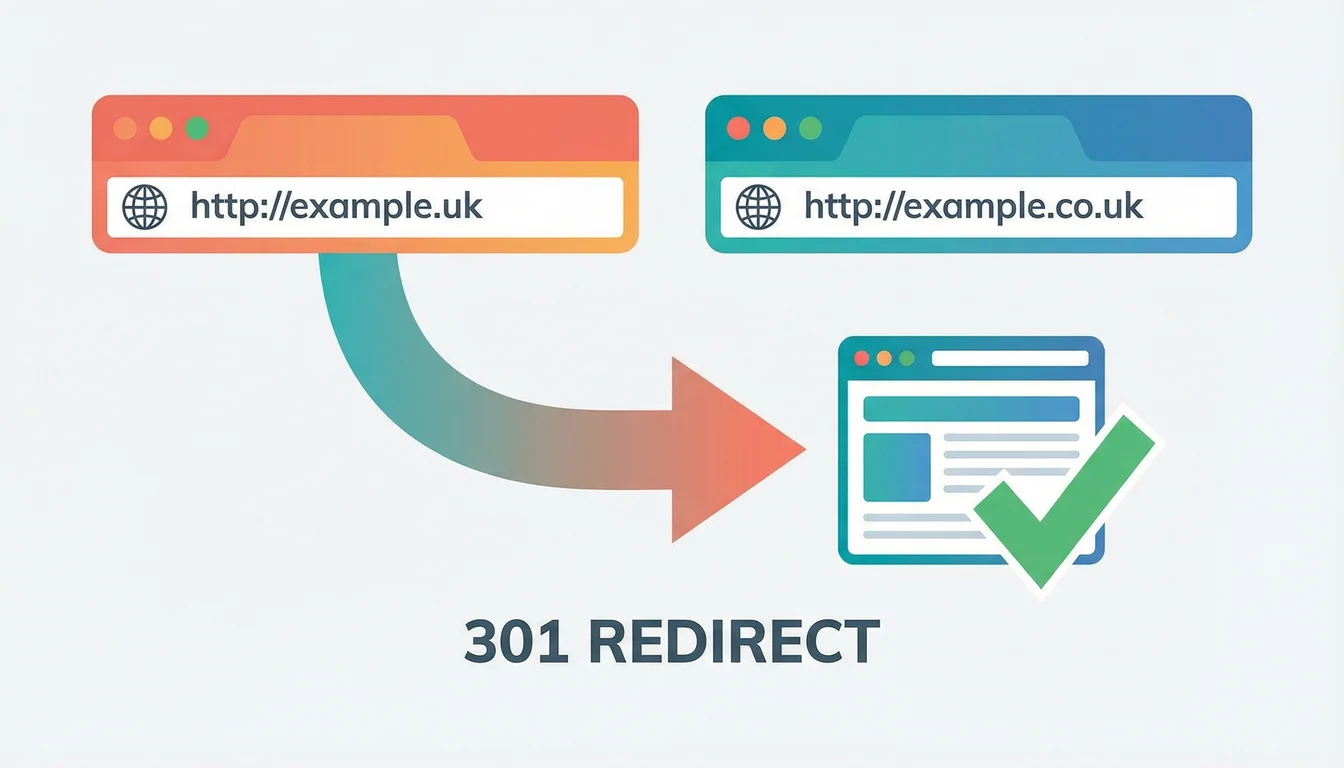
Then set up a permanent 301 redirect from the secondary domain to the primary. This tells search engines (and browsers) that both domains are the same business, and all the SEO value should flow to your chosen primary.
Most hosting control panels handle this in the DNS settings. With the My365i control panel, you can set up redirects and manage DNS for both domains from a single dashboard.
If you want to check how your domain's DNS is currently configured, our free DNS Lookup tool shows every record type and grades your email authentication setup. And our WHOIS Lookup tool can tell you when a domain was registered, when it expires, and who the registrar is.
The History: Why Both Exist
Britain's domain system started with .co.uk in 1985. The "co" prefix stood for commercial, mirroring the way .com works for the global internet. Other prefixes followed: .org.uk for charities, .me.uk for personal sites, .net.uk for networks.
Nominet, which has managed the UK namespace since 1996, launched the shorter .uk extension in June 2014. The idea was that British businesses deserved something as clean as France's .fr or Germany's .de, without the mandatory prefix.
For five years, anyone who already held a .co.uk domain got first dibs on the matching .uk version. That grandfathering period ended in June 2019. Since then, both extensions are available on a first-come, first-served basis.
The transition was supposed to be the big moment. It wasn't. Most businesses either registered the .uk defensively and pointed it at their existing site, or simply didn't bother. The 6-to-1 ratio tells you how that played out.
What About .com?
Some UK businesses register a .com instead of (or alongside) their UK domains. If you're selling internationally, a .com makes sense. But for a UK-focused business, a .com doesn't carry the same local trust signals.
Google doesn't automatically associate .com with any country. You'd need to set geographic targeting manually in Search Console. With a .co.uk or .uk, that targeting is built in.
If budget allows, register the .com as well. But prioritise the UK extensions first. A .co.uk and .uk pair protects your brand in the market that actually matters to you.
And watch out for renewal price traps. Some registrars offer the first year at 99p then charge £12 or more at renewal. Check the renewal price before you register. Before you get to that point, it's worth checking domain availability properly, including trademark searches and domain history, not just whether the name shows as free. If the .co.uk and .uk you want are both already taken, we've covered what to do when your dream domain is taken, including how to grab expiring UK domains for as little as £35.
How 365i Registers Your .uk Domain
365i is a UK domain provider with 460+ domain extensions available. We've been registering UK domains since 2002. The mechanics are open: .uk registrations route through Nominet via our long-standing platform partner 20i Ltd (Nominet-listed registrar, IPS tag STACK), and international TLDs route through Tucows / OpenSRS. The full chain, with a live WHOIS lookup for our own domain, is documented in how 365i actually registers your domain. Our pricing is straightforward: the renewal price is the same as the registration price. No introductory tricks, no surprise markups at year two.
Every domain includes free DNS management and free email forwarding, plus free Nominet WHOIS privacy for UK individuals on .uk domains (under Nominet's consent-based rules, the public WHOIS does not display a registrant's name or address unless the registrant consents; UK individuals are not displayed by default, at no extra cost). WHOIS privacy is also available as an optional add-on on other extensions where the registry supports it. You can manage everything from the My365i control panel alongside your hosting. Already registered elsewhere? Our step-by-step domain transfer guide walks you through moving your domains across.
Frequently Asked Questions
Should I register .uk or .co.uk for a new business?
Register both. Together they cost under £15 per year. Use .co.uk as your primary if you're targeting traditional UK consumers, or .uk if you're a tech startup or creative brand. Redirect the other to your primary site with a 301 redirect.
Does Google rank .uk higher than .co.uk?
No. Google treats both as UK country-code TLDs and gives them identical geographic targeting signals. Neither extension has an SEO advantage over the other. Both signal UK relevance equally.
Should I switch my existing .co.uk site to .uk?
Probably not. Changing your primary domain means updating every link, email address, business listing, and printed material. The SEO benefit is zero. Keep .co.uk as primary and register .uk as a redirect.
Someone registered the .uk version of my .co.uk domain. What can I do?
You can file a complaint through Nominet's Dispute Resolution Service (DRS). If you can prove the domain was registered in bad faith or is being used to confuse customers, Nominet can transfer it to you. The process costs around £750.
Can I use a .uk domain for business email?
Yes. A .uk domain works exactly like .co.uk for email. Set up MX records, configure SPF, DKIM and DMARC authentication, and you're good. The shorter address (name@company.uk) can look cleaner, but either extension works.
How much does a .uk domain cost?
Registration prices vary by registrar but typically range from £3 to £10 per year for both .uk and .co.uk. At 365i, the renewal price matches the registration price with no first-year discounts that inflate later. Check our UK domain pricing page for current rates.
Do customers trust .co.uk more than .uk?
Research shows 4 in 5 UK internet users prefer clicking .co.uk results. The extension has 30 years of brand recognition behind it. For most established businesses, .co.uk carries stronger trust signals with UK consumers.
How do I redirect my .uk domain to my .co.uk website?
Set up a permanent 301 redirect in your hosting control panel or DNS settings. This tells browsers and search engines that both domains point to the same site, and consolidates all your SEO authority on the primary domain.
Register Your UK Domains
Protect your brand with both .uk and .co.uk. 365i offers 460+ domain extensions with free DNS management and email forwarding, plus free WHOIS privacy on every .uk domain.
Browse Domain ExtensionsSources
Published: · Last reviewed: · Written by: Mark McNeece, Founder & Managing Director, 365i
Editorially reviewed by: Mark McNeece on · Our editorial standards