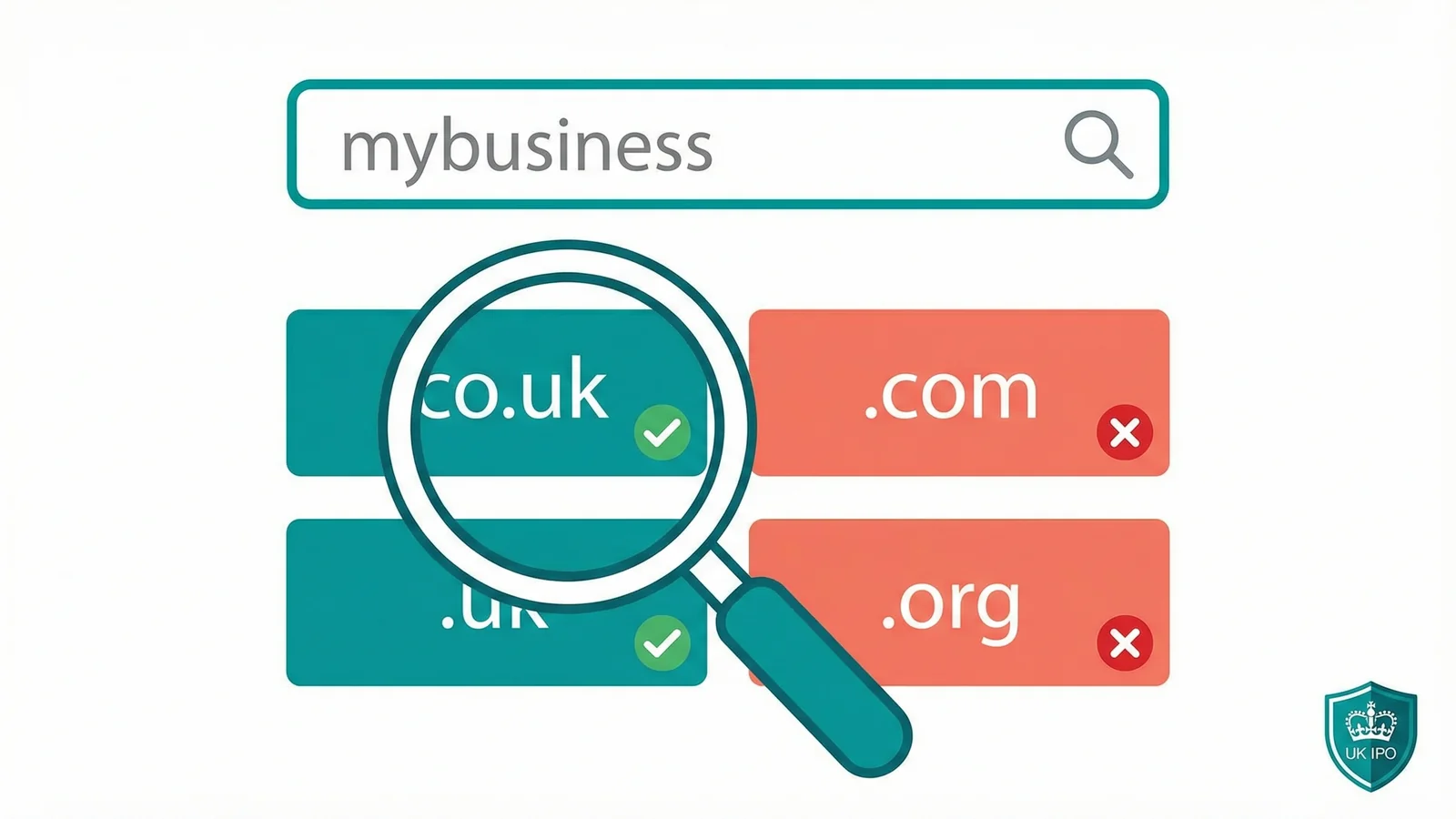
A whole batch of new domain endings is about to land. On 30 April 2026, the Internet Corporation for Assigned Names and Numbers (ICANN) opens its second application round for new top-level domains (the bit after the dot, so everything from .com and .co.uk to newer ones like .shop, .app, and .london). It's the first major expansion of the domain extension list since 2012. Over the 105 days that follow, big brands, cities, communities, and niche registries will be competing to own whatever comes after that dot.
For most UK small businesses, this is going to sound like a story happening somewhere else. The application fee alone is USD 227,000, with another USD 25,000 or so every year to keep the thing running. Nobody we know is queuing up to own .365i. Our launch-day breakdown for UK SMEs covers what to do on 30 April if you're not one of the applicants. But the round still matters, and not for the reason most coverage is focusing on. The interesting shift is what it does to brand identity, consumer trust, and, quietly, how AI systems like ChatGPT, Claude, and Gemini decide whose website to cite when they answer a question.
We've been selling domain names to UK businesses since 2002. We currently stock 460 extensions. Over the next five years that number is going to climb sharply. Here's what's actually happening, and what it means for you.
What is a new domain extension?
A domain extension, or "domain ending", is the bit after the final dot. In yourbusiness.co.uk, the extension is .co.uk. The industry term for it is a top-level domain, or TLD. A generic top-level domain (gTLD) is anything that isn't a country code: .com, .org, .shop, .app, .xyz, and the rest. These are the extensions ICANN controls directly, and they're the ones being handed out in the 2026 round.
For decades there were only a handful of generic ones. Then in 2012 ICANN opened the floodgates. The world applied for 1,930 new domain extensions. Around 1,100 made it through evaluation and got delegated. Of those, more than 400 were what the industry calls dotBrands: private extensions owned by a single company for their own use. .google, .apple, .bmw, .barclays, and hundreds more quieter examples.

Why 14 years later?
The 2012 round was messy. There were objections, auctions, trademark disputes, and a long tail of brands who ended up owning a TLD they never worked out what to do with. ICANN spent the years afterwards writing a new rulebook with input from registrars, governments, trademark lawyers, and community groups. The final Applicant Guidebook was adopted at ICANN84 in Dublin and published in December 2025. It runs to several hundred pages and draws on more than 300 separate consensus policy recommendations.
Theresa Swinehart, ICANN's senior vice president for global domains and strategy, put the purpose of the round this way:
"The New gTLD Program: Next Round presents an opportunity for businesses, communities, governments, and others to apply to operate their own secure space online, tailored to fit their organization, community, culture, language, and customer interests."
Theresa Swinehart, SVP Global Domains & Strategy, ICANN. ICANN press release, 20 May 2025.
It's a careful sentence. The word "secure" isn't decorative. One of the strongest arguments for owning your own TLD is that nobody else can register a name on it. It's the digital equivalent of owning the freehold on your whole street rather than renting an office on a shared road. When I first read that line, my first thought was: this is a pitch to boardrooms, not to marketers. And that matches what we're seeing in the pipeline.
The 2012 round: what worked, what didn't
The 2012 round gave us two lessons. The first is that some dotBrands have been transformational for the companies that took them seriously. Barclays is the textbook case. The bank moved its public-facing web presence to home.barclays in 2015, and its registry operations site sits at nic.barclays. Customers click a Barclays link and they end up on a domain nobody else in the world can register. That's a meaningful fraud defence when 94% of login attempts on the internet come from bots, as Cloudflare's 2026 threat report found.
Troels Oerting, Barclays' Chief Security Officer at the time, framed it cleanly when the migration was announced:
"The launch of the .barclays and .barclaycard domain names creates a simplified online user experience, making it crystal clear to our customers that they are engaging with a genuine Barclays site."
Troels Oerting, Chief Security Officer, Barclays. Reported by Kevin Murphy, Domain Incite, 18 May 2015.
That "crystal clear" bit is doing real work. A phishing attacker cannot register login.barclays or secure.barclays. They cannot pretend. The TLD itself is the signal.
The second lesson is harder. For every Barclays there are half a dozen dotBrands that got approved and then gathered dust. Maserati, Zippo, MetLife, Mont Blanc all applied for, got granted, and eventually abandoned their own TLDs. The reasons repeat. The sponsoring executive leaves. Marketing decides customers still type .com out of habit. The technical cost of running a registry never quite justifies itself. Industry people call these the ghost towns of the 2012 round, and the 2026 applicants are being told very firmly: don't apply unless you've got a strategy.
dotBrand, in focus
A dotBrand is a private TLD where the company owns the whole namespace. Nobody else can register a name there. Ever. The company sits as its own registry operator, with full control over who gets to publish under the brand.

In practice, dotBrands aren't really used for public marketing URLs. They're used as infrastructure. Google owns .google but most people never see a .google address in the browser bar; it sits behind internal services and authentication. BMW uses .bmw for campaigns, regional sites, and engineering systems. The pattern is the same across the better-run dotBrands: the TLD is a control layer, not a marketing tagline.
Jennifer Gore, Executive Director of the Brand Registry Group, has described this shift neatly:
"A dotBrand is not simply another URL, but a means of exerting direct control over how a brand operates at the root of the internet."
Jennifer Gore, Executive Director, Brand Registry Group. CircleID, 2025.
The phrase "at the root of the internet" matters. Most security, trust, and branding decisions happen after the DNS lookup. A dotBrand pushes them in front of it. If you own the TLD, every other policy you set flows downstream from it automatically.
What types of new domain extensions are likely to appear
Based on pre-registration filings, public statements, and the advisory firms that represent applicants (Com Laude, CSC, MarkMonitor, Identity Digital, GoDaddy Corporate Domains), we can expect roughly four categories of new domain extension in this round:
- New dotBrand domain extensions. Companies that didn't apply in 2012 and watched their competitors use it as a defensive moat. Expect more financial services, pharmaceuticals, global retail, and big UK names that skipped the last window.
- Community domain extensions. Membership organisations, professional bodies, and regional identities. Think along the lines of things like
.scotor.wales, but narrower: industry guilds, charity coalitions, co-operatives. - Geographic domain extensions. Cities and regions that didn't get their own extension first time round. If you remember
.londonlaunching in 2014, expect a wave of smaller cities to follow. - Generic keyword domain extensions. Words that describe an industry or activity, like
.vet,.cloud, or.dentist. These are the ones that eventually become public namespaces, with domains you can register as a normal small business.
The fourth category is the one that might touch you directly. If a new .accountant or .plumber or .brewery launches in 2028 or 2029, you may want to grab your brand on it before a competitor does. That's not urgent, but it's the thing to start watching for.
Why it probably isn't you applying
Let's be honest about the money. USD 227,000 is the base evaluation fee. That's the cover charge to have your application looked at. The full all-in cost, once you add legal advice, trademark strategy, objection reserves, registry back-end provisioning, ICANN contractual obligations, and ongoing operating fees, is typically between £400,000 and £900,000 over the first three years. This is not an SME decision. It's not really even a mid-market decision. The cost alone narrows the applicant pool to the top few thousand global brands.
There's an Applicant Support Programme with fee reductions of up to 85% for qualifying applicants from underserved regions, but the practical threshold for a UK SME still sits well above what a sensible marketing budget could justify. If someone is pitching you a dotBrand application on an SME budget, it's the wrong tool.
But it still changes your domain strategy
The 2026 round matters even if you're never going to apply. Three practical effects:
First, the .com monopoly keeps weakening. .com used to be shorthand for "a proper business". Over the last decade that has been eroded by .io, .ai, .co, .uk, and the wider alt-TLD ecosystem. Another wave of launches will push this further. If you've been putting off registering the .com of your name because it's taken, 2026 gives you permission to stop stressing about it. Our own .uk vs .co.uk analysis showed UK businesses already treat .co.uk as first-class.
Second, defensive registrations matter more. When a new generic TLD opens in your sector, you may want to register your brand on it as a trademark defence. These are cheap (usually £20 to £80 a year per extension) and they stop someone else passing off. The risk isn't that the new .plumber will become the dominant extension. It's that a competitor grabs yourcompany.plumber and confuses the people searching for you.
Third, monitor what the big brands in your vertical are doing. If your biggest customer or your biggest competitor moves to a dotBrand, they're signalling that they expect higher trust thresholds from the audience. That affects the bar for the rest of the sector.
The AI and trust angle nobody is talking about
Here's the bit that makes this round actually different from 2012. In 2012, the battle was search engine rankings and direct navigation. In 2026, a new player reads every website: AI agents. ChatGPT, Claude, Gemini, Perplexity, and the agents embedded inside them decide which sources to quote when they answer a user's question. And those agents are starting to care about where a page lives.

Research on ChatGPT citation patterns keeps coming back to the same finding: the domains it cites are the domains that other credible publishers cite. The Ahrefs analysis of 75,000 brands found that branded web mentions in authoritative publications had the strongest measured correlation with AI Overview visibility. An ALM Corp study of 30 million sources showed that ChatGPT, Perplexity, Gemini, and AI Overviews all converge on the same trust-weighted pool.
Into that pool, a dotBrand arrives with a built-in advantage: the extension itself is the proof of identity. An agent that sees news.barclays already knows, before reading a single word of the page, that this URL can only have been published by Barclays. No other entity on Earth is allowed to register it. That's a trust signal no amount of AI discovery files or schema markup can match for forgery resistance.
When I first sat with this, it reframed what dotBrand applications are actually buying. It isn't a shinier URL. It's a cryptographically meaningful fence around the company's voice at a time when AI systems are making thousands of cite-or-don't-cite decisions per second. As my sister site explains it, AI visibility is not about being found, it is about being understood. A dotBrand helps an AI understand exactly who is speaking, and that understanding is what gets you quoted.
Phil Lodico of GoDaddy Corporate Domains puts it more plainly in a recent essay on dotBrands as the trust layer for AI agents: an agent operating on a dotBrand should score higher, all other factors being equal, than an agent operating on .com. That's a hypothesis more than a measured finding yet, but it matches the direction of travel across every AI search study published in 2025 and 2026.
What UK SMEs should actually do
Short version: watch, don't panic. Longer version:
- Secure your
.co.uk,.ukand.comfirst. Those three cover about 95% of what UK buyers type. If you haven't registered all three of your core brand yet, do it before anything else. - Set a Google Alert for "new domain extensions 2026" plus your industry keyword. If
.dentistor.surveyorgets applied for, you want to be one of the first to know. - Check your current domains aren't expiring. The real-world risk of a lost domain is ten times greater than the risk of a new domain ending disrupting your market. Our free WHOIS Lookup tool will tell you the expiry date of any domain you own in about five seconds.
- If a new domain extension in your space launches, budget £50-£100 a year for defensive registrations. That's pocket change for brand protection. Register the obvious names (your company, your product, common misspellings), redirect them to your main site, and forget about them.
- Ignore the FOMO pitches. The 2012 round produced a wave of "you must register in every new extension" marketing. Most of the new domain endings from that round never took off. The same will be true in 2026. You don't need
yourbusiness.kitchen.
What we're watching
From our seat as a UK domain provider that's been in this market since 2002, the things we're keeping an eye on are:
- Which UK-specific extensions get applied for.
.londonis already a decade old and has over 90,000 registrations. Expect.manchester,.leeds, or regional equivalents to be on the list. - Whether any UK financial or utility giants go the Barclays route. If another major UK bank follows Barclays into a dotBrand, the argument for treating dotBrand as a trust signal gets stronger.
- Any community domain extensions covering professional bodies.
.gpfor general practitioners,.solicitor,.surveyor. These create defensive-registration opportunities for every SME in the sector. - Pricing and onboarding from the new registries. Some of the 2012 domain endings launched at £800 a year and quietly dropped to £15. We'll see the same pricing churn here, and the savings get passed on to customers.
When the interesting ones open to public registration, we'll stock them on our domains platform and write about them. If you're one of our customers, you won't need to do anything except check the pricing.
Frequently Asked Questions
When does the ICANN 2026 application round open?
The application window opens on 30 April 2026 and closes on 12 August 2026, a 105-day window. The Applicant Guidebook was adopted at ICANN84 in Dublin and published on 16 December 2025.
How much does a new domain extension cost to own?
ICANN's evaluation fee is USD 227,000 per application for your own branded extension. On top of that, most applicants budget between £400,000 and £900,000 across the first three years once you include legal advice, trademark strategy, registry back-end provisioning, and ongoing operating fees of roughly USD 25,000 per year. There's an Applicant Support Programme offering up to 85% discount for qualifying applicants from underserved regions.
Can a small UK business apply for its own domain extension?
Technically yes. Practically, no. The financial and operational thresholds put a branded extension beyond any realistic SME marketing budget. If a vendor is pitching an application to a small business on a five-figure budget, it's the wrong product. Spend that money on your main domain portfolio, security, and brand-building instead.
Will my .com or .co.uk domain become less valuable?
No. If anything, .co.uk and .com remain the most typed domain extensions in the UK by a wide margin. A wider TLD marketplace means more choice, not a replacement. Your existing domain keeps its value and its search rankings.
Do AI chatbots like ChatGPT care what domain extension a site uses?
Increasingly, yes. AI systems weight sources by trust signals, and a branded extension is one of the few unforgeable signals available: only Barclays can publish on .barclays, so a page there is guaranteed to come from Barclays. This is a minor ranking factor today and is likely to grow as agentic browsing matures.
What happened to the dotBrand extensions from the 2012 round?
Over 400 brands applied and were granted their own domain extensions. Some, like Barclays, Google, BMW, and Audi, built real infrastructure on them. Many others, including Maserati, Zippo, MetLife, and Mont Blanc, never found a strategic use and quietly let them lapse. The 2026 round has tighter applicant guidance to reduce the ghost-town effect.
Should I register my brand on every new domain extension that launches?
Only the ones relevant to your industry. Blanket defensive registration across every new extension was a costly mistake in the 2012 round. Register your brand on new TLDs in your sector (for example, a plumber might grab .plumber, an accountant might grab .accountant). Ignore the rest.
When will the new domain extensions from this round be available to register?
Expect the first public extensions from this round to launch from late 2027 through to 2029. Applications go through evaluation, objection, contention, and delegation before public registration opens. dotBrand extensions rarely open to the public at all, so only generic and geographic ones will affect where you can register your name.
Get Your Domain Names Sorted Before the Next Wave
We register 460 extensions today, from .co.uk to .london, .app, .ai, and hundreds more. Transparent pricing, free DNS management, and honest advice from a UK domain provider that has been in the game since 2002. We are open about the chain behind every .uk registration: read how 365i actually registers your domain.
Search Domain NamesSources
- New gTLD Program: 2026 Round - ICANN
- New Research Reveals Marketing Leaders See Strong Potential in gTLDs (ICANN press release, 20 May 2025)
- ICANN Board Adopts Next Round Applicant Guidebook (11 March 2025)
- Barclays confirms move away from .com to new gTLD - Domain Incite, Kevin Murphy
- DotBrands and the 2026 ICANN New gTLD Round - CircleID
- DotBrands as the Trust Layer for AI Agents - GoDaddy Corporate Domains
- Top Brand Visibility Factors in ChatGPT, AI Mode, and AI Overviews - Ahrefs
- Top Domains Cited by AI Search - ALM Corp
- New gTLD Application Window Expected to Open in April - Morgan Lewis
Published: · Last reviewed: · Written by: Mark McNeece, Founder & Managing Director, 365i
Editorially reviewed by: Mark McNeece on · Our editorial standards