On 11 December 2025, Google started rolling out its December core update. Within 48 hours, publishers across the UK and beyond watched their Discover traffic drop to zero. Not a gradual decline. Not a small ranking shift. A complete shutoff.
Some sites lost 98% of their Discover impressions overnight. Others went from 750,000 daily impressions to nothing, with no manual actions, no warnings, and no explanation from Google beyond "routine core update."
I've been running hosting infrastructure for UK businesses since 2002, and I've seen dozens of Google updates cause panic. This one was different. It didn't just change who ranks where. It changed whether sites appeared at all.
What Happened on 11 December
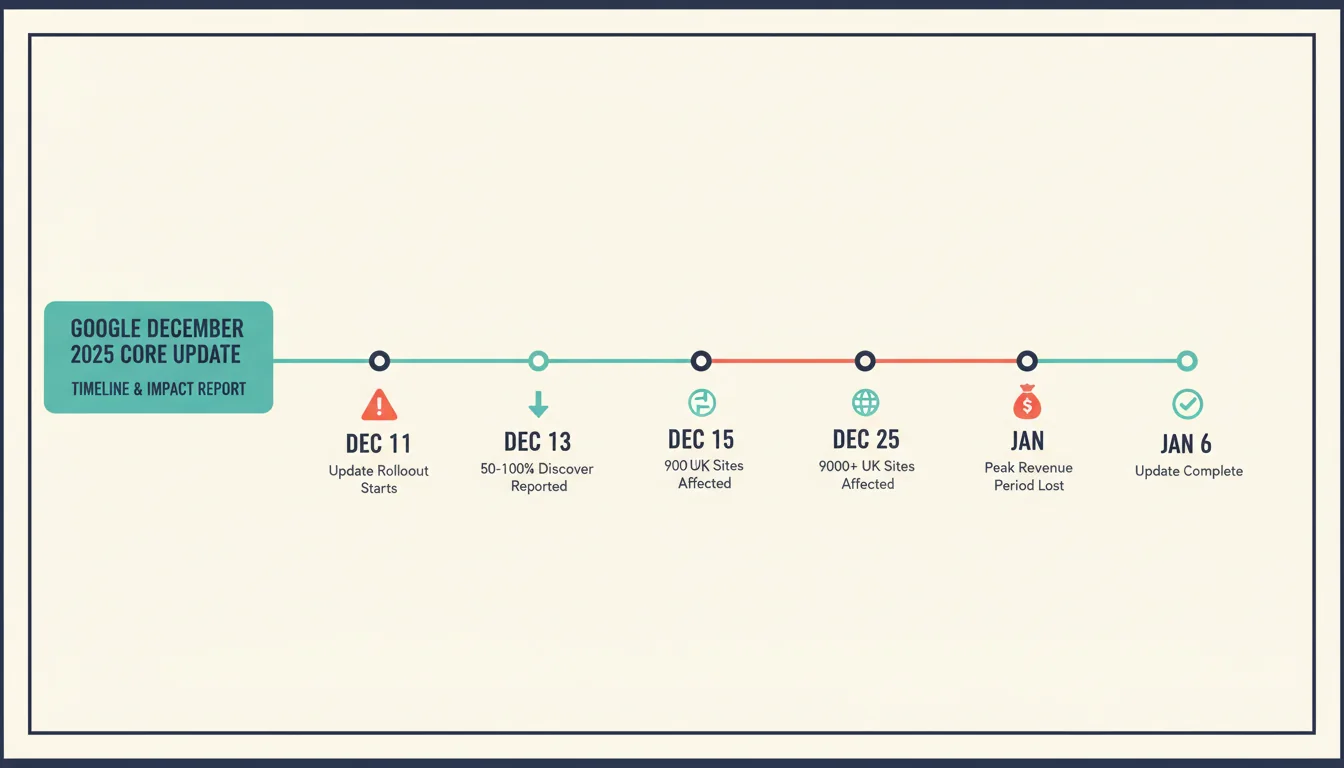
Google's December 2025 core update started at 12:25 PM Eastern on 11 December. The rollout itself isn't unusual; Google pushes core updates several times a year. What made this one stand out was the speed and severity of the Discover impact.
Previous core updates shifted search rankings gradually over days or weeks. This one flipped a switch on Discover distribution. Pages that had appeared reliably in users' Discover feeds for months, sometimes years, simply stopped being served.
Barry Schwartz at Search Engine Roundtable documented sites losing between 50% and 100% of Discover traffic within the first weekend. Some publishers noticed their impressions dropping even before the official announcement, suggesting Google had been testing components of the update earlier.
The Scale of Damage
The numbers from affected publishers paint a bleak picture:
- One UK publisher reported going from 750,000 daily Discover impressions to zero, with no recovery after two weeks
- A news site averaging 90,000 daily Discover clicks saw traffic vanish completely in under 48 hours
- Multiple publishers documented 98% declines in the days surrounding the rollout
- Roughly 9,000 UK-based sites experienced measurable Discover disruption according to third-party tracking data
These aren't small hobby blogs. Many were established publications with years of content, proper E-E-A-T signals, and editorial teams. The common thread wasn't poor quality. It was dependency on a single traffic source.
Why This Update Was Different
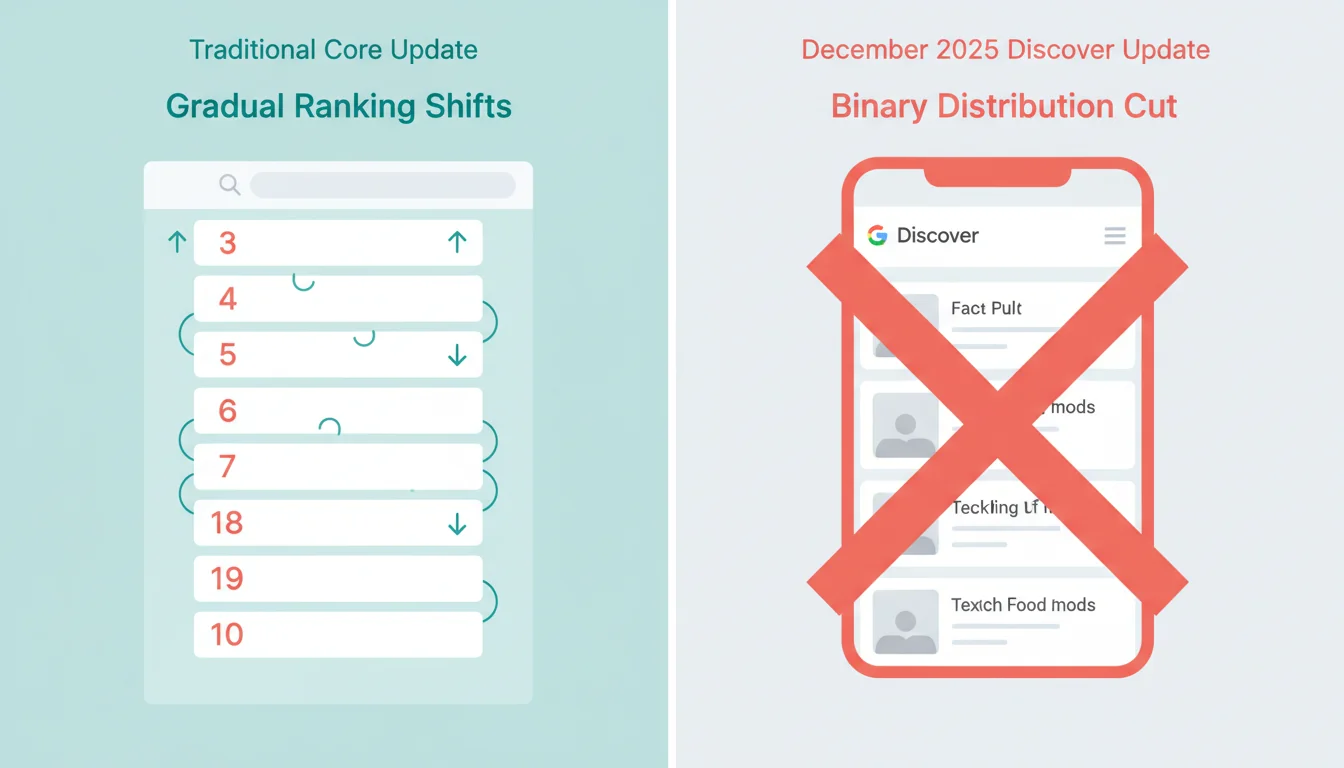
Traditional Google core updates affect search rankings through quality signals. Your page might move from position 4 to position 12, or from page one to page two. The changes happen over days and affect individual queries.
The December update hit distribution, not rankings. Google Discover doesn't work like search. There's no query, no keywords, no position. Google's algorithm decides which articles to surface in each user's feed based on interests, browsing history, and content signals. When Google changes how that selection works, the impact is binary: you're either in the feed or you're not.
That's why this felt so brutal. It wasn't a ranking slip you could recover from by tweaking title tags. It was a distribution channel turning off entirely.
"Building a business entirely on Google Discover traffic is like building a house on rented land. The landlord can change the terms whenever they want."
Lily Ray, VP of SEO & Head of Organic Research, Amsive Digital (Search Engine Land)
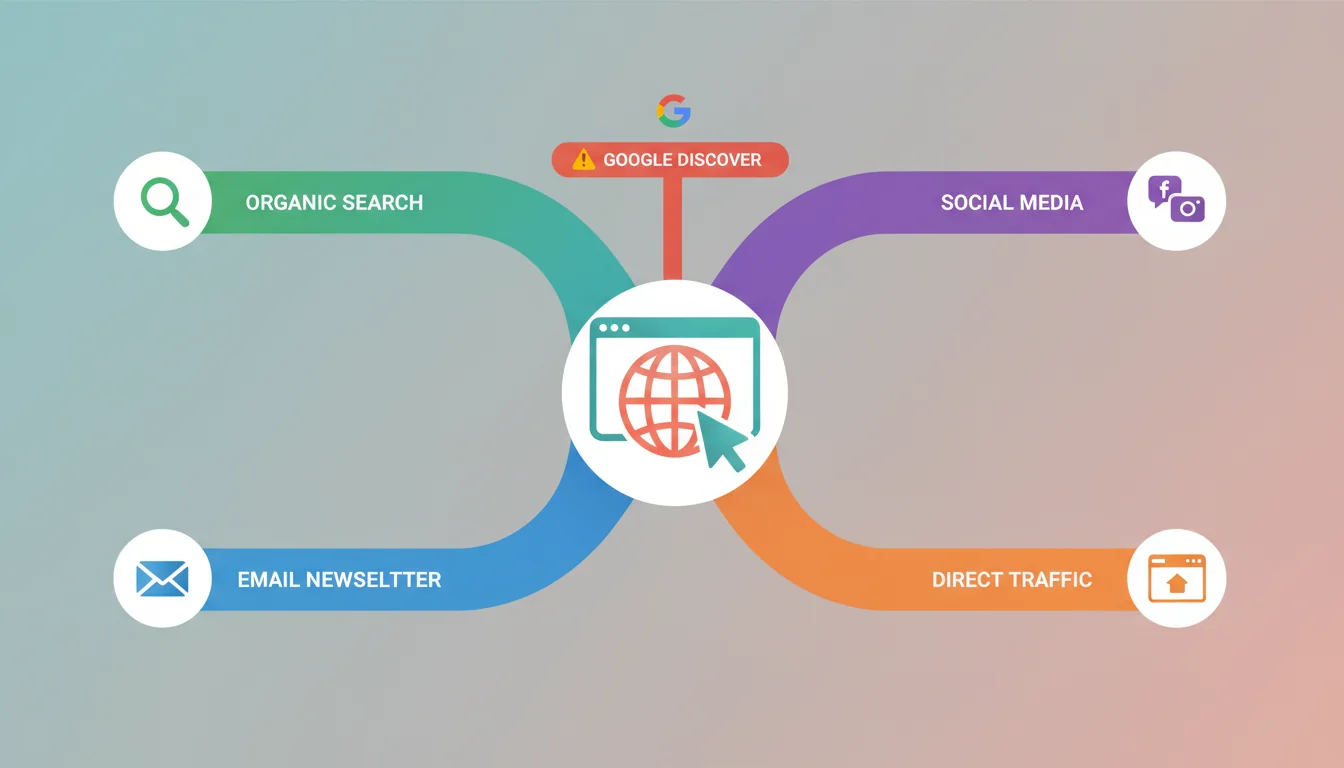
I've seen this play out across our own customer base at 365i. The sites that weathered December best weren't the ones with the most Discover traffic. They were the ones that treated Discover as one channel among many, with organic search, direct traffic, email, and social all carrying their share.
UK Publishers Got Hit Hard
UK publishers were disproportionately affected, and the reasons are worth understanding.
Over the past two years, many UK media companies shifted resources toward Discover optimisation as traditional search traffic became harder to grow. Google's increasingly aggressive feature snippets and AI Overviews had been eating into organic click-through rates, so Discover looked like the more reliable growth channel.
Some publishers hired dedicated Discover teams. Others restructured their content calendars around what performed in Discover feeds. A few built their entire revenue models on the assumption that Discover traffic would remain stable.
When a single algorithmic feed provides 60-80% of your traffic, you're not running a publishing business. You're renting shelf space in someone else's shop. And December proved the landlord can clear those shelves overnight.
The Christmas Timing Made Everything Worse
December is the most lucrative month for ad-supported publishers. CPM rates peak because advertisers spend aggressively before the year ends. Many publishers make 25-40% of their annual ad revenue in Q4, with December as the crescendo.
Losing Discover traffic in March would hurt. Losing it in December was financially devastating. Publishers reported 70-85% overall traffic declines during what should have been their highest-earning period. Some lost five-figure monthly revenue. A few have since shut down entirely.
Google's timing may not have been deliberate, but the effect was the same: the update hit when it would cause maximum financial damage to ad-dependent publishers.
What's Working for Recovery (and What Isn't)
By early January, some patterns emerged among publishers seeing partial recovery:
What's helping:
- Updating top-performing content with fresh, current information (not just changing dates)
- Strengthening author credentials and E-E-A-T signals across the site
- Improving WordPress hosting infrastructure for faster page loads and better Core Web Vitals
- Building email lists so you own the relationship with your audience
- Diversifying into organic search, social, and direct traffic
What isn't helping:
- Publishing more Discover-optimised content (doubling down on a broken channel)
- Changing article formats to chase what you think the algorithm wants
- Filing reconsideration requests (Discover changes aren't penalties)
- Waiting for Google to "fix" it (they don't consider it broken)
The "topical depth" point is the one most publishers underestimate, because the work involved is structural rather than editorial. The cleanest illustration we've shipped is on a brand-new client site, Lockerfella's areas page. Eighteen towns are listed, and every one of them is a dedicated child page at /areas/{town}/, with the postcodes covered (WV1 to WV11 for Wolverhampton, B1 to B98 for Birmingham), the response time from the Brewood base, and the named villages within each catchment. /areas/wolverhampton/ isn't /areas/birmingham/ with the town name swapped; the postcode lists are different, the response times are different, the local landmarks named in the copy are different. That's the structural fingerprint of a site Google's quality systems can read as topically deep, rather than as one thin page repeated across eighteen URLs. If you're rebuilding after the December collapse, the question to ask of every section of your site is whether someone could swap out one location, product, or service name and produce ten near-identical pages. If they could, that's the first thing to fix.
"The publishers who survive algorithm changes are those who build audiences, not those who chase algorithms."
Glenn Gabe, SEO Consultant and Google Algorithm Analyst (GSQi)
When I read Glenn's analysis of the December update, it crystallised something I've been telling our hosting customers for years: the sites that survive any platform change are the ones with genuine audiences who come back because they want to, not because an algorithm put them there.
The Real Lesson About Platform Dependency
Every few years, the web publishing world relearns the same lesson. Facebook Pages reached everyone in 2012, then throttled organic reach to sell ads. Twitter drove traffic reliably until the algorithm changed and engagement cratered. Now Discover.
The pattern is always the same. A platform opens up a distribution channel. Publishers flock to it. The platform changes the rules. Publishers suffer.
The difference with Google Discover is that many publishers didn't think of it as a platform dependency. They thought of it as "Google traffic," lumped together with organic search. But Discover and organic search are completely different systems with different rules, different signals, and different levels of publisher control.
In organic search, you can optimise your pages, build links, and improve your content. The relationship between effort and results isn't perfect, but it's real. In Discover, you're at the mercy of a recommendation engine you can't influence, control, or even understand.
How to Protect Your WordPress Site
If you rely on Discover for more than 20% of your traffic, treat this as your wake-up call. Here's what to do:
- Audit your traffic sources. Open Google Search Console, go to Performance > Discover, and compare to your organic search traffic. If Discover is your dominant channel, you're vulnerable.
- Build an email list. It's the only traffic channel nobody can take away. Even a list of 500 engaged subscribers is more reliable than 50,000 Discover impressions.
- Invest in organic search. Unlike Discover, organic search rewards consistent effort over time. Proper CDN configuration, fast hosting, and strong content still work.
- Speed up your site. Core Web Vitals affect both search and Discover. If your WordPress site loads slowly, you're losing across every channel. Managed WordPress hosting with built-in caching handles this for you.
- Create content for humans, not feeds. Write content that people would search for, share, and bookmark. If your content only works when an algorithm surfaces it, it probably isn't strong enough.
The publishers who came through December in decent shape all had one thing in common: they'd already diversified. Their Discover traffic dropping hurt, but it didn't threaten their survival.
As Glenn Gabe put it, the goal isn't to optimise for any single channel. It's to build something worth finding, regardless of how people find it. That starts with solid infrastructure (fast hosting, clean code, strong security) and builds from there with content that serves a real audience.
Update (May 2026): Five months on, Google has shipped Preferred Sources globally as a user-vote workaround for the algorithm. It's not a Discover recovery mechanism, but it does shift a small slice of distribution back to readers. We tested it on 365i.co.uk and documented what we deployed.
Frequently Asked Questions
When did the December 2025 update start affecting Discover traffic?
Google began rolling out the December 2025 core update on 11 December at 12:25 PM Eastern. Most publishers noticed Discover traffic drops within 24-48 hours, though some reported declines starting a few days earlier during what appears to have been pre-rollout testing.
How much Discover traffic did publishers lose?
Losses ranged from 50% to 100%. Documented cases include a UK publisher dropping from 750,000 daily impressions to zero and multiple sites reporting 98% declines. The severity varied by site, but total elimination of Discover traffic was common.
How is this different from a normal Google core update?
Normal core updates shift search rankings gradually. This update affected Discover distribution, which is a binary mechanism: you're either surfaced in users' feeds or you're not. There's no "position" in Discover to move up or down. Google either shows your content or it doesn't.
Were UK sites specifically targeted by this update?
No, the update was global. But roughly 9,000 UK sites were measurably affected because UK publishers had invested heavily in Discover optimisation over the previous two years, making them disproportionately dependent on that traffic source.
Can affected sites recover their Discover traffic?
Some partial recovery is happening through content refreshes, stronger E-E-A-T signals, and improved site performance. But most SEO analysts agree that sites should focus on diversifying traffic sources rather than trying to reclaim previous Discover levels.
How do I check if my Discover traffic was affected?
Open Google Search Console and go to Performance > Discover. Compare December 2025 to the previous month. If you see a steep drop starting around 11 December, the core update is the likely cause. If you don't see a Discover section at all, your site wasn't receiving meaningful Discover traffic.
How can I protect my site against future Discover changes?
Don't rely on any single traffic source for more than 20-30% of your total. Build an email list you own. Invest in organic search, which rewards consistent effort. Speed up your site with proper hosting and CDN setup. And create content people would actively search for, not just content designed to appear in feeds.
Is Your WordPress Site Built for Resilience?
Fast hosting, proper CDN configuration, and solid infrastructure help your site perform across every traffic channel, not just one algorithmic feed.
Explore WordPress HostingSources
Published: · Last reviewed: · Written by: Mark McNeece, Founder & Managing Director, 365i
Editorially reviewed by: Mark McNeece on · Our editorial standards